Tag: Meteor

  • NASA Invites: Enjoy the Lyrid Meteor Shower, Peaking April 21–22

    NASA Invites: Enjoy the Lyrid Meteor Shower, Peaking April 21–22

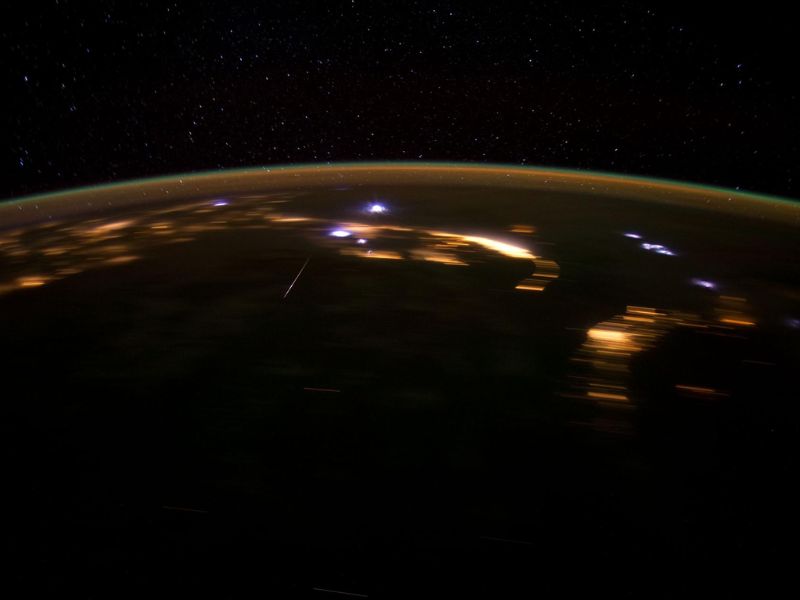
    While most cameras were looking up at the 2012 peak of the Lyrid meteor shower, astronaut Don Pettit aboard the International Space Station trained his video camera on Earth below. Footage from that night is now revealing breathtaking images of Earth at night with meteors burning up in the atmosphere.

    The constellation Lyra, visible in the northern sky, has long been associated with music, as it’s named after the lyre — a harp-like musical instrument. It is also from this constellation that the annual Lyrid meteor shower appears to radiate, with this year’s peak expected on the night of April 21 into the early morning of April 22.

    With this musical connection in mind, skywatchers are encouraged to tune into their favorite playlists and enjoy the celestial show that April brings, known for its fast and bright meteors.

    A Meteor Shower Full of Surprises

    Although the Lyrids aren’t as intense as the popular Perseids in August, they have surprised observers during exceptional years by producing up to 100 meteors per hour. NASA recorded particularly heavy showers in 1803 (Virginia), 1922 (Greece), 1945 (Japan), and 1982 (U.S.).Typically, the Lyrids produce about 10 to 20 meteors per hour at their peak.

    These meteors usually don’t leave long-lasting dust trails, but they can occasionally create bright flashes known as fireballs.

    You’ll start to see Lyrids after 10 p.m. local time, said Bill Cooke, head of NASA’s Meteoroid Environment Office at Marshall Space Flight Center in Huntsville, Alabama. “This year, light from the crescent Moon shouldn’t interfere much with viewing, but it’s best to keep the Moon behind you for optimal observation.

    According to Cooke, you can expect to see around five to six meteors per hour at about 4:30 a.m., when the radiant — the point in the sky from which the meteors appear to come — is high. Find a location away from city or street lights, bring a blanket, lie on your back, and look up at the sky. “After less than 30 minutes in the dark, your eyes will adjust, and you’ll start seeing meteors,” Cooke added.

    Meteor showers occur when Earth passes through trails of debris left behind by comets or fragments of asteroids. These particles collide with our atmosphere and burn up, creating colorful streaks across the sky. The Lyrids originate from comet C/1861 G1 Thatcher, discovered by A. E. Thatcher on April 5, 1861.

    Where the Lyrids Appear in the Sky

    Their radiant is near the star Vega, the brightest in the Lyra constellation and one of the brightest in the night sky.

    Interestingly, the best views are not directly at the radiant. Watching from an angle allows the meteors to appear longer and more dramatic. Looking straight at Vega may make them appear shorter.

    So get ready — April’s sky will put on a beautiful show, and it invites you to watch.


    Read the original article on: Nasa

    Read more: A Spinning Universe Could Solve One of Physics’ Biggest Mysteries
  • The Perseids Meteor Shower is Back, but Not Exactly

    The Perseids Meteor Shower is Back, but Not Exactly

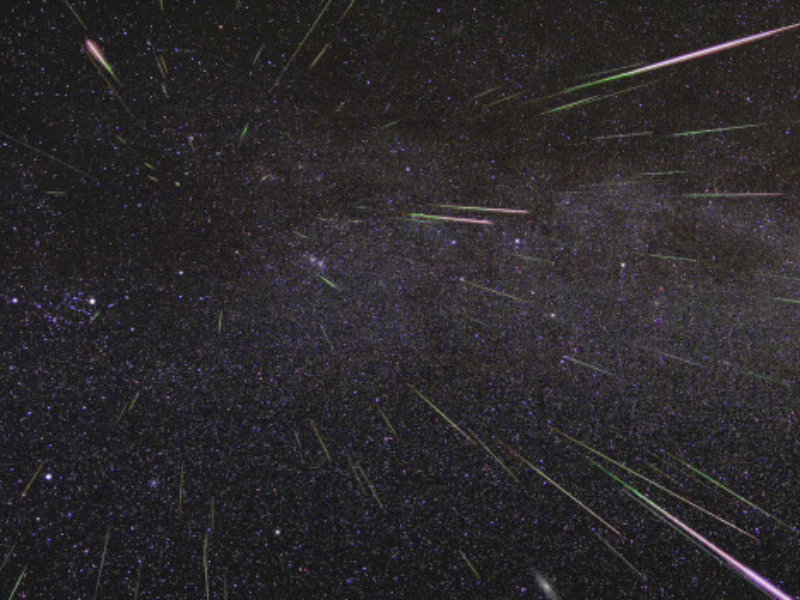
    A shower of Perseid meteors lights up the sky in 2009.
    A shower of Perseid meteors lights up the sky in 2009 in this NASA time-lapse image. Credit: NASA/JPL

    Typically bringing one of the most stunning yearly meteor showers visible in Earth’s night sky, typically providing 50-100 “shooting stars” per hour at its peak, the Perseids are going to peak on Aug. 12 and 13. There is only one issue: the full Moon.

    NASA astronomer Bill Cooke, who leads the Meteoroid Environment Office at NASA‘s Marshall Space Flight Center in Huntsville, Alabama, stated: “Sadly, this year’s Perseids peak will see the worst possible circumstances for spotters. He included that typically in North America, we would observe around 50 or 60 meteors per hour, but due to the full Moon during the regular peak this year, that number will decrease to only 10-20 meteors per hour at best. This is because the brightness of the Moon outshines everything else in the night sky, making it difficult to see anything except for the very brightest Perseids that pass high overhead and quickly burn up in the atmosphere.

    As the Moon lessens, the Perseids meteor showers will weaken on Aug. 21-22 and stop entirely by Sept. 1. They are the particle remnants of Comet Swift-Tuttle, a lumbering “snowball” made up of rock, dust, and ice, which orbits our Sun every 133 years. The comet itself was last apparent to us in 1992 and will not pass our way again until 2125.

    Just how far back sightings of the Perseids go continues to be a matter of some opinion, Cooke stated. The comet was not recognized until 1862, yet the meteor shower was observed over medieval Europe. The annual occurrence came to be known as “the Tears of St. Lawrence,” named after the seventh of the seven deacons of the Roman Church who were martyred by Emperor Valerian in August of 258 AD.

    You may still have a chance

    Therefore, it is probably not the optimal year to take a specific trip to witness the Perseids. Nonetheless, if you happen to be outside from midnight until dawn on August 13th, it is recommended to look up as you may still have the chance to witness one of the bright Perseid meteors that are visible despite the Moon’s brightness. Additionally, on occasion, an early Perseid meteor may streak across the sky up to a week before the peak.

    If you are interested in Knowing what else is in the sky this August, have a look at the latest “What’s Up” video from Jet Propulsion Laboratory:


    Originally published by: NASA