Washington State University researchers found a way to block a key viral protein, stopping viruses from entering cells.. This breakthrough suggests a promising new avenue for developing future antiviral treatments.
Published in Nanoscale, the study explored blocking a key molecular interaction herpes viruses use to invade cells, in a collaboration between the School of Mechanical and Materials Engineering and the Department of Veterinary Microbiology and Pathology.
The Complexity of Viral Cell Entry
“Viruses are incredibly clever,” said Jin Liu, the study’s corresponding author and a professor in the School of Mechanical and Materials Engineering. “The process of entering cells is highly complex, involving numerous interactions. While many of these may be insignificant, some are essential.”
The researchers studied a viral “fusion” protein herpes viruses use to enter cells, a process not well understood and a challenge for vaccine development.
To address this, the team used artificial intelligence alongside detailed molecular simulations. Professors Dutta and Liu used AI to pinpoint a single amino acid critical for viral entry.
Laboratory Experiments Confirm Key Viral Weak Point
After identifying the key amino acid, the team, led by Anthony Nicola, mutated it in the lab, stopping the virus from entering cells.
Liu emphasized that simulations and machine learning were crucial because testing even a single interaction experimentally can take months. Identifying the most important interaction beforehand made the lab work much more efficient.
“Out of thousands of interactions, it was just one that mattered. Without simulations, relying on trial and error could have taken years,” Liu said. “Combining computational modeling with experimental work is highly efficient and can significantly speed up the discovery of key biological interactions.”
Although the interaction’s importance was confirmed, questions remain about how the mutation affects the full protein, and researchers will use simulations and AI to investigate.
“There’s a gap between what experimentalists observe and what simulations reveal,” Liu said. “The next challenge is understanding how this single interaction influences structural changes on a larger scale, which is very complex.”
The study, led by Liu, Dutta, and Nicola with PhD students Ryan Odstrcil, Albina Makio, and McKenna Hull, was funded by the National Institutes of Health.
Introducing ionocaloric cooling — a groundbreaking method for reducing temperatures that could replace current refrigeration systems with a safer, more environmentally friendly alternative.
How Traditional Refrigeration Systems Work
Conventional refrigeration works by moving heat away from an area using a fluid that absorbs warmth as it evaporates into a gas, then circulates through a closed system and condenses back into a liquid.
While efficient, many of the refrigerants used in this process are harmful to the environment.
There’s more than one way to make a material absorb or release heat energy.
In 2023, scientists from Lawrence Berkeley National Laboratory and the University of California, Berkeley, introduced a new approach that leverages the energy stored or released during a material’s phase change—like when ice melts into water.
How Ions Can Trigger Cooling Without Heat
When ice melts, it absorbs heat from its surroundings, producing a cooling effect. Interestingly, this process can be triggered without raising the temperature by adding charged particles, or ions—a principle seen when salt is used to melt ice on roads.
The ionocaloric cycle applies this same idea, using salts to shift a fluid’s phase and generate cooling.
Image Credits:Illustration of the ionocaloric cycle concept. (Jenny Nuss/Berkeley Lab)
“The world of refrigerants remains an unresolved challenge,” said mechanical engineer Drew Lilley of Lawrence Berkeley National Laboratory in California.
“To date, no one has created an alternative cooling method that is effective, efficient, safe, and environmentally friendly. We believe the ionocaloric cycle could achieve all of these objectives if developed properly.”
Modeling the Ionocaloric Cycle for Greater Efficiency
The team developed a theoretical model of the ionocaloric cycle, demonstrating its potential to match or even surpass the efficiency of modern refrigerants. By running an electric current through the system, ions are moved within the material, altering its melting point and thereby changing the temperature.
The researchers conducted experiments using a salt composed of iodine and sodium to melt ethylene carbonate—a common organic solvent also found in lithium-ion batteries and derived from carbon dioxide. This feature could make the system not only carbon neutral (GWP zero) but potentially carbon negative.
In their tests, applying less than one volt of electric charge produced a temperature change of 25 degrees Celsius (45 degrees Fahrenheit), surpassing the performance of existing caloric cooling technologies.
image Credits:The ionocaloric cycle in action. (Jenny Nuss/Berkeley Lab)
Balancing Environmental Impact, Efficiency, and Cost
“We’re aiming to strike a balance among three key factors: the refrigerant’s global warming potential (GWP), its energy efficiency, and the overall cost of the equipment,” explained mechanical engineer Ravi Prasher from Lawrence Berkeley National Laboratory.
“Our initial results look very promising across all three areas.”
Conventional vapor compression refrigeration systems, however, depend on gases with high GWP—such as hydrofluorocarbons (HFCs)—which contribute significantly to environmental harm.
Ionocaloric Cooling and the Global Push to Reduce HFCs
Countries under the Kigali Amendment have committed to reducing HFC use by 80% within 25 years — a target ionocaloric cooling could help achieve.
Researchers are now working to transition the technology from lab experiments to scalable commercial systems that could serve both cooling and heating needs.
Recent studies have shown promising results with nitrate-based salts recycled using electric fields and membranes, confirming what Prasher and his team had envisioned.
“We’ve developed a new thermodynamic cycle that works,” said Prasher. “The next step is testing materials and methods to solve the engineering challenges.”
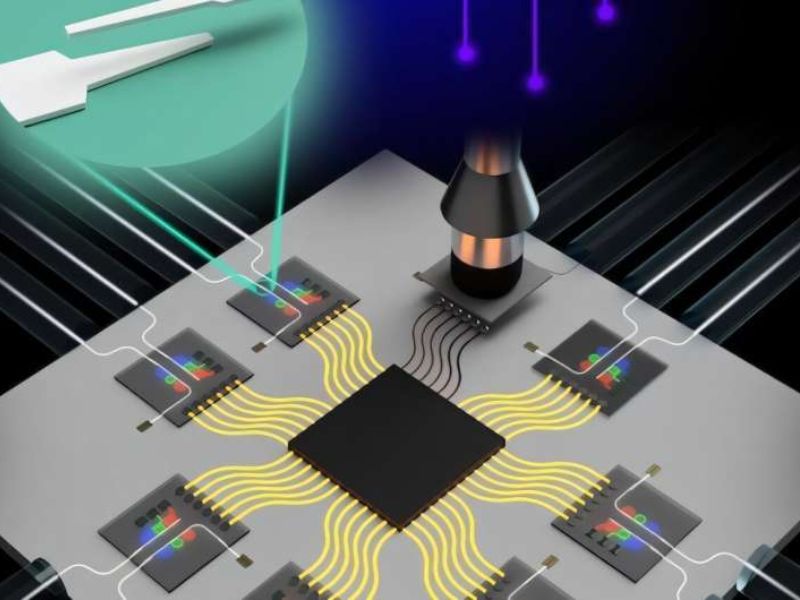
The MIT device in the green callout could be key to faster, more energy-efficient data communication. It solves a major problem associated with packaging an electrical chip (black, center) with photonic chips (the eight surrounding squares). This image also shows an automated tool placing the final photonic chip into position. Image Credits: Drew Weninger, MIT.
Digital computing and communications are headed toward a future that combines electronics—processing data using electricity—with photonics, which uses light for the same purpose. This integration could enable vastly greater global data flow while also improving energy efficiency.
“In short, merging photonics and electronics in a single package is the 21st-century equivalent of the transistor. Without that breakthrough, future scaling won’t be possible,” says Lionel Kimerling, MIT’s Thomas Lord Professor of Materials Science and Engineering and director of the MIT Microphotonics Center.
FUTUR-IC Aims to Revolutionize Microchip Manufacturing with Resource-Efficient Solutions
That’s where FUTUR-IC comes in—a new MIT-based research team. “Our mission is to develop a microchip industry value chain that uses resources efficiently,” says Anu Agarwal, head of FUTUR-IC and principal research scientist at the Materials Research Laboratory (MRL).
FUTUR-IC researchers, including Anu Agarwal and Lionel Kimerling, have developed a new method for co-packaging photonic and electronic chips that addresses key limitations of existing approaches. A major benefit is that manufacturers can use standard tools and low-cost passive alignment to produce the device more economically.
The patented device was featured on the cover of Advanced Engineering Materials earlier this year. A related paper by DMSE student Drew Weninger won Best Student Paper at last fall’s 57th International Symposium on Microelectronics.
Weninger, Kimerling, Agarwal, Serna (Bridgewater State), and Ranno (MIT) co-authored the paper.
Advancing a More Resource-Efficient Microchip Sector
Kimerling points out that by 2020, more than 50 billion devices—including cell phones and GPS systems—will connect to the cloud, driving demand on large-scale data centers. Meanwhile, the amount of data flowing through these centers is increasing a thousandfold every decade.
This surge in communication consumes energy. “And we have to meet that demand without increasing energy use, since the global economy isn’t growing as fast,” says Kimerling, who is also affiliated with the MRL. To address this, we must either boost energy production or improve the energy efficiency of information technology.
Images detailing the fabrication process. In a), the process flow used to fabricate and package the chip-to-chip coupling prototypes. In b), cross-sectional SEM images show the minimum and maximum feature sizes for the SOI and SiN 𝑥 . In c,d), the chip-to-chip prototype and separate glass chip on the testing stage. In e), a schematic of the testing setup. Credit: Advanced Engineering Materials (2024). DOI: 10.1002/adem.202402095
Integrating Photonics and Electronics to Tackle the Microchip Energy Crisis
Merging photonics with the electronics found in modern microchips could help solve energy efficiency issues, since transmitting data with light is far more energy-efficient than using electricity. “Our guiding principle is to rely on electronics for computation and photonics for communication in order to manage the energy crisis,” explains Agarwal.
But this approach presents significant obstacles.
One major challenge is the high cost and complexity of linking electronic and photonic chips within the same unit. Optical fibers have cores that are just ten micrometers wide, while photonic chips have tiny cross-sections—only 0.2 by 0.5 micrometers—requiring extremely precise alignment to prevent light from scattering. Currently, technicians must test each connection individually with a laser to confirm proper light transmission.
“And with the growing demand for higher data capacity, the number of fiber connections is rising rapidly,” Weninger noted. “This active alignment method won’t be sustainable for scaling in the future.”
Greater Flexibility
The newly developed device, known as an evanescent coupler, significantly eases the challenge of aligning fibers within an electronic-photonic system. “Traditional couplers rely on a single coupling point, which demands extremely precise alignment,” explains Agarwal. “Our coupler, however, features a longer interaction region, which greatly relaxes those alignment requirements.” This improvement allows for passive robotic assembly of the integrated circuits, enabling more efficient light transmission without the need for active laser alignment.
Another notable breakthrough, according to Ranno, is that the coupler enables vertical light transmission between the multiple chip layers. This is a major advancement, as guiding light out of the horizontal plane is typically very challenging.
“In electronics, moving electrons between layers is straightforward,” says Weninger. “But light doesn’t naturally bend at sharp angles.” The new design overcomes this limitation, allowing optical signals to travel between stacked chips.
Ranno summarizes: “We’ve created a photonics-electronics integration design that’s space-efficient, dependable, tolerant of alignment variations, and minimizes light loss—essentially, it checks all the boxes for a high-performance interconnect.”
This work was carried out in part through the use of facilities at MIT.nano, and includes contributions from MIT’s Electronic-Photonic Packaging Consortium.
The cherished Italian dish, cacio e pepe, is famous for two things: its amazing taste and its notoriously tricky preparation. On the surface, it appears to be a straightforward recipe, with just three ingredients: pasta, pecorino romano cheese, and black pepper. However, as anyone who has attempted to cook it can attest, the cheese tends to clump when added to the hot pasta water, transforming what should be a velvety, creamy sauce into a lumpy, sticky disaster.
Scientists uncover why cheese sauces clump—and reveal a foolproof cacio e pepe recipe
In the journal Physics of Fluids, researchers from the University of Barcelona, the Max Planck Institute for the Physics of Complex Systems, the University of Padova, and the Institute of Science and Technology Austria explored the science behind mixing cheese in water. They identified the mechanism responsible for turning a smooth cheese sauce into a clumpy one and created a fail-safe recipe for cacio e pepe based on their discoveries.
Researchers from the University of Barcelona, the Max Planck Institute for the Physics of Complex Systems, the University of Padova, and the Institute of Science and Technology Austria investigated the science of mixing cheese with water in the journal Physics of Fluids. They uncovered the process that causes a smooth cheese sauce to become lumpy and developed a foolproof recipe for cacio e pepe based on their findings.
For these researchers, their work went beyond mere intellectual curiosity. “We are Italians residing outside of our homeland,” stated author Ivan Di Terlizzi.
Exploring cacio e pepe as a physical system to prevent waste and savor tradition
We frequently share meals and appreciate traditional cuisine. One of the dishes we’ve prepared is cacio e pepe, which we found intriguing enough to explore as a physical system. Naturally, we also had the practical motivation of not letting quality pecorino go to waste.
The team began by examining the starch in pasta water as the crucial component for creating an ideal sauce. Normally, fats like cheese don’t blend well with water, but starch acts as a stabilizer that helps unify the mixture. Through experimentation, the researchers discovered that a starch-to-cheese ratio of 2–3% resulted in the smoothest and most consistent sauce.
Another crucial factor in achieving the perfect cacio e pepe sauce is controlling the heat—or more specifically, avoiding excessive heat. High temperatures cause the proteins in the cheese to break down and clump together, resulting in an undesirable texture. To prevent this, the researchers recommend allowing the water to cool slightly before adding the cheese and gradually warming the sauce to the desired temperature.
For home cooks wanting to prepare cacio e pepe, the team shared a science-based recipe developed from their experiments. The process begins with making starchy water, and they suggest using a precise amount of powdered starch, such as potato or cornstarch, instead of depending on the variable starch content found in typical pasta water.
“Accurate Starch Measurement is Key for Optimal Results, says Di Terlizzi”
“Since starch plays such a crucial role and its quantity can significantly affect the outcome, we recommend using a precisely measured amount,” explained Di Terlizzi. “This level of accuracy is only possible when you use a controlled amount of powdered starch relative to the amount of cheese.”
After adding the starch to the water, the researchers recommend blending it with the cheese to create a smooth, even mixture. This sauce is then returned to the pan and gently heated to serving temperature. Finally, the pepper and pasta are stirred in—and it’s ready to enjoy.
Looking ahead, the researchers have a wide array of ideas waiting to be explored.
“There’s a dish called pasta alla gricia, which is essentially cacio e pepe with the addition of guanciale, or cured pork cheek,” said author Daniel Maria Busiello. “It appears to be easier to prepare, though we’re not exactly sure why—that’s something we may look into in future research.”
We use cookies on our website to give you the most relevant experience by remembering your preferences and repeat visits. By clicking “Accept All”, you consent to the use of ALL the cookies. However, you may visit "Cookie Settings" to provide a controlled consent.
This website uses cookies to improve your experience while you navigate through the website. Out of these, the cookies that are categorized as necessary are stored on your browser as they are essential for the working of basic functionalities of the website. We also use third-party cookies that help us analyze and understand how you use this website. These cookies will be stored in your browser only with your consent. You also have the option to opt-out of these cookies. But opting out of some of these cookies may affect your browsing experience.
Necessary cookies are absolutely essential for the website to function properly. These cookies ensure basic functionalities and security features of the website, anonymously.
Cookie
Duration
Description
cookielawinfo-checkbox-analytics
11 months
This cookie is set by GDPR Cookie Consent plugin. The cookie is used to store the user consent for the cookies in the category "Analytics".
cookielawinfo-checkbox-functional
11 months
The cookie is set by GDPR cookie consent to record the user consent for the cookies in the category "Functional".
cookielawinfo-checkbox-necessary
11 months
This cookie is set by GDPR Cookie Consent plugin. The cookies is used to store the user consent for the cookies in the category "Necessary".
cookielawinfo-checkbox-others
11 months
This cookie is set by GDPR Cookie Consent plugin. The cookie is used to store the user consent for the cookies in the category "Other.
cookielawinfo-checkbox-performance
11 months
This cookie is set by GDPR Cookie Consent plugin. The cookie is used to store the user consent for the cookies in the category "Performance".
viewed_cookie_policy
11 months
The cookie is set by the GDPR Cookie Consent plugin and is used to store whether or not user has consented to the use of cookies. It does not store any personal data.
Functional cookies help to perform certain functionalities like sharing the content of the website on social media platforms, collect feedbacks, and other third-party features.
Performance cookies are used to understand and analyze the key performance indexes of the website which helps in delivering a better user experience for the visitors.
Analytical cookies are used to understand how visitors interact with the website. These cookies help provide information on metrics the number of visitors, bounce rate, traffic source, etc.
Advertisement cookies are used to provide visitors with relevant ads and marketing campaigns. These cookies track visitors across websites and collect information to provide customized ads.