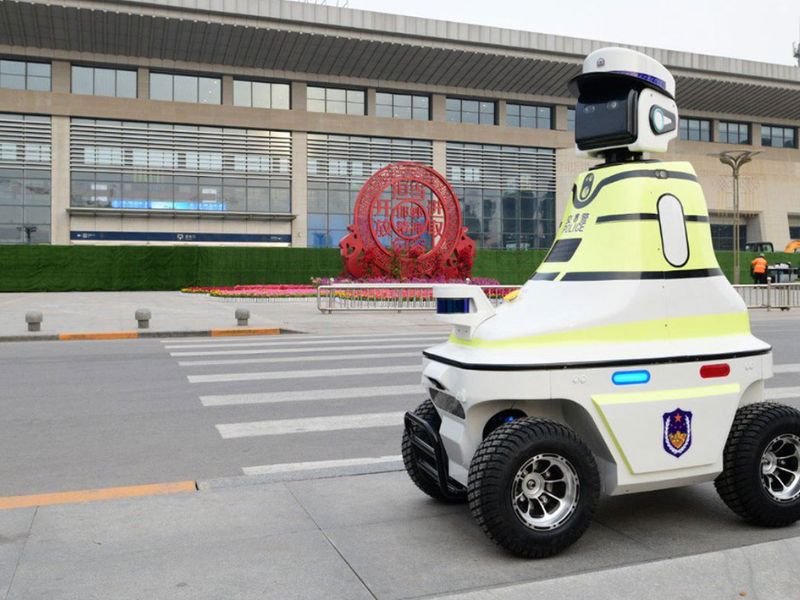

China has introduced a new addition to its expanding range of population-focused technologies. In Handan, the Public Security Department has deployed three types of traffic robots to assist officers.
State-run Xinhua news agency reports that Zhou Zuoying, deputy director of the Traffic Management Research Institute under the Ministry of Public Security, described this as the nation’s first deployment of “robot traffic police.”
Distinct Roles of China’s AI-Powered Traffic Robots
The Global Times reports that China’s three types of robots each have unique roles in AI traffic management: patrolling roads, assisting at vehicle offices, and reporting hazards and suspicious activity. The third model specializes in issuing accident warnings and alerting passing drivers when police are addressing incidents.
One machine, called “Highway Patrol,” mimics a human officer in a yellow uniform and white cap, identifies drivers, and photographs traffic violations.
Another type, the “traffic guidance” robot, assists residents at vehicle offices by answering questions and providing directions. It will also automatically notify the police of any safety risks or suspicious individuals, according to the Global Times. The third type, the “accident warning” robot, alerts drivers that an officer is handling a road accident.
24/7 Operation and Uncertain Deployment Scale of Traffic Robots
Li Huai from the Handan Public Security Bureau said the robots will run 24/7, though the number of units deployed remains unclear, according to the Global Times. What is certain is that China is increasingly relying on technology in law enforcement.
The country has already implemented facial recognition technology to track hikers and mandated RFID tags on new vehicles to prevent toll evasion. Some police officers wear facial recognition goggles to help capture fugitives.
China first used police robots in 2016 with AnBot at Shenzhen Airport and the E-Patrol Robot Sheriff on streets in 2017.
The country still faces major challenges modernizing traffic laws and integrating new technologies at state and federal levels. A prime example is the ongoing project to standardize vehicle license plates across Mercosur.
Ongoing Legislative Discussions and Implementation Challenges
Lawmakers have debated technical needs, crime reduction, and system improvements. However, they have yet to fully implement the project.
The Mercosur Resolution, approved on December 15, 2010, unifies license plates across Brazil, Argentina, Uruguay, Paraguay, and Venezuela, covering 110 million vehicles to improve traffic management, safety, and data sharing.
In summary, China has finally developed effective robots to support traffic officers in maintaining order.
Read the original article on: Tellus Org Br
Read more:This Asthma Treatment May Offer a Way to Eliminate Severe Food Allergies