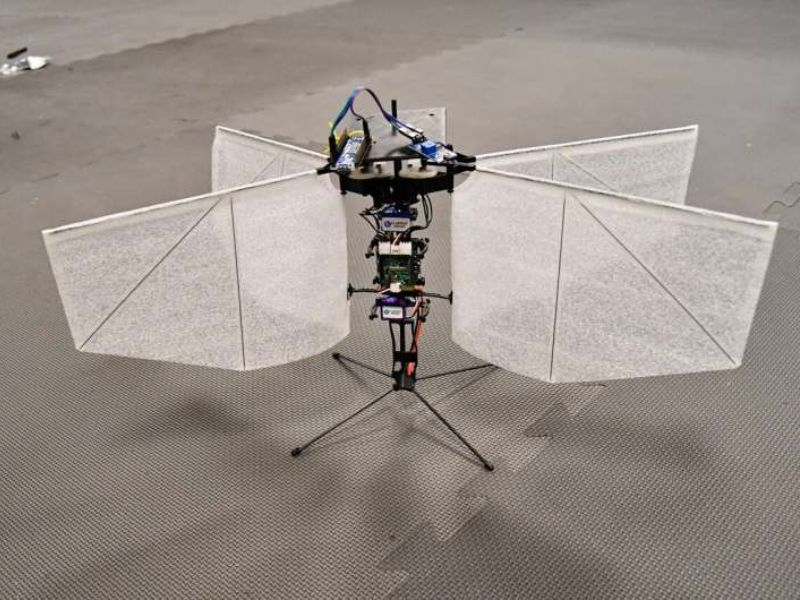

University of Cincinnati researchers are creating a flapping-wing drone that tracks and hovers around moving light sources, mimicking a moth drawn to a flame.
UC professor Sameh Eisa and his students study these efficient drones, aiming to miniaturize them for stealth surveillance.
A Drone That Adapts to Its Environment
Moths can hover, fly backward, and automatically adjust to wind or obstacles to stay in place or track moving targets. Similarly, Eisa’s moth-inspired drone makes continuous adjustments to maintain its position and distance from a light source, even as it moves.
“We’re focused on size and efficiency,” Eisa explained. “These small robots need to fly like moths for optimal performance.”
Nature-Inspired Engineering
In his Modeling, Dynamics, and Control Lab, Eisa focuses on engineering inspired by nature. He previously studied drones that mimic albatrosses, using dynamic soaring to travel long distances efficiently.
In his latest study, published in Physical Review E, Eisa and doctoral student Ahmed Elgohary proposed that hovering insects achieve their remarkable flight control through mechanisms similar to extremum-seeking feedback systems.
Such systems enable drones to navigate in real time without relying on complex computations, GPS, or artificial intelligence—by continuously adjusting control inputs like wing flap frequency.

Flapping-wing drones manage roll, pitch, and yaw by moving each wing independently — motions so rapid they appear as a blur, much like a hummingbird’s wings.
“Our simulations show extremum-seeking control can mimic insect hovering without AI,” said lead author Ahmed Elgohary.
“It’s a straightforward, real-time, model-free feedback mechanism that may explain how small creatures achieve such agility with minimal brainpower,” Eisa explained.
How Feedback Loops Keep the Drone Stable
The drone continually evaluates its performance—such as locating a light source—and corrects its path through a constant feedback loop, enabling highly stable and consistent flight.
How stable?It replicated the unique hovering motions of moths, bees, dragonflies, and even hummingbirds.
“Moths make it look effortless,” Eisa added. “We use extremum-seeking control because it appears to mirror biological behavior.”

Hovering insects like the hummingbird clearwing moth flap in a figure-eight pattern, generating lift both up and down.Their flexible wings deform with each beat to enhance lift and agility.
In UC’s netted flight lab, Elgohary and Rohan Palanikumar demonstrated the four-wing flapping drone.
Controlled Wobble Enables Precision Hovering
Elgohary noted that manual control was far harder and less stable than the drone’s own system. Once engaged, the drone lifted off and hovered—slightly unsteady by design. This subtle wobble helps the system gauge performance changes and continuously fine-tune its flight path.
Eisa said the study aids future drone design and reveals how tiny insects achieve remarkable flight.
“This could reshape our understanding of biophysics,” he said. “If hovering insects like moths truly use a form of extremum-seeking feedback, it may be a mechanism shared across other species as well.”
Read the original article on: Techxplore
Read more: Overworking Harms Health More than Excessive Drinking