Tag: North America

  • North America Is Sinking Into the Earth’s Mantle

    North America Is Sinking Into the Earth’s Mantle

    Something’s going on beneath the surface of North America
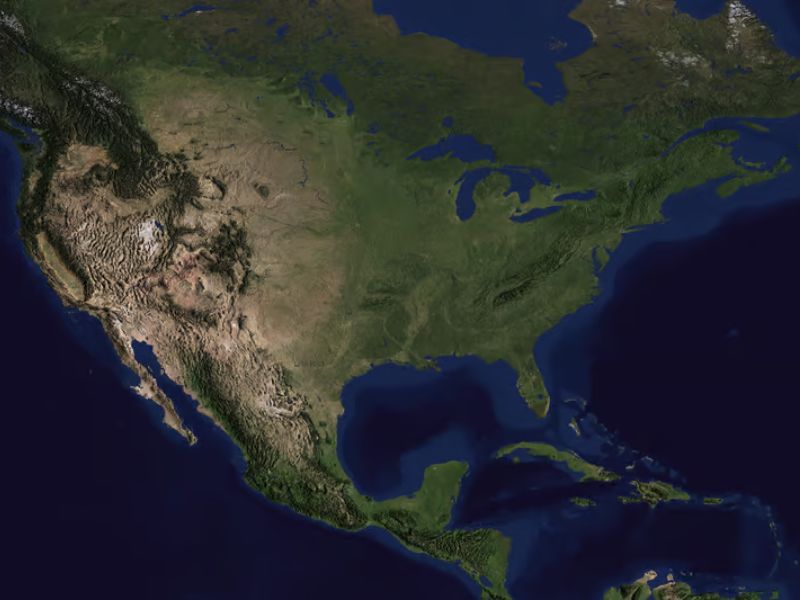
    NASA/Goddard Space Flight Center Scientific Visualization Studio The Blue Marble Next Generation data is courtesy of Reto Stockli (NASA/GSFC) and NASA’s Earth Observatory

    A study published in the journal Nature Geoscience has revealed a subtle yet significant phenomenon beneath the North American continent: its ancient bedrock is slowly sinking into the Earth’s mantle. This descent occurs in a drip-like fashion, forming a funnel-shaped structure concentrated in the Midwestern United States, which pulls the ancient rocks horizontally before they drop into deeper layers.

    What Are Cratons — And Why Do They Matter?

    The ancient rock in question is known as a craton—extremely old and stable blocks that form the foundation upon which continents rest. Around 35 major cratons are recognized worldwide. But stability doesn’t mean immutability.

    Cratons can change due to the influence of mantle plumes—upwellings of hot material from deep within the Earth that can locally melt and deform the crust above. For example, the North China Craton experienced extensive disintegration over millions of years, losing its deepest root layers. Geologists had long suspected that something similar might be happening beneath North America.

    Led by Junlin Hua, the team behind the new study created a full-waveform seismic tomographic model of North America using data from the EarthScope project. This model offered new insights into the geological processes at work beneath the continent’s crust and mantle.

    Until now, craton thinning had only been studied retrospectively, looking at changes millions of years after they happened. What sets this study apart is that it shows the process is happening right now—giving researchers a rare opportunity to observe and study cratonic deformation in real time.

    “We observed that something might be happening beneath the craton. Fortunately, we also developed a new idea about what’s driving this thinning,” said Hua.
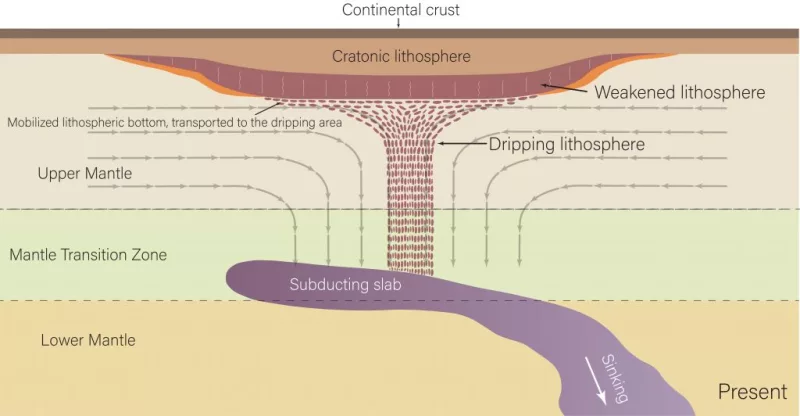
    A figure in the study shows rock dripping from the craton, and the researchers hypothesize that the remnants of the subducting Farallon slab beneath the craton are causing the dripping.
    Hua et al., Nature Geoscience

    Researchers believe the main force behind the thinning of the North American craton is the Farallon Plate, which has been subducting beneath North America for more than 200 million years. Though it once played a key role in shaping the continent, its ongoing subduction continues to supply magma and release volatile compounds that gradually weaken the craton’s base.

    A Broader Impact Beyond the Dripping Zone

    The Farallon Plate appears to affect the entire craton, spanning much of the U.S. and Canada, even though the dripping concentrates in just one area.

    Still, researchers stress that there’s no reason for alarm—North America is not hollowing out or facing sudden surface collapse. More intriguingly, the dripping process may eventually stop as the plate sinks deeper into the mantle and its influence diminishes.

    This kind of discovery is crucial if we want to understand how a planet evolves over long periods,” said geophysicist Thorsten Becker. It helps scientists explain how geological forces form continents, break them apart, and recycle them back into the Earth.


    Read the original article on: New Atlas

    Read more: New Form of Dark Matter May Explain Milky Way’s Core Mysteries
  • Recent Study Reveals Surprising Boreal Forest Fire Effects in North America

    Recent Study Reveals Surprising Boreal Forest Fire Effects in North America

    A novel research endeavor, employing a unique method to examine satellite images of boreal forests spanning the past thirty years, has identified that fire might be altering the landscape of the area in an unforeseen manner, catching researchers off guard with its findings.
    Credit: Pixaobay

    A novel research endeavor, employing a unique method to examine satellite images of boreal forests spanning the past thirty years, has identified that fire might be altering the landscape of the area in an unforeseen manner, catching researchers off guard with its findings.

    Throughout history, fires in North American boreal forests have typically resulted in the replacement of coniferous trees with faster-growing deciduous trees. This shift to deciduous trees has several climate-related benefits, such as increased carbon absorption and greater light reflection, leading to a cooling effect and reduced fire risk.

    Reversing the Post-Fire Shift to Deciduous Dominance

    However, a recent study led by Northern Arizona University, published in Nature Climate Change, has surprisingly revealed that although forests do become more dominated by deciduous trees after fires, this change is not permanent. Over the course of a few decades, the same forests gradually revert back to being dominated by coniferous trees.

    Furthermore, the study found that the abrupt loss of coniferous forests due to wildfires was offset by the gradual increase in coniferous forests in areas that had not recently experienced fires. This balanced out the overall forest composition, preventing a widespread shift toward deciduous cover.

    Long-Term Effects of Fires on Forest Composition and Climate

    Scott Goetz, a co-author of the study and a Regents’ professor at Northern Arizona University, noted, “Fires clearly lead to a transition from conifer to deciduous cover, but when we examine these changes over many decades, we observe deciduous trees gradually being replaced by conifer trees three to four decades after a fire. There are complex dynamics at play, but when we consider them collectively, the net impact on the climate appears to be relatively modest.”

    Logan Berner, another co-author of the study, added, “This finding was somewhat unexpected, as recent studies had suggested shifts toward deciduous forests at local and regional levels. Our research indicates that there have not been comprehensive changes in forest composition in recent decades, but we anticipate that ongoing climate warming and increased wildfire activity could lead to significant alterations in forest composition in the years to come.”

    Credit: Nature Climate Change (2023). DOI: 10.1038/s41558-023-01851-w

    The researchers emphasize that this observed shift may not be permanent; recent decades have witnessed an increase in fire disturbances in these forests, suggesting that the return to coniferous dominance may take longer than in the past. Additionally, as the climate continues to become warmer and drier, it will influence both the way forests burn and how they regenerate.

    Insights from Shifting Forest Composition

    Brendan Rogers, a study co-author and associate scientist at Woodwell Climate Research Center, commented, “Considering various fire management strategies, such as those aimed at reducing carbon emissions and mitigating fire risks to local communities and infrastructure, this study lays a crucial groundwork for future research. Particularly in the wake of a summer marked by record-breaking fires in Canada, comprehending the shifting composition of these forests in response to fire over time is vital for guiding optimal management practices and safeguarding people and the environment.”

    Analyzing Forest Changes and Climate Impact Using Satellite Data

    The research team conducted their investigation as part of NASA’s Arctic Boreal Vulnerability Experiment (ABoVE), for which Goetz serves as the Science Team Lead. As part of their project within ABoVE, they harnessed high-resolution satellite imagery from the Landsat series of satellites to assess alterations in forest composition in the boreal forests of Alaska and Canada, both in fire-affected areas and those untouched by fire. They also calculated the climate feedback effects by using satellite measurements of surface reflectivity.


    Read the original article on: Phys Org

    Read more: The Influence of Deforestation and Afforestation on the International Water Cycle