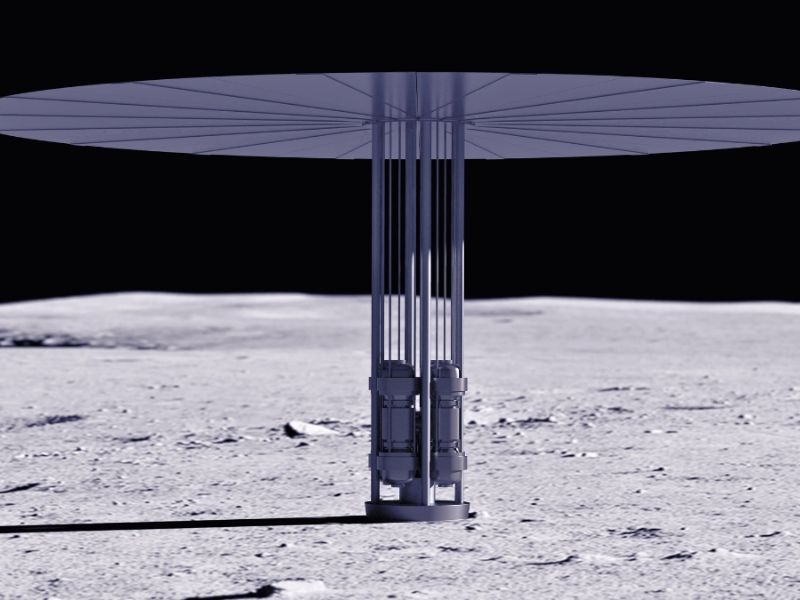

NASA and the U.S. Department of Energy have confirmed their ongoing collaboration to create a nuclear fission reactor for use on the Moon’s surface.
NASA announced it aims to finish the reactor’s development, including possible Earth tests, by 2030. The reactor is intended to provide reliable, long-term power for lunar missions, reducing the need to transport fuel from Earth.
“This agreement lets NASA and the Department of Energy collaborate on technologies for a new era of space exploration,” said NASA administrator Jared Isaacman.
They face a tough task. Building a safe, reliable nuclear reactor is hard on Earth—on the Moon, it’s even harder. Its harsh environment makes fission reactor design difficult, especially managing waste heat.

Cooling a Reactor on the Moon
On Earth, nuclear reactors use water to remove heat, releasing it as steam. On the Moon, low gravity, near-vacuum, and no atmosphere make fluids behave differently and heat hard to disperse.
Potential solutions include using solid-state heat conduction or liquid metal coolants, though both introduce extra design challenges.
The Moon is also blanketed in fine dust. Unlike Mars, which experiences massive dust storms, lunar dust is abrasive and becomes electrostatically charged from solar radiation. It sticks to surfaces, so Moon equipment must be designed to resist dust interference.
Read the original article on: Sciencealert
Read more: Effects of Pointing Inaccuracies in Quantum key Distribution Systems