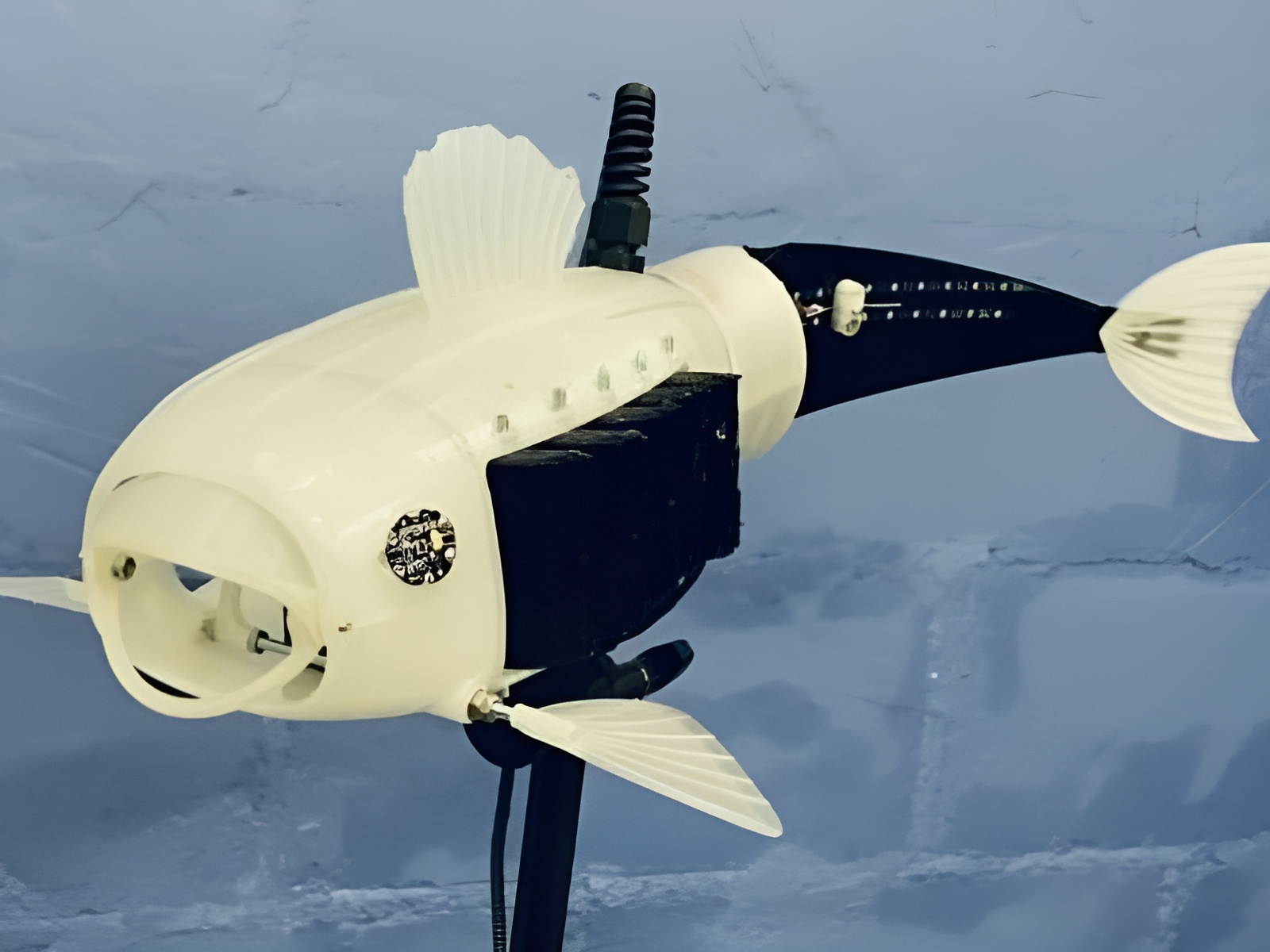

Researchers at the University of Surrey have developed a robotic fish that can consume plastic waste while generating its own energy. The team created the device, called the robo-fish, to tackle the rising problem of microplastic pollution in oceans, rivers, and lakes.
Unlike most machines, the robot does not rely on batteries. Instead, it uses a microbial fuel cell that breaks down microplastics and turns them into energy. Simply put, the more plastic it consumes, the more power it produces to keep swimming. This makes it one of the first self-powered robots designed to help clean the environment.
The Natural Robots Contest at the University of Surrey
The University of Surrey first developed the robo-fish for the Natural Robots Contest. The contest challenged participants to design a nature-inspired robot that could benefit the environment, and Eleanor Mackintosh, an undergraduate studying chemistry, created the winning concept.
In an interview with New Atlas, Mackintosh explained that plastic pollution in water is a serious global issue. She noted that the problem affects not only oceans but also rivers, streams, lakes, and ponds. Her design focused on adaptability, reasoning that a fish-like robot would be ideal for cleaning polluted water since fish naturally live and move in those environments.
A panel of experts chose her concept and later developed it into a functioning prototype. Mackintosh said real fish inspired the idea. She explained that fish adapt perfectly to their environment, and their gills rank among nature’s most remarkable systems. She adapted gills to filter microplastics from water instead of oxygen.

The robo-fish measures about half a meter in length, roughly the size of a salmon. It moves through the water by swishing its tail, much like a real fish. As it swims, its mouth stays open, drawing in water. Inside the body, a chamber gathers microplastics while the cleaned water flows back out through gill-like openings.
Once the internal chamber fills up, the robot shuts its mouth and pushes the filtered water outward. The gill-like flaps are lined with a fine mesh that catches plastic while allowing water to pass through. Currently, the system can trap particles as small as two millimeters.
Advanced Sensors and Nighttime Tracking
The robot is also fitted with small sensors that monitor light conditions and water quality. At night, the robo-fish can emit a glow, which not only creates a striking visual effect but also allows researchers to easily track where it moves.
For now, the fish is operated remotely, but the research team aims to make future versions more autonomous. Later models could potentially navigate on their own, capture even smaller plastic particles, and cover greater distances.
Plastic pollution remains one of the planet’s most serious environmental challenges. Each year, millions of tons of plastic end up in the ocean. As time passes, much of this waste breaks down into microplastics—tiny fragments that are extremely difficult to remove from the water.

These tiny particles are now showing up almost everywhere — in sea salt, in fish and shellfish, and even inside the human body, including blood and lungs. Scientists warn that microplastics can harm cells, interfere with hormones, and carry toxic chemicals through the food chain.
Highlighting the significance of the project, Dr. Robert Siddall, a lecturer at the University of Surrey and founder of the Natural Robots Contest, explained that scientists still don’t know where most of the plastic dumped into waterways eventually ends up. He added that the robo-fish and similar future technologies could be an important first step toward locating and managing plastic pollution.
Global Innovations in Biomimetic Robotics for Water Cleanup
The UK’s robo-fish is not the only innovation aimed at tackling microplastic pollution. In Sichuan University in China, scientists recently introduced a tiny self-healing robotic fish that draws microplastics toward its surface as it swims. Meanwhile, engineers in South Korea are testing robotic trout designed to monitor water quality in fish farms. Across the world, researchers are increasingly using biomimicry—imitating nature’s designs—to address environmental problems.
However, experts warn that robotics alone cannot fix the crisis. Mackintosh noted that while technology may help remove plastic already present in water, preventing further pollution is just as important. She emphasized that reducing plastic waste will require action from governments, industries, and individuals alike.
Dr. Robert Siddall emphasized that the project marks only the start of a new direction. He described the robo-fish as a reminder that we can redesign technology—not to damage the planet, but to help safeguard and restore it.
Read the original article on:myelectricsparks