Tag: Power

  • Tiny Nuclear Battery Could Power Devices For Decades

    Tiny Nuclear Battery Could Power Devices For Decades

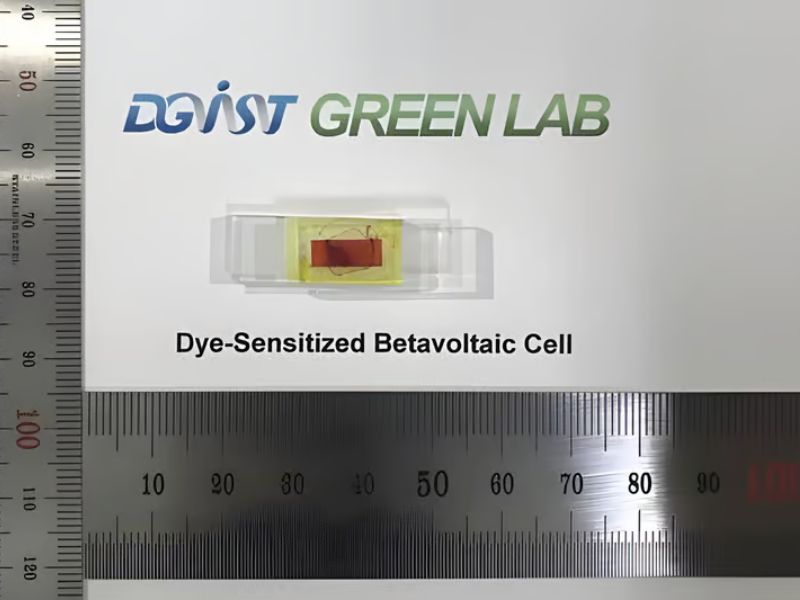
    A small dye-sensitized betavoltaic cell has radiocarbon on both the cathode and anode to increase its energy-conversion efficiency
    Su-Il In

    Researchers at the Daegu Gyeongbuk Institute of Science & Technology in South Korea have developed a nuclear battery capable of converting radiation directly into electricity for decades — all without the usual dangers associated with nuclear radiation.

    How the Betavoltaic Cell Works

    Known as a dye-sensitized betavoltaic cell, this battery harnesses beta particles, which are simply high-energy electrons. The key to its operation lies in carbon-14, a radioactive isotope that emits beta particles. These particles interact with a titanium dioxide semiconductor coated with a ruthenium-based dye, causing electrons to be knocked loose from the dye and generating an electric current.

    The half-life of carbon-14 is around 5,730 years, meaning the battery could potentially retain 50% of its original output after nearly six millennia. However, practical power output would likely decline much sooner as materials degrade over such long periods.

    The prototype boasts a power density of 20.75 nanowatts per square centimeter per millicurie at 2.86% efficiency. In simpler terms, this isn’t much. Roughly the size of an aspirin, it produces about 0.4% of the power needed to run a basic pocket calculator. You’d need around 240 of these tiny nuclear batteries to power a times table refresher.

    Practical Uses for the Battery

    Despite this, the battery generates enough energy to power medical devices like pacemakers or remote environmental sensors. It could also supply power to RFID tags, microchips, or even trickle charge capacitors for devices that require a quick burst of energy. This technology is still in its early stages but holds promise for various low-power applications.

    A graph showing carbon-14 half-life
    New Atlas

    Although many might associate nuclear radiation with danger, the researchers assure that this battery design is actually quite safe. The beta particles emitted by carbon-14 are already naturally present in many substances, including the human body. Shielding for this battery can be as simple as a thin piece of aluminum foil, or even paper, which effectively blocks the beta particles. In fact, these solid-state, non-flammable batteries might even be safer than lithium-ion batteries, which are prone to overheating, leaking, and explosions.

    Atomic batteries aren’t new, though. The first radioisotope battery, developed in 1954 by the US Atomic Energy Commission, used strontium-90 as the radioactive source and worked similarly to today’s betavoltaic cells.

    Space Missions and Recent Advances

    In the 1960s, Radioisotope Thermoelectric Generators (RTGs) began being used in space missions, converting energy from alpha-emitting isotopes like plutonium-238 into electricity. The first mission using RTGs was the US Navy’s Transit 4A satellite, which played a key role in the early stages of satellite navigation and modern GPS.

    More recently, Betavolt introduced a 3-volt diamond nuclear battery using nickel-63 and a diamond semiconductor, utilizing the same beta particle concept to power devices for 50 years. Another company, Arkenlight, has been working on carbon-14 diamonds to produce atomic battery power, and their technology is steadily advancing.

    While atomic batteries have been around for a while, recent advances in materials, efficiency, and safety are finally making them viable for practical, everyday uses without the need for nuclear reactors.


    Read the original article on: New Atlas

    Read more: World’s First 18650-Sized Potassium-Ion Battery Aims to Tackle Lithium Shortage

  • Researchers Challenge Their Own Findings by Generating Power From Earth’s Rotation

    Researchers Challenge Their Own Findings by Generating Power From Earth’s Rotation

    Credit: Pixabay

    Researchers harness tiny voltage from Earth’s rotation, revealing a potential new energy source.

    The foundation for this research dates back to 2016 when Princeton astrophysicist Christopher Chyba and JPL planetary scientist Kevin Hand initially argued that such energy generation was impossible. However, as they revisited their own conclusions, they began to question the assumptions underlying their proof. This shift in perspective led them, along with Spectral Sensor Solutions scientist Thomas Chyba, to explore whether specific conditions could enable power generation from Earth’s dynamics.

    To test their hypothesis, the researchers designed an experiment using a 29.9-centimeter manganese-zinc ferrite cylinder. This material was carefully selected because it encourages magnetic diffusion, allowing magnetic fields to spread more freely. The team placed the cylinder in a controlled, darkened lab to eliminate interference from light and positioned it precisely perpendicular to both Earth’s rotation and magnetic field.

    Precise Measurements Reveal 18 Microvolts, Strengthening Link to Earth’s Rotation

    The researchers used a custom-designed cylinder to harvest electricity. (Chyba et al., Physical Review Research, 2025)

    After carefully measuring and accounting for all variables, they detected a voltage of 18 microvolts. Notably, when they altered the cylinder’s angle or used a different material, the voltage disappeared. The correlation indicated a direct link to Earth’s rotation.

    “The device appeared to violate the conclusion that any conductor at rest with respect to Earth’s surface cannot generate power from its magnetic field,” said Christopher Chyba. To strengthen their findings, the team repeated the experiment in a residential building rather than a laboratory and observed the same response.

    While these results are promising, the generated electricity remains extremely small, and scaling up the process remains uncertain. Moving forward, independent researchers must replicate—or challenge—these findings to determine whether this method could become a practical energy source. Although many questions remain, this breakthrough demonstrates the potential for harnessing Earth’s natural forces in new and unexpected ways.


    Read Original Article: Science Alert

    Read More: For the First time, Scientists Observe Living Plant Cells Producing Cellulose and Constructing Cell Walls

  • Geothermal Energy Could Supply Power for Almost All New Data Centers by 2030

    Geothermal Energy Could Supply Power for Almost All New Data Centers by 2030

    As AI and cloud providers accelerate data center construction, a power shortage looms. However, a new report suggests that the solution could lie underground.
    Image Credits:Feifei Cui-Paoluzzo / Getty Images

    As AI and cloud providers accelerate data center construction, a power shortage looms. However, a new report suggests that the solution could lie underground.

    According to an analysis by the Rhodium Group, advanced geothermal power could meet nearly two-thirds of new data center energy demand by 2030. This expansion would increase U.S. geothermal capacity from 4 gigawatts to around 16 gigawatts—at costs comparable to or lower than current electricity prices for data centers.

    In the Western U.S., where geothermal resources are more abundant, the technology could cover 100% of new data center demand. For instance, Phoenix could add 3.8 gigawatts of data center capacity without building additional conventional power plants.

    Unlocking Geothermal’s Full Potential with Advanced Techniques

    Geothermal energy has immense potential for providing reliable electricity. Traditionally, geothermal power plants have been limited to regions where the Earth’s heat is close to the surface. However, advanced geothermal techniques could unlock up to 90 gigawatts of clean power in the U.S. alone, according to the Department of Energy.

    Enhanced geothermal systems (EGS) employ deeper and wider drilling techniques, allowing access to hotter rock formations and increasing power output. The sector has seen a rise in startups leveraging expertise and technology from the oil and gas industry.

    For example, Fervo Energy, founded by former oil and gas engineers, applies horizontal drilling techniques to expand geothermal potential. In 2024, the company raised over $200 million following significant cost reductions in well drilling.

    Meanwhile, Bedrock Energy is developing deep-drilling technology to minimize the space required for geothermal systems. Its specialized rigs bore more than 1,200 feet underground, enabling office buildings and data centers with limited footprints to generate consistent power year-round.

    Revolutionizing Drilling with Gyrotron-Powered Technology

    Quaise Energy’s drilling technology sounds like something straight out of science fiction. Instead of using traditional drill bits, the startup employs microwaves from gyrotrons to vaporize rock, enabling drilling up to 12.4 miles (20 kilometers) deep. At these depths, rock temperatures remain close to 1,000°F year-round, providing an almost limitless heat source for power generation or building heating.

    While most geothermal companies focus on harnessing Earth’s heat, another startup is taking a different approach. Sage Geosystems uses underground wells for energy storage by injecting water under pressure. When electricity is needed, the water is released through a turbine, functioning similarly to an inverted hydroelectric dam.

    According to the Rhodium Group, geothermal energy’s low operating costs make it competitive with current data center energy expenses. When data centers are sited based on existing factors—such as proximity to fiber optics and major metro areas—geothermal power costs around $75 per megawatt hour. However, if site selection prioritizes geothermal potential, costs could drop to approximately $50 per megawatt hour.

    The report also assumes that new geothermal capacity would be installed “behind the meter,” meaning power plants would connect directly to data centers rather than the electrical grid. With grid connection wait times stretching for years, direct energy supply has become an increasingly attractive solution for data center operators racing to expand capacity.


    Read the original article on: TechCrunch

    Read more: Scientists Unveil Battery Powered by Nuclear Waste

  • Revolutionary Energy Tech: Sustainable Power Harnessed from Biomolecular Crystals

    Revolutionary Energy Tech: Sustainable Power Harnessed from Biomolecular Crystals

    Credit: Pixabay

    A groundbreaking method now enables the eco-friendly generation of electricity from organic materials, potentially revolutionizing how electronic devices are powered.

    Advancing Piezoelectric Biomolecular Research

    Researchers at the University of Limerick (UL), Ireland, have developed a method to grow organic crystals that harvest energy by applying pressure to amino acid molecules, the building blocks of proteins.

    While piezoelectricity, or electricity from pressure, is often linked to ceramics and polymers, it also occurs naturally in biomolecules. The UL team, part of the Actuate Lab, previously used computer models to predict how much electricity biological materials could produce, with potential applications in powering electronics and medical devices.

    In a breakthrough published in Physical Review Letters, the team introduced a silicon molding technique to shape crystals for uses such as medical devices and car sensors. Tapping these shapes generates voltage that, when amplified, could charge devices using everyday forces.

    PhD student Tara Ryan, Associate Professor Sarah Guerin, PhD student Krishna Hari, and Dr. Suman Bhattacharya pictured in the Bernal Institute at University of Limerick. Credit: University of Limerick

    “Our low-cost, low-temperature technique opens the door for biomolecular piezoelectrics as eco-friendly, high-performance ceramic alternatives,” said lead author Krishna Hari.

    Reducing Environmental Impact

    This research, funded by the European Research Council through the Pb-FREE project, has significant environmental implications. UL lecturer and researcher Associate Professor Sarah Guerin, named Research Ireland’s Early Career Researcher of the Year in 2023, highlighted the broader potential of this discovery.

    “We hope this methodology transforms solid-state chemistry and inspires others working in sustainable piezoelectrics,” Guerin said. She added that replacing lead-based piezoelectrics with biomolecular alternatives could eliminate 4,000 tons of hazardous electronic waste generated annually.

    EU regulations have restricted lead use in many industries, but piezoelectric sensors remain one of the last technologies permitted to include the toxic material due to a lack of viable alternatives. This research offers a promising pathway to eliminating lead from consumer electronics altogether.


    Read Original Article: Scitechdaily

    Read More: Mystery of the Summer-Killing Volcano Uncovered