Tag: Sensation

  • A New Artificial Skin Aims to Give Humanoid Robots the Sensation of Pain

    A New Artificial Skin Aims to Give Humanoid Robots the Sensation of Pain

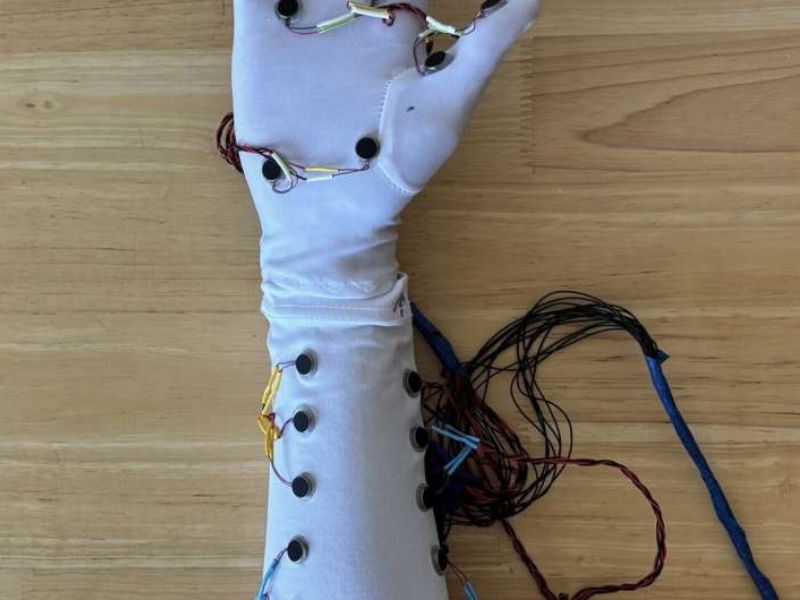
    For years, humanoid robots have been built to be strong, precise, and durable. They rely on cameras for vision, sensors to gauge force, and highly accurate systems to carry out tasks. What they’ve long lacked is the ability to sense and respond to their own bodies. That gap is now starting to close thanks to a breakthrough by researchers from universities in Shanghai and Hong Kong.
    Image Credits:© Astrid Eckert/TUM

    For years, humanoid robots have been built to be strong, precise, and durable. They rely on cameras for vision, sensors to gauge force, and highly accurate systems to carry out tasks. What they’ve long lacked is the ability to sense and respond to their own bodies. That gap is now starting to close thanks to a breakthrough by researchers from universities in Shanghai and Hong Kong.

    The team has created a flexible robotic skin that can detect touch, impact, and physical damage, effectively acting as an artificial nervous system. This development enables robots to identify potentially harmful situations, serving a role similar to how humans experience pain or discomfort.

    Image Credits:tmeier1964

    Unlike conventional sensors that focus on specific spots, this new skin envelops the robot’s entire body, making the arms, legs, and torso act as a single continuous sensor.

    The system relies on flexible, pressure-responsive materials that can detect small changes caused by impacts, deformation, or wear. Rather than depending only on cameras or motor force readings, the robot gains a direct awareness of what is happening to its own body.

    This heightened sensitivity enables quicker and smarter reactions to unexpected events, which is especially important for robots working close to humans.

    Practical Benefits in Everyday Scenarios

    The advantages are easy to imagine in everyday situations. For example, if a robot is carrying heavy furniture and an object drops on its foot, a traditional robot might keep moving, unaware of the damage, increasing the risk of falling or further harm.

    With the new skin, the impact would be sensed instantly. The robot could stop, adjust its position, or activate safety measures to reduce danger to itself and to nearby people.

    Such responsiveness is essential in settings like homes, hospitals, factories, and logistics hubs, where mechanical failures can result in serious accidents.

    Another key advantage is the ability to detect minor, nearly invisible damage. Tiny cracks or deformations in the outer layer can let dust or moisture seep in, gradually harming internal components.

    Early Detection and Modular Design for Easy Maintenance

    The new robotic skin can spot these issues early, before they escalate. It also features a modular design, letting users replace damaged sections with simple “patches” instead of swapping the entire skin.

    This approach lowers maintenance costs, extends the robot’s operational life, and makes humanoid robots more practical for long-term, real-world use.

    Image Credits: koshinuke_mcfly

    While the research is currently centered on humanoid robots, the team notes that the technology has much broader potential. Advanced prosthetics, for instance, could gain from responsive surfaces that deliver tactile feedback to users.

    Other possible applications include protective gear, rescue tools, and medical devices. In high-risk situations, the ability to sense excessive pressure, heat, or impact can be critical for preventing injuries or system failures.

    The researchers stress that the aim is not to give robots human-like emotions. The concept of “pain” in this context is purely functional, not a conscious or subjective sensation.

    Enhancing Safety and Reliability Around Humans

    The ultimate goal is to develop safer, more dependable machines that can operate alongside people in a predictable manner. By detecting risks and damage early, robots can respond proactively, reducing accidents and building trust in these technologies.

    As humanoid robots move beyond the lab and into everyday environments, innovations like artificial skin may play a crucial role—not in humanizing machines, but in making them more physically aware and better adapted to the human world.


    Read the original article on: Gizmodo

    Read more:A Supercomputer Builds one of the Most Lifelike Virtual Brains ever Created

  • Brain Implant Lets Man Share Movement and Sensation

    Brain Implant Lets Man Share Movement and Sensation

    In 2020, Keith Thomas suffered a devastating accident when he dove into a pool and broke his spine. The injury left him paralyzed from the chest down, unable to move or feel his arms and legs. Confined to a hospital room during the pandemic, he volunteered for a groundbreaking clinical trial aimed at restoring sensation and movement through a cutting-edge brain implant.
    Image Credits:Feinstein Institute for Medical Research

    In 2020, Keith Thomas suffered a devastating accident when he dove into a pool and broke his spine. The injury left him paralyzed from the chest down, unable to move or feel his arms and legs. Confined to a hospital room during the pandemic, he volunteered for a groundbreaking clinical trial aimed at restoring sensation and movement through a cutting-edge brain implant.

    The researchers designed the device to reestablish communication between his brain, body, and spinal cord. Using AI, the system translates Thomas’s movement intentions into muscle-activating pulses, while fingertip sensors send touch back to his brain. Within a year, he could lift a cup, wipe his face, and feel his dog’s fur again.

    Encouraged by the results, researchers at the Feinstein Institutes and Zucker School of Medicine asked: if a brain implant can restore one person’s movement, could it also control another’s muscles?

    A recent preprint suggests that such “interhuman” links might indeed be possible. Using only his thoughts, Keith Thomas was able to move the hand of a healthy volunteer through carefully targeted electrical stimulation of her muscles.

    Sharing Movement and Sensation

    The team also tested the multi-person neural bypass with Kathy Denapoli, who has partial paralysis and difficulty moving her hand. By sending his brain signals through the system, Thomas helped her pour water—and, remarkably, he later sensed the texture of the objects she touched.

    Though it sounds like science fiction, this method could revolutionize rehab—letting patients guide each other. By sharing movement, Thomas helped Denapoli nearly double her hand strength.

    As the researchers noted, this technique “not only restores elements of sensorimotor function,” but also “fosters interpersonal connection—enabling individuals with paralysis to regain a sense of agency, touch, and shared action through another person.”

    How Your Brain and Body Work in Perfect Harmony

    We move through daily life effortlessly—pouring coffee half awake or catching a ball without thinking. Behind these simple actions lies a complex circuit: the brain sends commands through the spinal cord to activate muscles, while sensory nerves feed touch and temperature back to fine-tune every motion.

    For people with spinal cord injuries, this loop is broken. Now, brain and spinal implants are helping bridge the gap. Tiny electrodes record brain signals that AI algorithms decode to control muscles or robotic limbs, while sensors restore a sense of touch.

    Keith Thomas’s implant represents a leap forward. It connects his brain, spine, and muscles simultaneously, translating his thoughts into movement and sending sensory feedback to his brain.

    The Moment Touch Returned After Years of Silence

    Over time, Thomas regained control of his arms and felt his hand again for the first time in three years.

    There was a time I didn’t know if I even wanted to live,” he said. “Now, I can feel someone holding my hand. It’s overwhelming—and if this can help others even more than it’s helped me, it’s worth it.

    To help people recover from paralysis or speech loss, scientists are developing brain-computer systems that translate thoughts into movement or even emotion.

    In a new study, researchers connected Keith Thomas’s brain implant to a healthy volunteer acting as his “avatar.” The volunteer wore electrode patches on her arm linked to Thomas’s brain signals. When Thomas imagined movement, his neural activity triggered her muscles, allowing her to grasp and lift objects.

    Mastering Touch Through Neural Feedback

    During training, Thomas learned to distinguish between objects—like a baseball or foam ball—by touch feedback sent to his brain, achieving over 90% accuracy even while blindfolded.

    The system also helped Kathy Denapoli, a woman with partial paralysis. Guided by Thomas’s brain signals, she could pour water and lift a soda can nearly three times faster than on her own. Remarkably, Thomas began to feel the textures of the objects she touched.

    By linking brain, spinal cord, and muscles, the implant may promote natural recovery. Thomas regained movement and sensation, and Denapoli’s grip strength improved.

    Though still unreviewed, this “thought-driven therapy” could one day help people recovering from stroke or ALS. “I was more fulfilled helping someone in real life,” Thomas said.


    Read the original article on: Singularityhub

    Read more: Scientists Developed a New Refrigeration Method

  • New Haptic Technology Brings the Sensation of Touch to Virtual Reality Experiences

    New Haptic Technology Brings the Sensation of Touch to Virtual Reality Experiences

    USC researchers have created a wearable system that allows for more natural and emotionally rich interactions in shared virtual environments, expanding opportunities in remote work, education, healthcare, and more.
    Image Credits: Premankur Banerjee

    USC researchers have created a wearable system that allows for more natural and emotionally rich interactions in shared virtual environments, expanding opportunities in remote work, education, healthcare, and more.

    Restoring the Power of Touch in a Digital World

    Touch is essential to human communication and connection, helping build trust, regulate stress, and form emotional bonds from infancy through adulthood. Yet in today’s digital world, where many interactions happen through screens, physical contact is often absent.

    To address this, researchers at the USC Viterbi School of Engineering have created a wearable haptic system that allows users to share and feel physical gestures—like handshakes, pats, and squeezes—in virtual reality, even across long distances.They detailed their work in a paper published on the arXiv preprint server.

    Wearable Devices Bring Realistic Touch to Virtual Interaction

    The system features gloves and sleeves equipped with small vibration motors that mimic pressure and motion, enabling users to engage with both virtual objects and each other through realistic touch feedback.

    A user study, also presented at the IEEE World Haptics Conference, found that participants felt more connected and engaged when they could physically feel virtual gestures.

    Even as people spend more time socializing online, we’re seeing increased rates of depression, anxiety, and what’s known as ‘touch starvation,‘” said Heather Culbertson, associate professor at USC Viterbi and lead author of the study. “Virtual interactions are here to stay—but we need to make them better mirror the emotional benefits of real-life experiences.

    Image Credits:Premankur Banerjee

    The system allows up to 16 users to connect at once, each represented by a full-body 3D avatar that mimics their real-world movements in a shared virtual space. Unlike video calls, users can move freely, interact with each other, and engage with virtual objects—such as passing items or collaborating on tasks.

    This project came from a simple but powerful human need—to feel close to those we miss,” said Premankur Banerjee, a PhD student in Heather Culbertson’s Haptics Robotics and Virtual Interaction Lab and the study’s lead author.

    Making Long-Distance Communication Feel Close

    After spending over five years away from my own family, this work became personal. It’s not just about creating a sense of presence, but about bringing back the feeling of physical closeness in long-distance communication,” he said.

    To recreate touch, users wear gloves and armbands with vibration motors that simulate motion and pressure, allowing them to feel gestures and interactions in VR.

    Tests showed that participants experienced a stronger sense of connection and presence with tactile feedback. The study also examined how gesture speed and vibration type affect emotional and sensory perception, offering insights for designing more immersive touch-based experiences.

    Merging Science and Emotion in Communication Technology

    Building this kind of technology demands collaboration across disciplines,” said Culbertson. “Our team integrates computer science, engineering, neuroscience, psychology, and social science to develop tools that are not just technically effective, but also enable emotionally rich social interaction.

    The global move toward online communication—accelerated by the COVID-19 pandemic—has offered great convenience but also led to unintended effects. Despite being more digitally connected than ever, many people, especially younger generations, continue to struggle with loneliness, anxiety, and depression.

    Platforms like Zoom and FaceTime help us stay visually and verbally connected, but they lack the physical interaction that humans naturally need,” said Heather Culbertson.

    She emphasized that while this technology can’t replace real-life contact, it can meaningfully enhance social interaction when being together in person isn’t possible.

    Enhancing Care, Collaboration, and Closeness Across Distances

    In hospitals and long-term care settings, the system could help patients and loved ones share comforting physical gestures across distances. In remote work or learning environments, it enables more immersive, collaborative engagement. For families and friends separated by travel or deployment, it helps restore a deeper sense of closeness.

    Touch is essential to human well-being. While technology can’t fully replicate it, bringing tactile experiences into virtual spaces is an important step toward more emotionally connected digital communication,” Culbertson said.


    Read the original article on: Techxplore

    Read more:Humanoid Robots Symbolize China’s Ambitions in AI