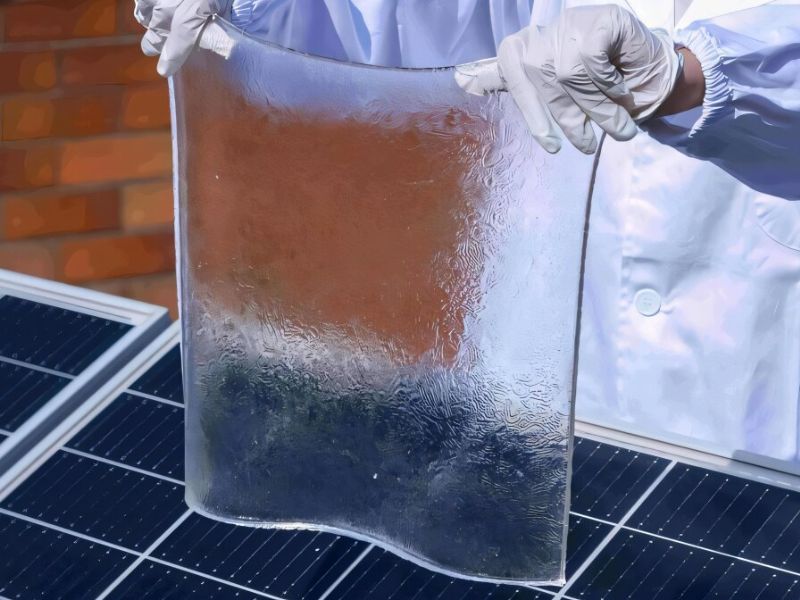

A research team at The Hong Kong Polytechnic University (PolyU) has created a low-cost, easy-to-apply hydrogel coating that improves heat dissipation in solar panels by effectively cooling “hot spots,” while also boosting power generation efficiency and contributing to Hong Kong’s urban carbon-neutrality goals.
Hot spots, often caused by partial shading, significantly reduce solar panel efficiency and can destabilize power supply systems. This innovation from PolyU provides a strong and effective solution to this critical industry challenge.
PolyU Develops Hydrogel to Enhance Solar Panel Efficiency
The hydrogel cooling technology was developed by a PolyU team led by Prof. Yan Jerry, Chair Professor of Energy and Buildings, along with Dr. Liu Junwei, Research Assistant Professor in the Department of Building Environment and Energy Engineering. Their research demonstrated that applying the hydrogel coating to solar panels can reduce hot-spot temperatures by up to 16°C and increase power output by as much as 13%.
When used on rooftop and building-integrated photovoltaic (BIPV) systems, the hydrogel coating is expected to offset nearly half of the power losses caused by hot spots, greatly enhancing the long-term stability and efficiency of solar PV systems for building electricity supply.

Prof. Yan said, Our hydrogel cooling tech solves hot-spot issues in solar panels without altering circuit designs. It is both cost-effective and easy to use, making it suitable for diverse urban environments. Based on case studies in Hong Kong and Singapore, our team projects potential annual power generation increases of 6.5% and 7.0%, respectively.
“The estimated payback periods are impressively short, at just 4.5 years and 3.2 years. Globally, this technology could offset around 50% of power losses caused by hot spots in BIPV systems, highlighting its significant role in advancing solar energy technology.”
Durable Hydrogel Boosts Solar Panel Performance
Hot spots in solar photovoltaic systems warrant serious attention, as they not only reduce efficiency due to higher operating temperatures but can also create fire hazards in severe cases. Research examining 3.3 million photovoltaic panels found that 36.5% had thermal defects, with affected modules showing an average temperature rise of over 21°C, accelerating panel aging and degradation.
“The PolyU hydrogel coating provides superior cooling performance while exhibiting exceptional durability, making it ideal for extended outdoor applications.”

Dr. Liu explained, Our team incorporated the natural polymer hydroxyethyl cellulose and the fibrous material leafy cotton thread into the hydrogel matrix to tackle the key issues of cracking and shrinkage that typically affect conventional hydrogels over time. While traditional hydrogels can shrink by as much as 46% with prolonged use, our innovation greatly reduces cracking and shrinkage, limiting volumetric shrinkage to 34%.
“Moving forward, we aim to build on this hydrogel evaporative cooling technology to further the development and wider adoption of emerging photovoltaic technologies.”
Read the original article on: Tech Xplore
Read more: The V4 Drone, Now The Fastest In The World, Hits 656 km/h and Regains The Speed Record