A groundbreaking discovery could transform space exploration: researchers have developed a way to produce solar energy on the Moon using lunar dust itself. This technique involves converting lunar regolith—the abundant surface material on the Moon—into a type of glass that can conduct electricity, potentially enabling the creation of sustainable lunar outposts without relying on equipment sent from Earth.
From Dust to Moonglass: How It Works
The study, led by Felix Lang from the University of Potsdam in Germany, was published in the journal Device. Using NASA-developed lunar regolith simulants, the team mimicked Moon-like conditions and melted the material with concentrated sunlight, forming a new type of glass named “Moonglass.”
When paired with perovskite—a highly efficient light-absorbing crystal—this lunar glass forms solar cells that are resistant to cosmic radiation, making them well-suited for the Moon’s harsh environment. Additionally, the glass’s natural brown hue helps prevent darkening from prolonged exposure to space light, extending the lifespan of the solar panels.
While current prototypes achieve just 10% energy conversion, lab tests with process improvements have shown potential efficiencies up to 23%. For comparison, conventional space-grade solar panels can reach 40%. Still, the ability to manufacture solar panels directly on the Moon using local resources offsets the lower efficiency.
The major advantage lies in reducing mission costs and logistics. Producing solar panels in situ could cut the payload weight from Earth by up to 99%—a game-changer for long-duration or permanent lunar missions.
Testing the Tech on the Moon’s South Pole
Next steps involve testing the technology in actual lunar conditions. The team is planning a trial mission to the Moon’s south pole, an area with high solar exposure and frozen water deposits—ideal for supporting future human settlements.
If successful, this innovation could lay the foundation for solar power generation beyond Earth, opening the door to energy independence across the solar system.
Sweat, akin to blood, holds valuable insights into an individual’s health, and fortunately, its collection is much less intrusive. This forms the foundation for the creation of wearable sweat sensors, crafted by Wei Gao, an assistant professor of medical engineering, Heritage Medical Research Institute Investigator, and Ronald and JoAnne Willens Scholar.
Expanding Substance Measurement and Health Risk Evaluations
During the last five years, Gao has continuously enhanced his wearable devices, enabling them to measure various substances such as salts, sugars, uric acid, amino acids, and vitamins. Additionally, these devices can now detect more intricate molecules like C-reactive protein, offering timely evaluations of specific health risks. Recently, Gao collaborated with Martin Kaltenbrunner’s team at Johannes Kepler University Linz in Austria to integrate flexible solar cells, providing power to these advanced biosensors.
Gao’s lab employs a solar cell constructed from perovskite crystal, a material characterized by the same chemical structure as calcium titanium oxide. Perovskite has garnered considerable attention among solar cell developers due to several advantages
To begin with, it offers a more cost-effective manufacturing process compared to silicon, which has been the primary material in solar cells since the 1950s and requires extensive purification procedures.
Secondly, perovskite solar cell layers are exceptionally thin, almost “quasi-2D” in Gao’s terms, being up to 1,000 times thinner than silicon layers.
Light spectra
Moreover, perovskite can be tailored to different light spectra, ranging from outdoor sunlight to various indoor lighting conditions.
Most importantly, perovskite solar cells boast a higher power conversion efficiency (PCE) than silicon, signifying their ability to convert a larger portion of received light into usable electricity.
While silicon solar cells typically achieve PCE levels ranging from 26 to 27 percent, their practical usage usually stays within 18 to 22 percent. In contrast, Gao’s wearable sweat sensor equipped with a flexible perovskite solar cell (FPSC) sets a groundbreaking record with a PCE exceeding 31 percent, specifically under indoor light illumination.
Wearable sweat sensor showing layer next to the skin (left) and flexible solar cell (right). Intermediate layers include electronics and biomarker sensors. Credit: Jihong Min
According to Gao, the objective is not solely reliant on harnessing strong sunlight to energize their wearables. Instead, they prioritize real-life scenarios, encompassing typical office and home lighting conditions. Gao highlights that numerous solar cells may exhibit high efficiency in bright sunlight but falter in weaker indoor lighting settings. However, the FPSC integrated into the sweat sensor proves highly suitable for indoor lighting due to its excellent spectral response, closely aligned with the emission spectrum of common indoor lighting.
Challenges with Lithium-ion Batteries and Silicon Solar Cells
Earlier versions of Gao’s wearable sweat sensors relied on bulky lithium-ion batteries, necessitating recharging with an external power supply. To find a lighter and more sustainable electricity source for these high-demand devices, Gao’s team explored the use of silicon solar cells, but found them to be inflexible, inefficient, and reliant on strong lighting conditions.
They also experimented with harnessing energy from chemicals present in human sweat, considering it a readily available biofuel, as well as from body motion. However, these approaches proved unstable or demanded too much effort from the wearer.
Extended Wear and Enhanced Biomarker Monitoring
The adoption of FPSCs has revolutionized Gao’s sweat sensors, allowing them to be worn continuously for 12 hours a day. These sensors provide uninterrupted monitoring of pH, salt, glucose, and temperature, along with periodic monitoring (every five to 10 minutes) of sweat rate. Notably, all of these functionalities are achieved without the need for batteries or a specially dedicated light source. Additionally, the use of a lighter and less cumbersome power source has opened up space in the wearable for more detectors, enabling the simultaneous monitoring of a greater number of biomarkers.
The sweat sensor as it would be worn on the body, capable of being powered by both sunlight and ambient indoor light. Credit: Jihong Min
Multi-layered Construction and Four Interacting Components
Similar to its predecessors, the novel wearable sweat sensor is constructed using an origami-like approach, incorporating distinct layers for different functions. The sensor comprises four key interacting components:
Power management: This component efficiently distributes the electricity obtained from the integrated solar cell.
Iontophoresis: The second component induces sweating without requiring any physical exercise or exposure to high temperatures from the wearer. In Gao’s study, iontophoresis was conducted every three hours to ensure a continuous supply of sweat for monitoring biomarkers.
Electrochemical measurement: The third component facilitates the measurement of various substances present in the sweat.
Data processing and wireless communication: The fourth component manages data processing and wireless communication, enabling the sensor to interface with a cellphone app, displaying real-time monitoring results.
Once fully assembled, the sensor measures 20 x 27 x 4 millimeters and can endure the mechanical stress associated with being worn on the body. Gao emphasizes that many elements of the sweat sensor, such as the electronics and FPSC, are reusable, with the exception of the disposable sensor patch. This patch can be mass-produced at a low cost using inkjet printing, allowing for customization based on the user’s desired substances to be measured in their body.
The flexible perovskite solar cell that powers Wei Gao’s wearable sweat sensor. Credit: Stepan Demchyshyn
The application of these solar-powered sweat sensors extends far beyond the capabilities of current fitness or health trackers. They have the potential to measure a wide range of parameters. For instance, they can aid in diabetes management, as studies have indicated that glucose levels in sweat closely correlate with blood glucose levels. Additionally, these sensors can detect various conditions like heart disease, cystic fibrosis, and gout.
Enabling Precise Monitoring of Cortisol, Hormones, and Metabolites
Their noninvasive nature and ability to conduct multiple measurements in short intervals allow them to establish an individual’s baseline for substances such as cortisol, hormones, or metabolites of different nutrients and medications.
Once these baseline levels are established, any future deviations can serve as a more effective diagnostic indicator compared to a single blood draw. Moreover, due to their relatively low cost, there is optimism that these sensors can become valuable diagnostic tools globally, including in developing countries.
Read the original article on: Tech Xplore
Read more: From Fruit Waste To Water-purifying Material
A group of scientists in China has created an innovative solar-powered contraption that effectively cleanses water, making it safe for consumption. Credit: eduardkraft/Depositphotos
The University of Science and Technology of China has made a breakthrough in water purification by introducing a unique wooden device that utilizes bacteria to construct essential nanostructures, enabling evaporation as a reliable method for making water potable.
The Fundamental Concept
The fundamental concept of an evaporative water purifier is reminiscent of what many of us learned in science class. By concentrating sunlight onto the device, the water within heats up and transforms into steam, leaving behind any harmful impurities. The resulting steam is then directed into a separate container where it condenses back into pure, safe-to-drink water.
Throughout the years, we have witnessed numerous applications of this fundamental idea, employing diverse materials and arrangements. These implementations include devices that float atop a lake, drawing water from beneath and purifying it, sponges enveloped in bubble wrap, porous structures composed of graphite flakes, solar stills crafted from carbon-coated paper, and cellulose aerogels.
A diagram of the new solar water purifier. The top is a light-absorbing layer of carbon nanotubes, the middle is a heat-insulating layer of glass bubbles, and the bottom is wood. Adapted from Nano Letters 2020, DOI: 10.1021/acs.nanolett.0c01088
In this particular investigation, the novel device consists of multiple layers. The uppermost layer comprises carbon nanotubes, known for their effective absorption of solarheat. Positioned in the middle is a layer composed of miniature glass bubbles, creating an insulating aerogel to retain the generated heat. Below this layer, there is a block of wood, with water situated beneath it.
Bacteria Utilization
However, the pivotal component is the utilization of bacteria. The researchers initiated the process by applying the microorganisms onto the wood surface and allowing them to undergo fermentation. As the subsequent steps involve incorporating the glass bubble and carbon nanotube layers, the bacteria play a crucial role in constructing cellulose nanofibers around these components, effectively binding the entire structure together.
In this specific design, water`s conveyed upward through the wood, utilizing its inherent porous structure that aids trees in maintaining hydration. As the water reaches the uppermost layer containing carbon nanotubes capable of absorbing light, it undergoes heating and evaporation. Simultaneously, the glassy aerogel layer functions as an insulator, preventing the dissipation of heat downward.
Up To Now The Best Evaporator Design
According to the researchers, this solar evaporator design surpasses many others in terms of efficiency. It achieves an impressive evaporation rate of 2.9 kg m–2 h–1 and demonstrates a remarkable solar-to-vapor efficiency of 80 percent. Furthermore, the use of wood and carbon nanotubes offers an additional advantage as these materials are both cost-effective and widely available.
Read the Original Article NewAtlas.
Read More: A New Energy Storage System Can Store Solar Power For Nearly 20 Years.
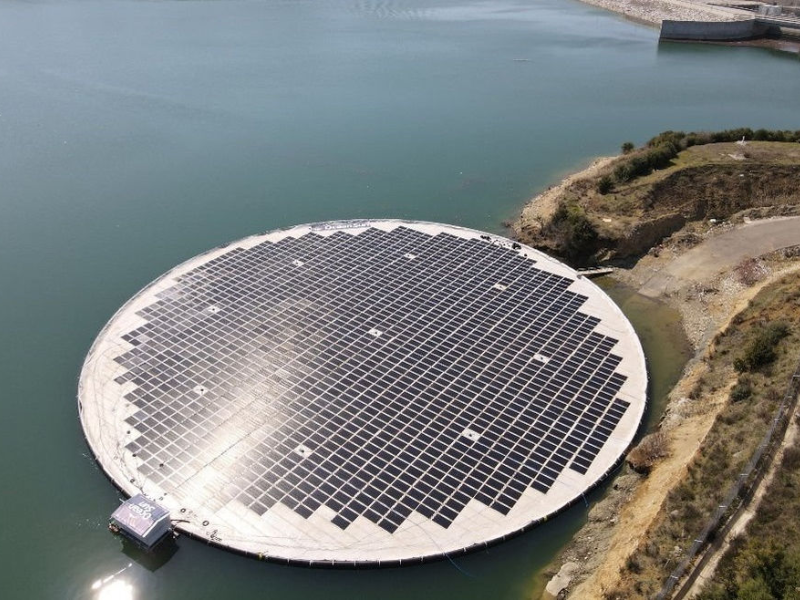
In June, the initial floating solar panel system located at Banja reservoir suffered damage. Credit: Offshore Energy.
The Norway-based Ocean Sun, got the floating solar power project at the Banja reservoir in Albania, back online.. A tornado damaged the 500 kW unit last year simply days after it was commissioned.
Floatovoltaics are an exciting name for solar panels set up on water. Which helps cool the devices and improve performance. The supporters of the technology point out that covering a lake decreases evaporation.
It is particularly beneficial for hydropower plant operators. Statkraft placed the first such photovoltaic unit in the Balkans into operation almost a year back, yet disaster struck some days later.
The 500 kW ring-fenced system in Albania was struck by a tornado. According to Norway-based Ocean Sun, which installed it. The firm recognized it was partly submerged, which it experienced severe damages. Yet it currently claims that it is back online.
A ring-fenced floating PV system can hold up against 50-year winds
“Ocean Sun consulted the best meteorologists to anticipate the brand-new expected 50-year return winds. Leading naval architects were consulted to assess design and mooring for the brand-new adverse weather conditions that we currently also can expect in Europe,” according to Founder and Chief Executive Officer Børge Bjørneklett. That included that “several lessons were learned.”
Ocean Sun CEO Bjørneklett: Many lessons were learned
The demonstrator floater at Statkraft’s 72 MW Banja hydropower plant reservoir near Gramsh in central Albania is prepared to consist of four equal-sized units. The update reads. Ocean Sun claimed the 2 MW floating photovoltaic plant would certainly be finished this year. The financial investment price was at first estimated at EUR 2 million.
Ocean Sun enters more markets this year.
The first unit spans virtually 4,000 square meters and has 1,536 solar panels. While an additional 160 panels were positioned on land nearby, Exit.al reported. The broken assets were carried ashore to be fixed.
Ocean Sun, which likewise has offices in Singapore and Shanghai. Said the floating power plant’s design was verified by DNV, an independent assurance, and risk management provider. The Norwegian company emphasized that it anticipates getting in several other markets by the end of the year.
Another floating solar power plant project is underway in Albania. Private as well as state-owned utilities in Greece, Romania, and Montenegro are additionally making the initial steps to use the brand-new technology.
Read the original article on Balkan Green Energy News.
Read more: Air France-KLM Includes Biofuel Tax to Plane Tickets.
We use cookies on our website to give you the most relevant experience by remembering your preferences and repeat visits. By clicking “Accept All”, you consent to the use of ALL the cookies. However, you may visit "Cookie Settings" to provide a controlled consent.
This website uses cookies to improve your experience while you navigate through the website. Out of these, the cookies that are categorized as necessary are stored on your browser as they are essential for the working of basic functionalities of the website. We also use third-party cookies that help us analyze and understand how you use this website. These cookies will be stored in your browser only with your consent. You also have the option to opt-out of these cookies. But opting out of some of these cookies may affect your browsing experience.
Necessary cookies are absolutely essential for the website to function properly. These cookies ensure basic functionalities and security features of the website, anonymously.
Cookie
Duration
Description
cookielawinfo-checkbox-analytics
11 months
This cookie is set by GDPR Cookie Consent plugin. The cookie is used to store the user consent for the cookies in the category "Analytics".
cookielawinfo-checkbox-functional
11 months
The cookie is set by GDPR cookie consent to record the user consent for the cookies in the category "Functional".
cookielawinfo-checkbox-necessary
11 months
This cookie is set by GDPR Cookie Consent plugin. The cookies is used to store the user consent for the cookies in the category "Necessary".
cookielawinfo-checkbox-others
11 months
This cookie is set by GDPR Cookie Consent plugin. The cookie is used to store the user consent for the cookies in the category "Other.
cookielawinfo-checkbox-performance
11 months
This cookie is set by GDPR Cookie Consent plugin. The cookie is used to store the user consent for the cookies in the category "Performance".
viewed_cookie_policy
11 months
The cookie is set by the GDPR Cookie Consent plugin and is used to store whether or not user has consented to the use of cookies. It does not store any personal data.
Functional cookies help to perform certain functionalities like sharing the content of the website on social media platforms, collect feedbacks, and other third-party features.
Performance cookies are used to understand and analyze the key performance indexes of the website which helps in delivering a better user experience for the visitors.
Analytical cookies are used to understand how visitors interact with the website. These cookies help provide information on metrics the number of visitors, bounce rate, traffic source, etc.
Advertisement cookies are used to provide visitors with relevant ads and marketing campaigns. These cookies track visitors across websites and collect information to provide customized ads.