Tag: Solar Storms

  • New AI Predicts Solar Storms Days Early

    New AI Predicts Solar Storms Days Early

    Researchers at NYU Abu Dhabi (NYUAD) have created an AI model capable of predicting solar wind speeds up to four days ahead with far greater accuracy than existing techniques, according to a study in The Astrophysical Journal Supplement Series.
    Image Credits: sciencedaily

    Researchers at NYU Abu Dhabi (NYUAD) have created an AI model capable of predicting solar wind speeds up to four days ahead with far greater accuracy than existing techniques, according to a study in The Astrophysical Journal Supplement Series.

    Solar wind consists of a constant flow of charged particles emitted by the Sun. When it intensifies, it can trigger “space weather” that disrupts Earth’s atmosphere, push satellites out of orbit, damage their electronics, and disturb power grids. In 2022, a powerful solar wind storm caused SpaceX to lose 40 Starlink satellites, underscoring the critical need for improved forecasting.

    AI Trained on Solar Images Boosts Forecast Accuracy by 45%

    The NYUAD team, led by Dattaraj Dhuri and Shravan Hanasoge, trained their AI with NASA’s solar UV images and historical wind data, enabling it to detect patterns linked to solar wind changes. The model improves forecast accuracy by 45% over current operational systems and by 20% compared to earlier AI-based methods.

    This is a major step in protecting satellites, navigation, and power systems,” said Dhuri. “With AI and solar imaging, we can issue early warnings to safeguard critical technology.

    AI Breakthrough Strengthens Defense Against Space Weather Threats

    The achievement highlights AI’s potential to tackle one of space science’s most difficult problems—predicting solar wind. Reliable forecasts will help scientists prepare for space weather and protect vital infrastructure.

    NYU Abu Dhabi hosts more than 90 faculty-led labs and projects, with over 9,200 globally recognized research publications. NYU, ranked among the world’s top 35 by Times Higher Education, is the UAE’s highest-ranked university through NYUAD.


    Read the original article on: Science Daily

    Read more: Bending Ice Produces Electricity, Possibly Explaining Lightning
  • First-Ever Imaged Supermassive Black Hole Reveals Stunning Evolution in New Photos

    First-Ever Imaged Supermassive Black Hole Reveals Stunning Evolution in New Photos

    Credit Scitke

    To the casual observer, the Sun appears constant and unchanging. In reality, it is a turbulent sphere of seething plasma, where electrically charged gas is in constant motion, influenced by the Sun’s magnetic field. Understanding and predicting this chaotic activity remains one of the greatest challenges for modern solar physicists.

    One of the most unpredictable solar events is the coronal mass ejection (CME). These massive bursts of plasma erupt from the Sun’s corona when magnetic field lines suddenly realign, releasing enormous amounts of energy. CMEs can travel at speeds ranging from a few hundred to several thousand kilometers per second, sometimes reaching Earth within days if their trajectory is aligned with our planet. Upon arrival, they can disrupt satellite communications, GPS systems, and power grids while also triggering breathtaking auroras in the northern and southern hemispheres.

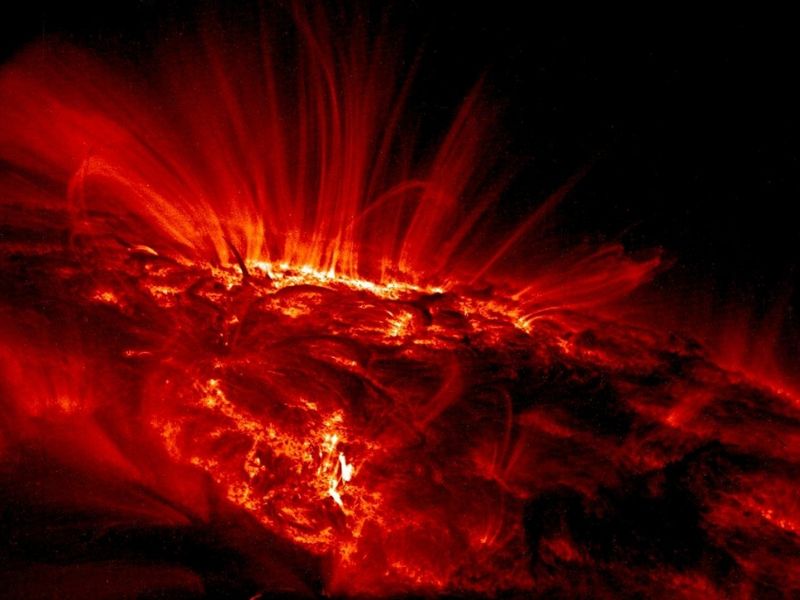
    A colossal CME departs the Sun in February 2000. lifting erupting filament off the active solar surface and blasted this enormous bubble of magnetic plasma into space. (NASA/ESA/SOHO)

    AI Revolutionizes Solar Storm Forecasting by Decoding Decades of Solar Activity

    Accurately forecasting CMEs and their effects on Earth’s magnetosphere has long been a challenge. However, a new study led by astronomer Sabrina Guastavino from the University of Genoa suggests that artificial intelligence could revolutionize solar storm predictions. Researchers trained machine learning algorithms on decades of solar activity, uncovering complex patterns that conventional methods often miss. Their AI model successfully analyzed the solar region AR13664, which produced intense flares and CMEs during the May 2024 solar storm—including a powerful X8.7-class flare.

    The AI-driven predictions proved remarkably accurate, significantly reducing uncertainties compared to traditional forecasting methods. The study not only predicted the occurrence and evolution of solar flares but also provided precise estimates of CME travel times and the onset of geomagnetic storms on Earth.

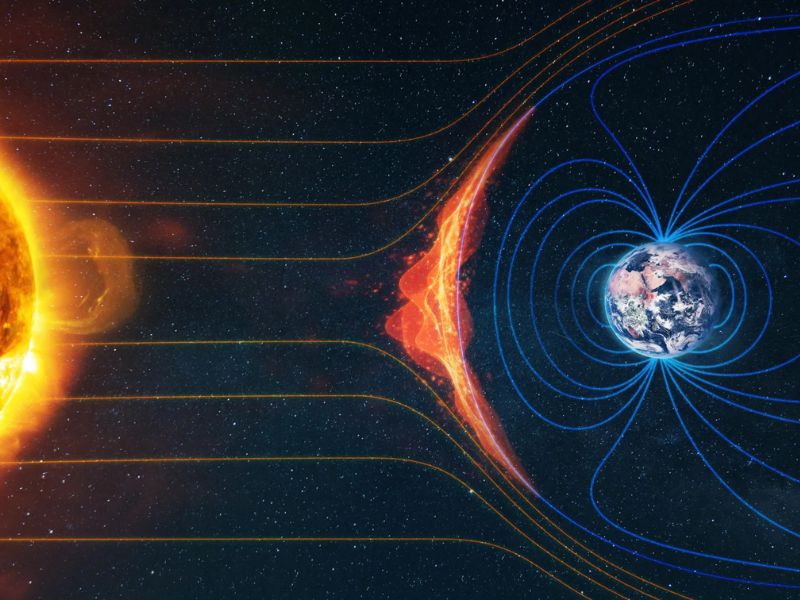
    Solar activity impacting Earth’s magnetosphere. (NASA)

    The implications of this breakthrough are profound. Improved forecasting could help mitigate power grid failures, communication disruptions, and satellite malfunctions caused by CMEs. Additionally, skywatchers might receive more reliable aurora forecasts, enhancing opportunities to witness nature’s dazzling light displays. As AI continues to refine space weather predictions, we may soon have a powerful tool for protecting critical infrastructure—and enjoying the beauty of the cosmos.


    Read Original Article: Science Alert

    Read More: First-Ever Imaged Supermassive Black Hole Reveals Stunning Evolution in New Photos