Tag: SpaceX's Starship Super Heavy Is One Crucial Step Closer To Sending Humans To Mars

  • SpaceX Starlink Satellites Make 25,000 Quick Moves in 6 Months, and  More Challenges Are Coming!

    SpaceX Starlink Satellites Make 25,000 Quick Moves in 6 Months, and More Challenges Are Coming!

    Starlink Satellites Do Cool Moves Over 50,000 Times to Stay Safe in Space!
    “Starlink Satellites Do Cool Moves Over 50,000 Times to Stay Safe in Space!” credit: Arda Kucukkaya/Anadolu Agency via Getty Images)

    Starlink (SpaceX) Satellites Do Fancy Dance Moves to Stay Safe, But There’s a Worrying Problem!

    SpaceX’s Starlink satellites have been doing impressive maneuvers to avoid bumping into other spacecraft and space junk. In just six months, from December 2022 to May 2023, they had to swerve over 25,000 times! That’s twice as many moves compared to the previous six months. Since the first Spacex Starlink satellite launched in 2019, they have made over 50,000 moves to prevent collisions.

    But here’s the concern: the number of maneuvers is increasing fast, like on a roller coaster going higher and higher. This worries experts because it could become difficult to manage and keep everyone safe in space. Hugh Lewis, a professor who knows a lot about satellites, says the number of moves is growing quickly. It’s doubling every six months, and that’s a problem because big numbers can be hard to handle.

    So, while it’s cool that Starlink satellites can avoid crashes with their cool dance moves, we need to figure out how to keep everything safe up there in space!

    1.000.000 Moves till 2028

    “Starlink Satellites Are Doing More and More Avoidance Moves!”Did you know that Starlink satellites have to do special maneuvers to avoid crashing into other satellites? In the first part of 2021, they did 2,219 of these moves. Then, in the next six months, they did 3,333. After that, it doubled to 6,873 moves! In the second half of 2022, they had to change their paths 13,612 times to stay safe. In the latest report, they did 25,299 moves in just six months, which means each satellite had to move about 6 times on average.

    This is a big problem because the number of moves keeps getting bigger and bigger. Every six months, it doubles! In just two years, it went up by 10 times. If it keeps going like this, in the next six months, they might have to do 50,000 moves, then 100,000, and even more!

    By 2028, they might have to move nearly a million times in just six months! That’s a lot! And this seems to only increase. SpaceX has already put about one-third of its planned satellites in space, and they’re launching more than 800 satellites each year. Other companies like Amazon and China are also trying to send their satellites into space.

    It’s a big challenge to make sure all these satellites can move around without crashing into each other. But people are working on it to keep space safe and make sure everything goes smoothly up there!

    The Projected  Future of Starlink: Avoiding Collisions in Space!
    “The Projected Future of Starlink: Avoiding Collisions in Space!” (Image credit: Hugh Lewis)

    Satellite Traffic and Safety Concerns in Space

    There are a lot of satellites in space—over 1.7 million of them! They are registered with an organization that oversees satellite radio frequencies. But not all of those satellites will actually be launched. Still, the numbers are so high that experts are worried about keeping order in space.

    If there are around 100,000 active satellites by the end of this decade, there will be a huge number of maneuvers needed to avoid collisions. It’s like driving on a highway and constantly swerving to avoid hitting something. That’s not very safe!

    The need to swerve isn’t just because of new satellites. There’s also a lot of space debris, like old satellites and rocket parts, floating around. This makes it even harder for satellite operators to keep their spacecraft safe.

    Elon Musk’s ambitious plan to launch 42,000 Starlink satellites in the coming years aims to bring high-speed internet to every corner of the globe. However, this grand vision raises concerns among experts. The sheer number of satellites could potentially obstruct astronomers’ observations, hindering their understanding of the universe. Moreover, the dense satellite presence may impede future space exploration missions, creating obstacles for spacecraft and posing long-term challenges. While the prospect of global internet access is enticing, it is crucial to carefully consider the potential consequences for scientific research and the exploration of space.

    Experts question if SpaceX, a big satellite company, can keep up with all the alerts for potential collisions. They think the risk of collisions will keep going up, even if SpaceX tries hard to prevent them.

    There’s concern about situations where no maneuvers are made. Even though the chance of a collision is low in each case, there are so many of them that it becomes a big risk. It’s like buying a lot of lottery tickets—you’re more likely to win if you have a million tickets instead of just one.

    Unless regulators limit the number of satellites in space, experts believe collisions will become common. This would create more space debris and lead to even more collisions. It could eventually result in the Kessler Syndrome, where collisions happen so often that parts of space become unusable, like in the movie “Gravity.” So, it’s important to figure out how to manage all these satellites and keep space safe for everyone.


    Read the original article on Space.

    Read more: NASA And SpaceX Explore the Idea of Shifting Hubble to a More Stable Orbit.
  • SpaceX’s Starship Super Heavy is One Crucial Step Closer to Sending Humans to Mars

    SpaceX’s Starship Super Heavy is One Crucial Step Closer to Sending Humans to Mars

    SpaceX’s massive Starship rocket remains to pass key tests on its road to sending the Mars-bound launch system up to orbit for the 1st time.

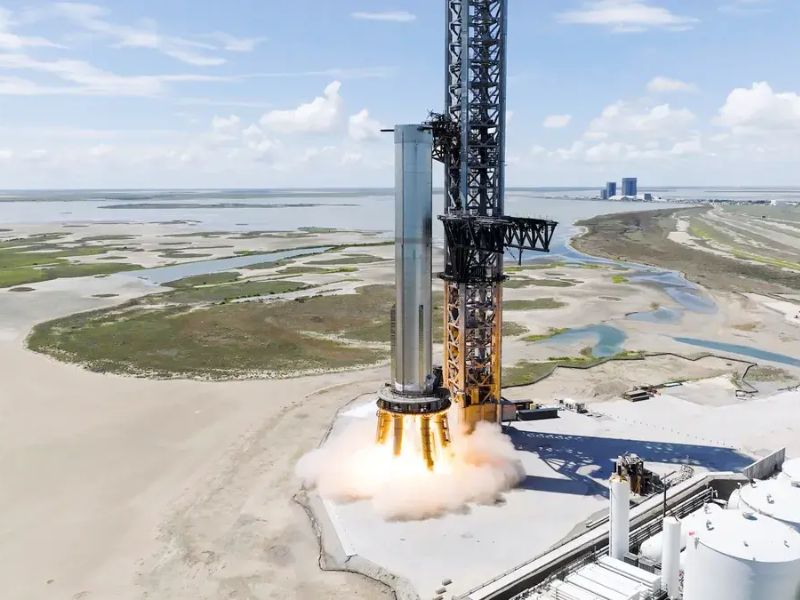
    The private space firm fired 7 Raptor engines on its Starship Super Heavy prototype, called Booster seven, on Monday, September nineteen. As Space.com points out, it´s the highest number of next-generation engines ever examined simultaneously.

    The engine test is an important examination ahead of Starship’s orbital maiden flight, which is expected to occur in the following months. That test flight will then pave the way for Starship to land people back on the lunar surface and also then send crewed missions to Mars.

    The latest Starship static fire engine test

    When it eventually lifts off towards orbit, Starship will launch atop a 230-foot (70 m) high Super Heavy booster furnished with 33 Raptor engines. The 165-foot high (50 meters) Starship will use six of the engines and will be fully reusable, helping to drastically reduce consecutive launch costs to make trips to the red planet financially feasible.

    In the lead-up to release, SpaceX has been carrying out one number of static fire engine tests, throughout which engines are fired up while the rocket continues on the ground. After the engine examination on Monday, SpaceX CEO Elon Musk tweeted that “chamber pressure looked good on all seven engines.”

    He also specified in a following tweet that “Booster 7 currently returns to high bay for robustness upgrades & booster eight moves to pad for testing. The next big test is probably complete stack wet dress rehearsal, after that 33 engine firing in a few weeks.

    The complete pile refers to the Starship mounted on top of the Super Heavy booster rocket. Put together, it is the world’s highest rocket, measuring 395 feet (120 m) in height. That is the setup that is expected to send astronauts to Mars.

    When will we observe Starship fly to orbit?

    SpaceX has been gradually increasing the number of Raptor engines it fires up throughout its Starship static fire examinations over the last few months.

    The company, for instance, just performed the first multi-engine static fire examination on August 31, having previously just tested one engine at a time on Booster seven and on the Starship prototype, respectively.

    Earlier in the summer, both SpaceX president Gwynne Shotwell and Ellon Musk had separately indicated that Starship would launch to orbit in May through to August. Offered the timeline for SpaceX’s full stack static fire test, a September launch does not look to be in the cards.

    That is not to say we are not very close to seeing the world’s biggest rocket finally fly into orbit. Unlike NASA’s much-delayed SLS rocket, which remains to sit on the pad ahead of a potential release this month, we have seen Starship prototypes launch before and carry out crazy flip maneuvers. So it is not so hard to imagine the real thing launching to orbit very soon.


    Read The Orinal Article On INTERESTING ENGINEERING.

    Read more: Proof Suggests Pandemic Came From Nature, Not A Laboratory, Panel Says