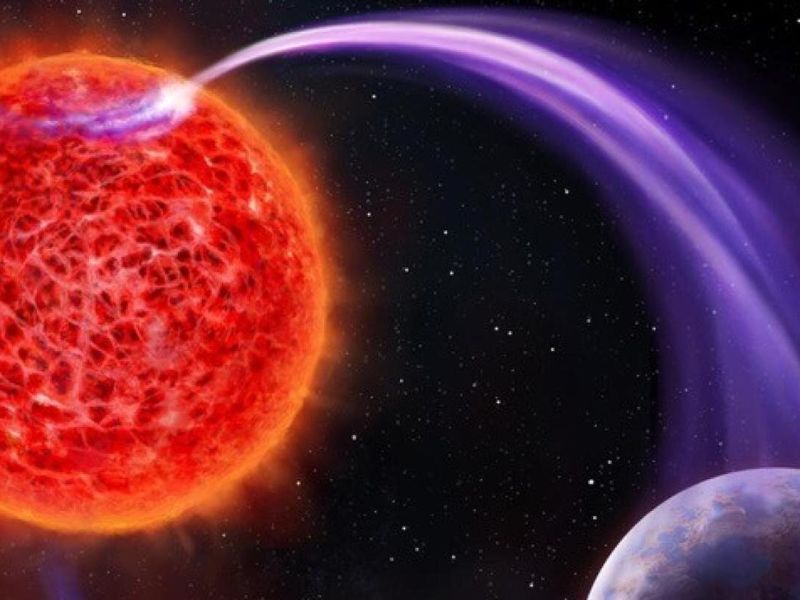

An international team, including Cornell’s Jake Turner, developed a method to uncover hidden stellar and exoplanetary signals in archival radio data. Using this technique, scientists have identified new radio bursts from dwarf stars and potentially from exoplanets. The method, Multiplexed Interferometric Radio Spectroscopy (RIMS), reveals some signals linked to star–planet interactions.
The findings appeared in the paper “The Detection of Circularly Polarized Radio Bursts from Stellar and Exoplanetary Systems” published in Nature Astronomy on January 27.
A Novel Approach to Exploring Archives
Modern radio telescopes collect vast data, usually used to image distant galaxies and black holes. Until now, archives never tracked stars’ minute-by-minute activity—something RIMS now enables. The technique turns one radio observation into a survey of hundreds or thousands of stars, like a net catching many fish at once.
“RIMS makes use of every second of observation across hundreds of directions in the sky. “What we once analyzed star by star, we can now do simultaneously,” said Cyril Tasse, lead author and Paris Observatory researcher. “Without this method, achieving the same level of detections would have required nearly 180 years of targeted observations.”

Using RIMS on over 1.4 years of data from the European LOFAR radio telescope, collected during the large-sky LoTSS survey, the team produced as many as 200,000 dynamic spectra from individual stars or stars with exoplanets.
Some of the signals uncovered by RIMS correspond to bursts consistent with intense stellar activity, similar to solar coronal mass ejections.
Signs of Magnetic fields Around Exoplanets
Even more strikingly, some of the signals display all the hallmarks of magnetic interactions between stars and planets—similar to the processes that produce certain auroras on Jupiter, the researchers noted.
These radio emissions may provide some of the first strong evidence of magnetic star–exoplanet interactions and exoplanetary aurorae, suggesting the presence of exoplanet magnetospheres, said Turner, a research associate at the Cornell Center for Astrophysics and Planetary Science and a member of the Carl Sagan Institute in the College of Arts & Sciences.
“Our findings show that some radio bursts—particularly those from the exoplanetary system GJ 687—are consistent with a close-in planet disturbing the star’s magnetic field and triggering intense radio emissions. Our models indicate that these bursts allow us to estimate the magnetic field of the Neptune-sized planet GJ 687 b, providing a rare indirect method to study magnetic fields on worlds beyond our solar system,” Turner explained.
“Exoplanets with magnetic fields develop, behave, and evolve very differently from those without them. That’s why it’s crucial to determine whether planets have these fields. Most importantly, magnetic fields can play a key role in supporting a planet’s habitability, as we see with Earth,” Turner explained.
Extending the Capabilities of RIMS
The RIMS breakthrough ushers in a new era, making any telescope array a sensitive detector of nearby stellar signals. The technique was tested on France’s NenuFAR telescope, detecting a burst from a star–planet system. That study, co-authored by Turner, was published last year in Astronomy & Astrophysics.
“This NenuFAR study may be just the second direct detection of exoplanet radio emission,” Turner said. “We are now conducting targeted follow-up observations to confirm the planetary origin of both signals. A confirmed detection would offer a powerful new method to study an exoplanet’s magnetic field.”
Turner added that future ground-based, space-based, and lunar radio telescopes could all employ this technique. It could reveal thousands of new signals, allowing large-scale studies of stellar emissions and star–planet interactions in our galaxy.
Read the original article on: Phys.Org
Read more: Deep Inside Uranus and Neptune, Water Exists in a Wholly Unusual Form