Tag: supernova

  • Double Supernova Unveils Extraordinary Celestial Structure

    Double Supernova Unveils Extraordinary Celestial Structure

    The composite image features X-rays illuminated in purple overlaying the nebula structure and stars captured by Hubble.
    Image credit: X-ray: NASA/CXC/Penn State Univ./L. Townsley et al.; Optical: NASA/STScI/HST; Infrared: NASA/JPL/CalTech/SST; Image Processing: NASA/CXC/SAO/J. Schmidt, N. Wolk, K. Arcand

    An enigmatic nebula named Tarantula in the neighboring galaxy has been a cosmic theater of stellar births and deaths for millions of years. While the closest supernova in the last 50 years, Supernova 1987A, originated from its outskirts, astronomers are now focusing on another intriguing supernova remnant within the nebula: 30 Doradus B.

    Pulsars, Neutron Stars, and Cosmic Insights

    Astronomers focused their study on the pulsar PSR J0537-6910, a type of neutron star emitting jets of material at regular intervals. As energetic objects release light across various wavelengths, Pulsars offer valuable insights into supernova remnants.

    By examining the pulsar’s properties, researchers estimated that the supernova event occurred approximately 5,000 years ago.

    Chandra Telescope’s X-Ray Gaze

    Utilizing NASA’s Chandra telescope, astronomers traced the stream of energetic particles from the pulsar, creating a pulsar wind nebula. Additionally, a halo of X-rays, a common feature in supernovae, was observed around the pulsar region.

    However, the colossal size of this halo, extending over 130 light-years, raised questions about its formation within the last 5,000 years.

    Unraveling the Mystery: Multiple Supernovae

    Researchers propose the occurrence of a previous supernova within the vicinity, predating the estimated 5,000-year timeline. The structures observed in the X-ray halo indicate the likelihood of at least two supernova events.

    The faint diffuse X-ray halo hints at a sequence of supernovae over a cosmically recent timeframe. The star-forming region around 30 Doradus B has continuously produced stars for 8 to 10 million years.

    The Unyielding Star Factory: Tarantula Nebula

    Tarantula Nebula is a dynamic star-making factory in the Large Magellanic Cloud, 160,000 light-years away. Its brilliance surpasses many stars in our galaxy, and if placed at the distance of the Orion Nebula, it would cast visible shadows, provided light pollution conditions permit.

    As researchers delve into the complexities of the Tarantula Nebula, the continuous interplay of stellar phenomena unveils captivating secrets about the cosmic history of this remarkable celestial entity.


    Read the original on The Astronomical Journal.

    Read more: Evolution’s Surprising Order: Unveiling Less Random Processes.
  • Webb Unveils Previously Unseen Formations within the Renowned Supernova

    Webb Unveils Previously Unseen Formations within the Renowned Supernova

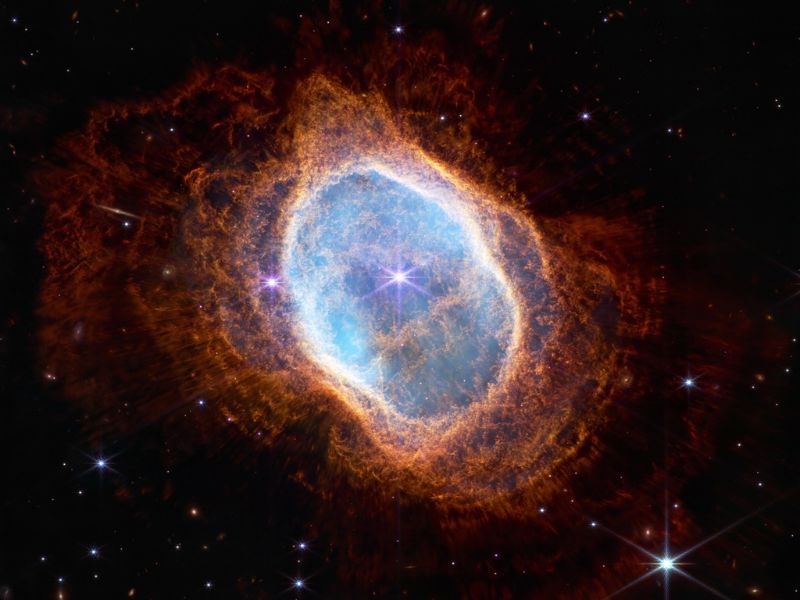
    The James Webb Space Telescope from NASA has initiated its examination of the famous supernova, SN 1987A, situated 168,000 light-years distant in the Large Magellanic Cloud.
    Credit: Pixaobay

    The James Webb Space Telescope from NASA has initiated its examination of the famous supernova, SN 1987A, situated 168,000 light-years distant in the Large Magellanic Cloud. This supernova has been under extensive scrutiny for nearly four decades, spanning from gamma rays to radio waves, since its detection in February 1987. Fresh observations using Webb’s NIRCam (Near-Infrared Camera) offer a vital piece of the puzzle in our comprehension of the gradual evolution of a supernova and its subsequent remnant formation.

    This image showcases a central configuration reminiscent of a keyhole. This central region is densely populated with clumpy gas and dust that was expelled during the supernova explosion. The dust is so compact that even the near-infrared light detected by Webb cannot pass through it, creating the dark “hole” within the keyhole shape.

    Hot Spots and Emissions Beyond the Ring

    Surrounding the inner keyhole is a vibrant, equatorial ring, creating a belt-like structure that connects two faint arms forming the outer rings, which resemble an hourglass. This equatorial ring is composed of material ejected tens of thousands of years prior to the supernova explosion and contains bright, hot spots. These hot spots emerged as the supernova’s shock wave collided with the ring. Now, similar spots are present even beyond the ring, accompanied by diffuse emissions around it. These spots mark the locations where the supernova shocks have encountered external material.

    Crescent-Like Structures Unveiled

    Although NASA’s Hubble and Spitzer Space Telescopes and Chandra X-ray Observatory have observed these structures to some extent, the unmatched sensitivity and spatial resolution of Webb have unveiled a novel feature within this supernova remnant: small crescent-like formations.

    Webb’s NIRCam (Near-Infrared Camera) captured this detailed image of SN 1987A (Supernova 1987A), which has been annotated to highlight key structures. At the center, material ejected from the supernova forms a keyhole shape. Just to its left and right are faint crescents newly discovered by Webb. Beyond them an equatorial ring, formed from material ejected tens of thousands of years before the supernova explosion, contains bright hot spots. Exterior to that is diffuse emission and two faint outer rings. In this image blue represents light at 1.5 microns (F150W), cyan 1.64 and 2.0 microns (F164N, F200W), yellow 3.23 microns (F323N), orange 4.05 microns (F405N), and red 4.44 microns (F444W). Credit: Science: NASA, ESA, CSA, Mikako Matsuura (Cardiff University), Richard Arendt (NASA-GSFC, UMBC), Claes Fransson (Stockholm University), Josefin Larsson (KTH), Image Processing: Alyssa Pagan (STScI)

    These crescent shapes are believed to constitute portions of the outer layers of gas propelled out from the supernova explosion. Their brightness may be a result of limb brightening, an optical phenomenon caused by our perspective of viewing the expanding material in three dimensions. In simpler terms, our viewing angle creates the illusion of there being more material in these two crescent regions than there might actually be.

    Webb’s Remarkable Image Resolution

    The exceptional resolution of these images is also worth noting. Prior to Webb, the now-retired Spitzer telescope observed this supernova in the infrared spectrum throughout its entire lifecycle, providing essential data on how its emissions evolved over time. However, it never achieved the same level of clarity and detail when observing the supernova.

    The Absent Neutron Star

    Despite decades of research since the initial discovery of the supernova, there are still several unsolved mysteries, particularly concerning the neutron star that should have formed in the aftermath of the supernova explosion. Much like Spitzer, Webb will continue to monitor the supernova’s progress over time.

    Its NIRSpec (Near-Infrared Spectrograph) and MIRI (Mid-Infrared Instrument) tools will enable astronomers to gather new, high-quality infrared data over time, shedding light on the recently identified crescent structures. Furthermore, Webb will maintain its collaboration with Hubble, Chandra, and other observatories, contributing fresh insights into both the historical and future aspects of this legendary supernova.


    Read the original article on: Phys Org

    Read more: New Method for Detecting Newborn Planets May Revolutionize Astronomy 

  • Astronomers Identify Twenty Ultraviolet-Emitting Supernova Remnants in the Andromeda Galaxy

    Astronomers Identify Twenty Ultraviolet-Emitting Supernova Remnants in the Andromeda Galaxy

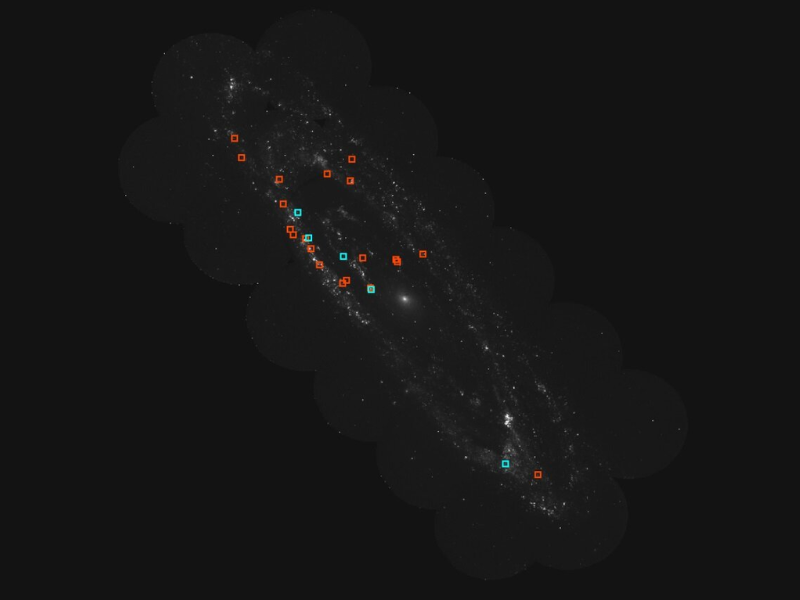
    Positions of the 20 SNRs with detected diffuse UV emission (red squares) and of the 5 SNRs with likely, but confused, diffuse emission (blue squares), overlaid on the image of the Andromeda Galaxy in the F148W filter. Credit: Leahy et al, 2023

    Utilizing the AstroSat satellite, astronomers from the University of Calgary, Canada, have identified twenty supernova remnants (SNRs) in the Andromeda Galaxy that exhibit diffuse ultraviolet emission. The finding, presented in a research paper released on January 25 on the arXiv preprint server, can help us better comprehend the beginning and properties of ultraviolet emission in SNRs.

    SNRs are diffuse, expanding frameworks resulting from a supernova explosion. They include ejected product expanding from the explosion and other interstellar product that has been swept up by the passage of the shockwave from the exploded star.

    Studies of supernova remnants

    Research studies of supernova remnants are essential for astronomers, as they play an essential function in the advancement of galaxies, dispersing the heavy elements made in the supernova explosion and offering the energy required for heating up the interstellar medium. SNRs are also presumed to be responsible for galactic cosmic rays’ acceleration.

    Although numerous extragalactic SNRs have been spotted to date, the ones showcasing ultraviolet (UV) emission are hard to find, mainly because of the solid interstellar termination for our galaxy in the UV. What is noteworthy, in spite of the recent progress in UV-based SNR research study, is that there doesn’t yet exist a catalog of extragalactic UV-emitting SNRs.

    That is why a group of astronomers conducted by Denis Leahy chose to perform a search for UV-emitting SNRs in the nearby Andromeda Galaxy (also called as Messier 31, or M31), intending to generate the first catalog of such things in another galaxy. They employed AstroSat’s Ultraviolet Imaging Telescope (UVIT) for this objective.

    “UV pictures of M31 were acquired by the Ultraviolet Imaging Telescope on the AstroSat satellite, and also the list of SNRs was obtained from X-ray, optical, and also radio catalogs of SNRs in M31. We used the UVIT pictures to find SNRs with diffuse emission, omitting those also contaminated with stellar emission,” the scientists wrote in the paper.

    Research Progress

    The team at first chose 177 SNRs to investigate whether or not they showcase diffuse ultraviolet emission. Out of the entire sample, 20 supernova residues ended up being UV emitters. The identified sources exhibit diffuse emission that is not connected with stars, although the strength of the diffuse emission varies.

    The astronomers contrasted the band luminosities of these twenty SNRs to the band luminosities of 7 formerly known UV-emitting SNRs in the Milky Way, Big Magellanic Cloud (LMC), and Small Magellanic Cloud (SMC). In outcome, they discovered similar spectral shapes in between the known SNRs and also the SNRs in the Andromeda Galaxy. The finding recommends that the UV emission from the supernova remnants reported in the paper is dominated by line emission, which this emission is connected with the SNRs.

    The research study’s authors suggest spectroscopic observations to validate the line nature of the UV emission from the recently determined SNRs. Nevertheless, they noted that it will be challenging to carry out spectroscopy for the typically crowded areas in the Andromeda Galaxy where these SNRs are located.


    Read the original article on PHYS.

    Read more: Earth’s Internal Core Rotation May Have Paused and Perhaps Reversed