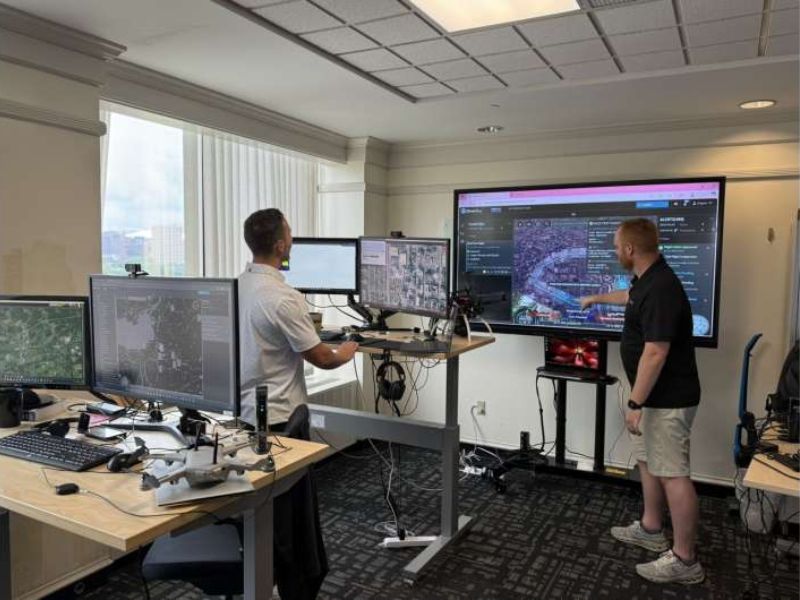
ResilienX employees Angelo Niforatos, left, and Ryan Pleskach, right, overview the NASA safety tools integrated into the company’s commercial system, July 11, 2025, at the ResilienX Headquarters in Syracuse, New York. Image Credits: ResilienX
As advanced air mobility aircraft become more common in U.S. airspace, the country will need improved preflight planning to address potential risks in advance—and NASA is creating the tools to support this effort.
Effective preflight planning is essential for maintaining safety in the increasingly complex and high-risk airspace of the future. Having a single platform that provides timely, predictive, and current risk assessments helps drone and air taxi operators quickly identify potential hazards in their flight plans.
Demonstrating NASA’s Risk-Assessment Tools in Commercial Aviation
NASA is creating tools to deliver these capabilities and, in June, teamed up with aviation safety firm ResilienX Inc. to demonstrate how commercial operators can integrate them into their operations.
During tests at ResilienX’s Syracuse, New York facility, researchers leveraged NASA services that enabled flight operators to submit flight plans before takeoff, receive risk assessment results, and decide whether to continue with the planned flight or modify it and reassess risks. This streamlined process helps minimize safety risks for both passengers and people on the ground.
The three NASA-developed services evaluate the specific risks that highly automated aircraft pose when operating at low altitudes in urban areas.
The collaboration was conducted through a Phase III NASA Small Business Innovation Research (SBIR) contract, building on earlier efforts to evaluate weather-related risks. This work is already enabling the direct integration of safety technologies into ResilienX’s platform. Additionally, the partnership aims to offer indirect advantages to ResilienX’s partners and clients—such as the U.S. Air Force and regional operators—contributing to the enhancement of overall safety in future airspace operations.
Although roboticists have developed increasingly sophisticated systems over the past decades, most current robots still lack the dexterity and sensory capabilities of human hands. As a result, their effectiveness in real-world tasks—such as household chores, disaster debris removal, and assembly or maintenance work is often limited, especially in high-temperature environments like steel mills and foundries, where extreme heat can impair performance and reduce the precision needed for safe and accurate operation.
Researchers at the University of Southern California have developed a new robotic hand called MOTIF (Multimodal Observation with Thermal, Inertial, and Force sensors), designed to enhance the object manipulation skills of humanoid robots. Detailed in a paper published on the arXiv preprint server, the MOTIF hand integrates multiple types of sensors, including tactile sensors, a depth sensor, a thermal camera, inertial measurement unit (IMU) sensors, and a visual sensor.
“Our work stemmed from the need to push robotic manipulation beyond conventional visual and tactile sensing,” explained Daniel Seita, Hanyang Zhou, Wenhao Liu, and Haozhe Lou in an interview with Tech Xplore. “Many current multi-fingered robotic hands lack the integrated sensory systems needed for tasks that require thermal perception and responsive touch feedback.”
Designing a Human-Inspired Robotic Hand for Versatile and Precise Object Manipulation
The primary goal of Seita and his team was to design a flexible, multimodal robotic hand inspired by the human hand—capable of handling objects with both care and accuracy. By incorporating richer sensory input, their robotic hand can manage more delicate and complex object interactions across diverse settings, from domestic environments to industrial workplaces.
“At the outset, our main idea was to explore how to design systems that better reflect the way humans perceive the world in daily life. Our inspiration came from observing human behavior,” said Zhou and Liu.
“In the past, we worked with several off-the-shelf dexterous robotic hands. We found that most existing hardware prioritizes mechanical transmission, and the commercially available models didn’t meet the sensory needs required for many of our research goals. That experience led us to pursue a customizable, DIY hardware platform that would give us the flexibility to design and refine systems according to our specific vision.”
According to the research team, “The MOTIF hand is a sophisticated robotic platform that integrates multiple sensing technologies thermal, depth, RGB visual, inertial (IMU), and tactile into a single, dexterous unit. It builds upon the popular LEAP hand design, offering expanded sensing capabilities. Its standout features include a high level of environmental awareness, safe interaction with hot objects, and the ability to distinguish between items that look similar but have different physical characteristics.”
The MOTIF hand, the robotic hand developed by the researchers. Image Credits: Zhou et al
Evaluating Temperature-Aware Grasping Through Controlled Laboratory Experiments
To assess the capabilities of the MOTIF hand, the research team conducted two separate experiments in a controlled lab environment. The first focused on the hand’s ability to grasp objects while taking surface temperature into account, helping it avoid contact with dangerously hot areas.
The second experiment tested the hand’s capacity to distinguish between objects of identical shape but differing weights. For this task, the hand used simple fingertip flicking motions to estimate each object’s mass.
“The key achievement of our work is the successful integration of multiple sensor types into a single dexterous robotic hand, which greatly enhances its manipulation abilities,” said Lou. “Our results demonstrate that thermal sensing paired with 3D reconstruction supports safer grasping, while inertial sensing enables accurate mass classification.”
Promising Early Results and Future Plans for Real-World Deployment
In early trials, the MOTIF hand performed impressively grasping various items safely and estimating their weight with notable precision. Looking ahead, the researchers plan to refine the hand further and test it in broader scenarios to explore its potential in real-world applications.
Seita and his team believe the hand holds strong promise for use in domestic tasks, commercial kitchens, and industrial settings. With its ability to handle hot objects safely and perform fine manipulation, it could surpass current robotic systems in applications like cooking, welding, or fastening components tasks that demand both force sensitivity and adaptation to varying object temperatures.
“In the future, we plan to further improve the MOTIF hand by incorporating high-resolution fingertip sensors, such as the Digit 360, to achieve even more detailed tactile feedback,” Liu said. “We also intend to enhance our multimodal sensing algorithms and investigate new applications in complex real-world scenarios, including advanced in-hand manipulation and settings that demand intricate thermal and force-based interaction.”
“This work introduces a platform system,” Zhou added. “We presented it last week at the ISER 2025 conference in Santa Fe, where we had the opportunity to exchange ideas with many outstanding researchers. Our hope is that this project will encourage the community to explore additional sensing modalities in their own research.”
On Tuesday, Microsoft announced it was streamlining management and leveraging new technology, amid reports of thousands of employee layoffs.
The AI-driven tech giant did not reveal the exact number of job cuts, but U.S. media reports estimate around 6,000 positions, roughly 3% of its global staff.
According to a filing with Washington state’s labor agency, this included 1,985 employees based in Microsoft’s home state.
Microsoft Cites Market Shifts in Ongoing Organizational Changes
“We are making organizational adjustments to better position the company for success in a rapidly changing market,” a Microsoft spokesperson said in an emailed statement.
The company, progressing with its AI integration across all products, also stated it aims to “enable employees to dedicate more time to meaningful tasks by utilizing new technologies and tools.”
Two weeks ago, Microsoft reported strong quarterly earnings for the January to March period, driven by impressive growth in its cloud computing and AI sectors.
Celebrating its 50th anniversary this year, Microsoft was among the first major tech firms to heavily invest in artificial intelligence after ChatGPT’s 2022 debut shook the industry.
We use cookies on our website to give you the most relevant experience by remembering your preferences and repeat visits. By clicking “Accept All”, you consent to the use of ALL the cookies. However, you may visit "Cookie Settings" to provide a controlled consent.
This website uses cookies to improve your experience while you navigate through the website. Out of these, the cookies that are categorized as necessary are stored on your browser as they are essential for the working of basic functionalities of the website. We also use third-party cookies that help us analyze and understand how you use this website. These cookies will be stored in your browser only with your consent. You also have the option to opt-out of these cookies. But opting out of some of these cookies may affect your browsing experience.
Necessary cookies are absolutely essential for the website to function properly. These cookies ensure basic functionalities and security features of the website, anonymously.
Cookie
Duration
Description
cookielawinfo-checkbox-analytics
11 months
This cookie is set by GDPR Cookie Consent plugin. The cookie is used to store the user consent for the cookies in the category "Analytics".
cookielawinfo-checkbox-functional
11 months
The cookie is set by GDPR cookie consent to record the user consent for the cookies in the category "Functional".
cookielawinfo-checkbox-necessary
11 months
This cookie is set by GDPR Cookie Consent plugin. The cookies is used to store the user consent for the cookies in the category "Necessary".
cookielawinfo-checkbox-others
11 months
This cookie is set by GDPR Cookie Consent plugin. The cookie is used to store the user consent for the cookies in the category "Other.
cookielawinfo-checkbox-performance
11 months
This cookie is set by GDPR Cookie Consent plugin. The cookie is used to store the user consent for the cookies in the category "Performance".
viewed_cookie_policy
11 months
The cookie is set by the GDPR Cookie Consent plugin and is used to store whether or not user has consented to the use of cookies. It does not store any personal data.
Functional cookies help to perform certain functionalities like sharing the content of the website on social media platforms, collect feedbacks, and other third-party features.
Performance cookies are used to understand and analyze the key performance indexes of the website which helps in delivering a better user experience for the visitors.
Analytical cookies are used to understand how visitors interact with the website. These cookies help provide information on metrics the number of visitors, bounce rate, traffic source, etc.
Advertisement cookies are used to provide visitors with relevant ads and marketing campaigns. These cookies track visitors across websites and collect information to provide customized ads.