Tag: Turbine

  • Micro Wind Turbine for Rooftops Earns Landmark Certification

    Micro Wind Turbine for Rooftops Earns Landmark Certification

    Credit: Depositphotos

    German company SkyWind has become the first manufacturer to secure full certification for its compact NG wind turbine. Designed for easy installation on residential rooftops, these small yet efficient devices offer homeowners a way to supplement grid electricity with clean, renewable power.

    A Different Approach from Giant Turbines

    Large-scale wind turbines usually dominate the spotlight in renewable energy. In 2023, for instance, China launched the world’s largest wind turbine with a 260-meter (853-ft) diameter, only to surpass it a year later with an even larger model featuring 310-meter (1,107-ft) blades. While such massive installations can power thousands of households, SkyWind has focused on a more accessible, user-oriented solution for harnessing wind.

    The NG micro turbine first appeared in 2009, when company founder Fritz Unger presented his patented single-blade design at a young researchers’ competition. Since then, more than 10,000 units have been sold and deployed in settings ranging from private homes to mountain ski lodges.

    Rigorous Testing and Certification

    Recently, SkyWind achieved a new milestone by becoming the first firm worldwide to receive full certification from the ICC Small Wind Certification Council. The process, carried out in Utah, included two years of rigorous testing to confirm the turbine’s energy output, safety, reliability, and long-term performance.
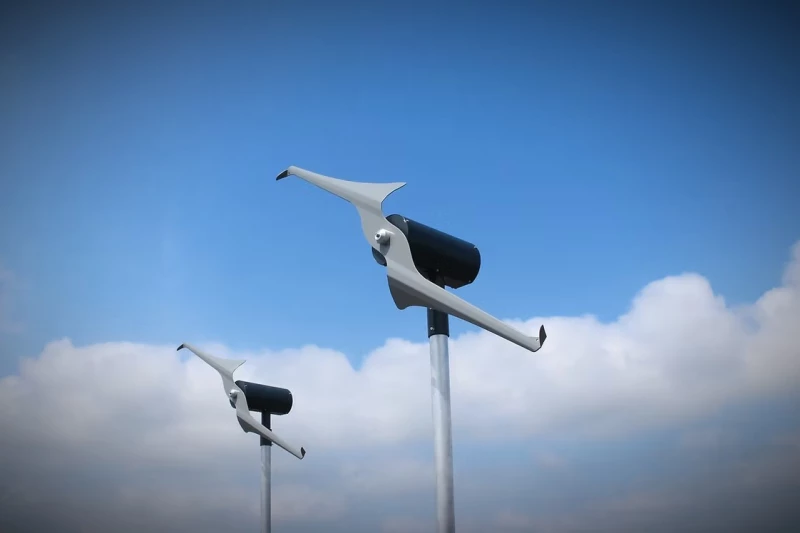
    The NG’s single rotor measures only 1.5 m (4.92 ft) in diameter, making it about the size of a satellite dish
    SkyWind

    Each NG turbine is certified to generate 615 kWh of electricity per year. Although this represents only about 6% of the average American household’s annual consumption of 10,791 kWh, homeowners can install multiple units to increase capacity. Alternatively, a single turbine can serve specific purposes, such as powering lighting in a garage or an outbuilding. SkyWind also highlights that its turbines tend to perform best during stormy weather, when solar panels are less effective, making the two technologies a strong complement.

    Compact Design with Smart Features

    Compact in size—comparable to a rooftop satellite dish at 1.5 m (4.92 ft) in diameter—the NG turbines are quiet, feature onboard monitoring systems, and include automatic braking and storm-shutdown capabilities. Each unit is priced at €2,949 (about US$3,450).

    SkyWind achieved an important milestone by securing SWCC certification, said Unger, now the company’s CEO. It demonstrates our dedication to thorough testing and global quality standards, while giving customers confidence in the durability and performance of our turbines.


    Read the original article on: New Atlas
    Read more: The Price Of Keeping Wind Turbines Out Of Sight

  • Old Wind Turbine Blades Recycled Into Stronger Plastics

    Old Wind Turbine Blades Recycled Into Stronger Plastics

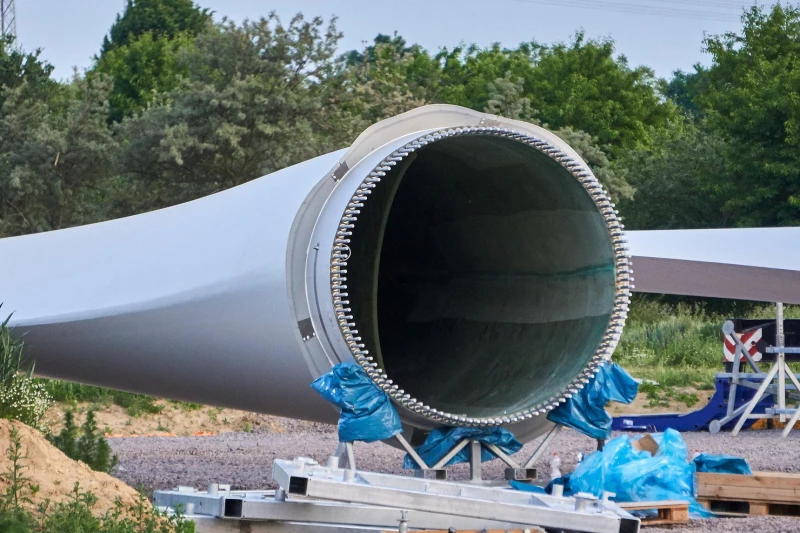
    Wind turbine blades are absolutely enormous, and those from the 1990s that are now at the end of their life are hard to recycle
    Enrique / Pixabay

    Recycling massive wind turbine blades challenges researchers because they use ultra-durable materials designed to withstand harsh conditions for decades.However, researchers at Washington State University have developed a smart way to take advantage of these properties and turn discarded blades into tough, long-lasting plastics—without using harsh chemicals.

    Difficulty in Breaking Down Reinforced Material

    The main difficulty lies in breaking down the lightweight, hardened material used in many older blades from the 1990s: glass fiber-reinforced polymer (GFRP). Instead of fully breaking the material’s chemical bonds, the researchers found a more efficient approach.

    “For this work, we didn’t need to fully break down all the bonds and push the reaction to completion,” explained Baoming Zhao, co-author of the study published in Resource, Conservation, and Recycling. “As long as we can break the cross-linked network into smaller pieces that are melt-processable, we can mix them with nylon and create a new composite.”

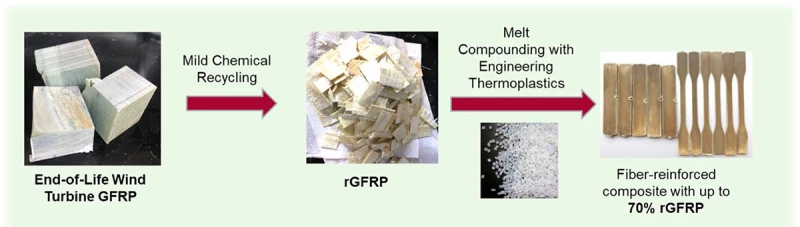
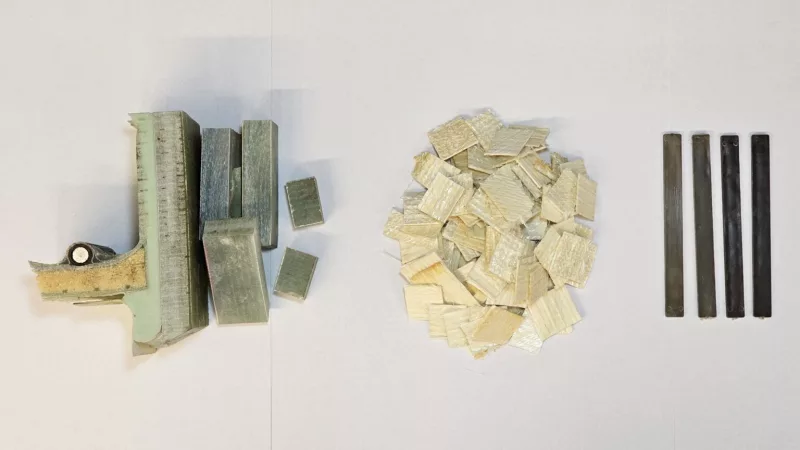
    Left: wind turbine blade waste. Middle: treated and dried wind turbine blade glass-fiber reinforced polymer (GFRP). Right: injection-molded plastic containing 70% recycled GFRP
    Washington State University

    The process begins by cutting discarded turbine blades into 2-inch (5 cm) blocks, then shredding those into chips.The researchers soak these chips in a mild solution of zinc acetate (a low-toxicity organic salt) in superheated, pressurized water for two hours.

    Promising Results in Material Performance

    The researchers recover intact glass fibers and resin using this method, then blend them with melted thermoplastics—like those found in milk bottles—and nylon to create high-performance composite materials. The resulting recycled nylon plastic proved to be over three times stronger and eight times stiffer than standard versions.

    Turbine blades are chopped into blocks, shredded into chips, treated with a solution to recover fibers and resins, and then melted with thermoplastics to produce stronger materials
    Washington State University

    The process also brings other advantages.The team filters and reuses the zinc acetate catalyst and also applies the technique to other widely used plastics, such as polypropylene, which appears in food containers, toys, and office supplies.

    This innovation turns used turbine blades into valuable resources for plastic recycling facilities, all while preserving an environmentally friendly process. The researchers now work to lower the pressure requirements of their method to boost scalability and are also exploring recyclable materials for producing new turbine blades.

    Wind turbine blades are made from composite materials that can withstand harsh weather conditions for decades
    Markus Distelrath / Pixabay

    If you’re into this kind of innovation, you might also enjoy other creative ideas for reusing wind turbine blades—like turning them into surfboards, road materials, or floating docks for saunas. Companies like Siemens Gamesa and GE are already producing recyclable blades, and bio-based resins could one day help decompose them more easily after use.


    Read the original article on: New Atlas

    Read more: Recycled Wind Turbine Blades Turned into Asphalt for New Roads

  • Another Turbine World Record – But This Time, Not By China

    Another Turbine World Record – But This Time, Not By China

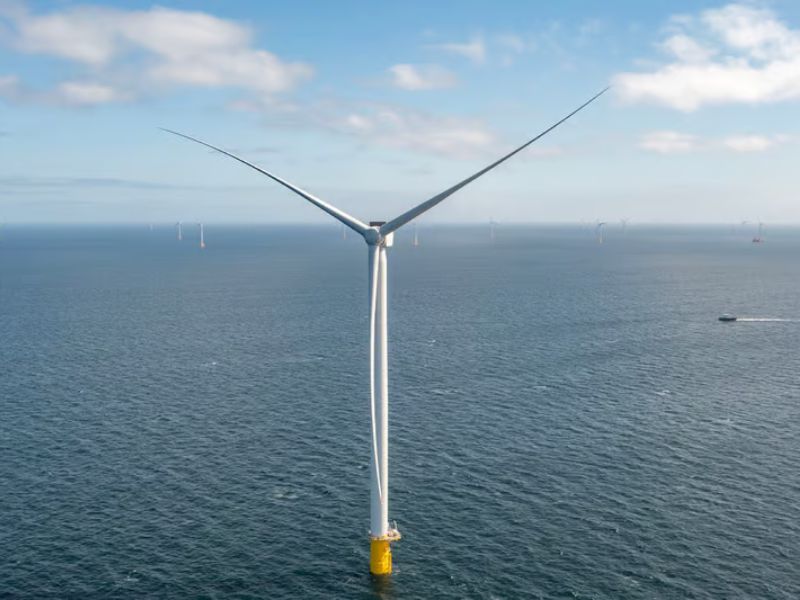
    The SG DD-276 turbine spans over three football fields across with a 21.5 MW capacity
    Siemens Gamesa

    In the ever-competitive game of “who builds it bigger,” China has stepped aside for now as European company Siemens Gamesa sets a new world record with a massive wind turbine installed at the Østerild test field in Denmark.

    A Giant Among Giants

    While the lead wasn’t huge, the achievement is still remarkable. The Siemens SG DD-276 turbine spans an impressive 276 meters (905 feet) from blade tip to blade tip and has a rated capacity of 21.5 megawatts (MW) — enough to power around 70,000 Danish homes annually. Throughout its operational lifetime, the turbine is expected to prevent the emission of approximately 55,454 tons of CO₂ that fossil fuel energy would otherwise produce.

    This technological leap came with a hefty price tag. The European Union contributed €30 million (around US$33 million) through its innovation fund to support Siemens Gamesa’s HIPPOW project (Highly Innovative Prototype of the most Powerful Offshore Wind — yes, that’s the acronym).Although Siemens Gamesa hasn’t disclosed the Levelized Cost of Energy (LCOE) for this turbine yet, Denmark reported offshore wind costs of around €46 per megawatt-hour (MWh) in 2018.

    Siemens Gamesa has been in the wind power game since 1991 and was behind the installation of 11 turbines in the world’s first offshore wind farm at Vindeby, Denmark. The SG DD-276 marks the 5,000th turbine installed by the company, across 14 countries, with a total installed capacity exceeding 27 GW.

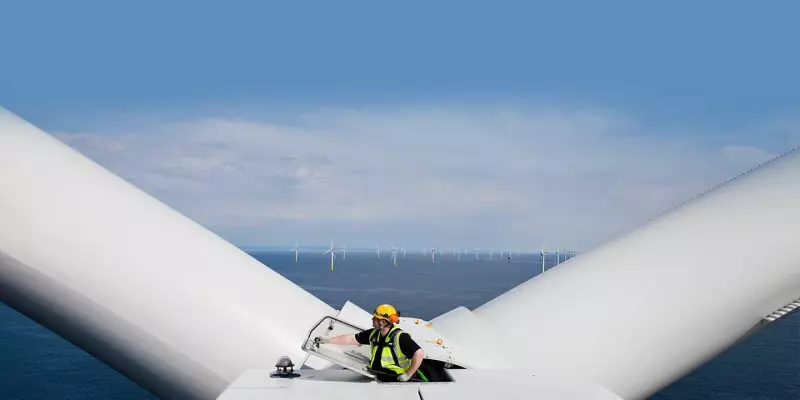
    A worker atop an offshore Siemens Gamesa turbine
    Siemens Gamesa

    Previously, China’s Mingyang Smart Energy held the record with its 20 MW MySE18.X turbine, which had surpassed the 18 MW offshore model from Dongfang Electric Corporation. But in such a fast-paced industry, records don’t last long.

    The Next Generation Is Already on the Horizon

    In fact, Dongfang has already completed a 26 MW turbine that has yet to be deployed, while Mingyang has announced plans for next-generation 22 MW turbines. Once either of those go live, Siemens will likely lose the top spot.

    Adding to the uncertainty, recent tariff escalations between the US, EU, and China may disrupt the supply of critical minerals and rare earth elements — such as those used in circuit boards and neodymium magnets — since China controls much of the global supply chain. That means this latest record may not last for long.


    Read the original article on: New Atlas
    Read more: First U.S. Onshore Wave Energy Project Receives Green Light