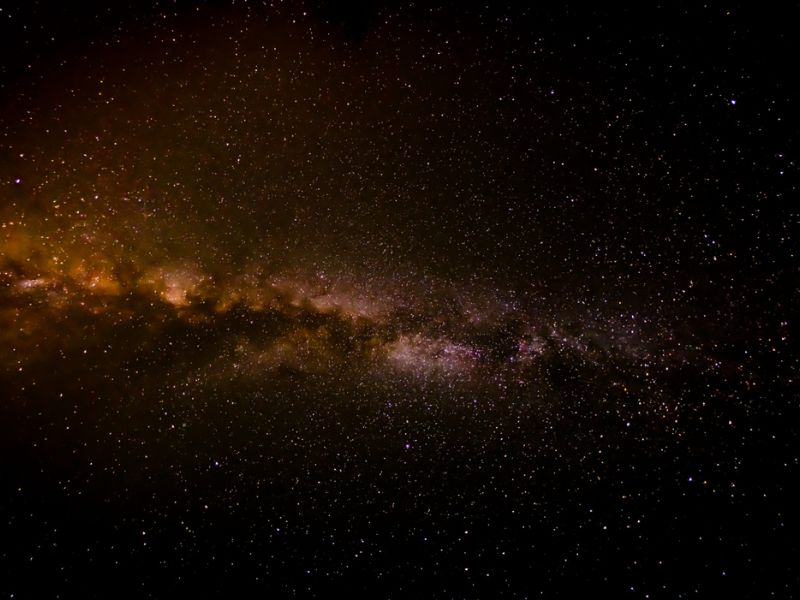

Astronomers have discovered “Quipu,” possibly the universe’s largest structure, spanning 1.3 billion light-years—over 13,000 times the Milky Way’s size, Live Science reports.
The Controversy of the Hercules-Corona Borealis Great Wall
Previously, the Hercules-Corona Borealis Great Wall—situated 10 billion light-years from Earth and spanning a similar length—was regarded as the universe’s largest structure. However, scientists still dispute whether it truly exists.
While analyzing the data, scientists discovered Quipu along with four additional megastructures. The ArXiv study (pending peer review) reports that these five structures contain 45% of galaxy clusters, 30% of known galaxies, and 25% of observable matter.

The authors noted in the paper that “Quipu is so prominent that it can be spotted with the naked eye on a sky map of galaxy clusters within the studied redshift range, without relying on any specialized detection technique.”
What Are Cosmic Superstructures?
Structures such as Quipu are immense assemblies of galaxy clusters, smaller groups, and individual galaxies that typically aren’t gravitationally bound together. A well-known example is the Laniakea supercluster, home to the Milky Way.
The research indicates that Quipu plays a major role in shaping the movement of our cosmic neighborhood. Scientists say it drives much of the Local Group’s unusual motion relative to the Cosmic Microwave Background (CMB). Still, more studies are required to fully grasp how this structure affects its surrounding region of the universe.
Although Quipu is immense, it won’t persist as a single structure indefinitely. Researchers predict that, with ongoing cosmic evolution, it will gradually break apart into smaller segments that will eventually collapse.
The Future Fate of Cosmic Superstructures
The study points out that “as the universe continues to evolve, these superstructures will inevitably divide into multiple collapsing units.”
Although temporary, they exhibit distinctive characteristics and exist in unique cosmic environments, which makes them especially valuable to astronomers.
Investigating a system as vast as Quipu offers insights into how galaxies form and evolve, while also helping refine cosmological models.
Read the original article on: Think Move Make
Read more: A High-Tech Capsule for Stomach Diagnostics