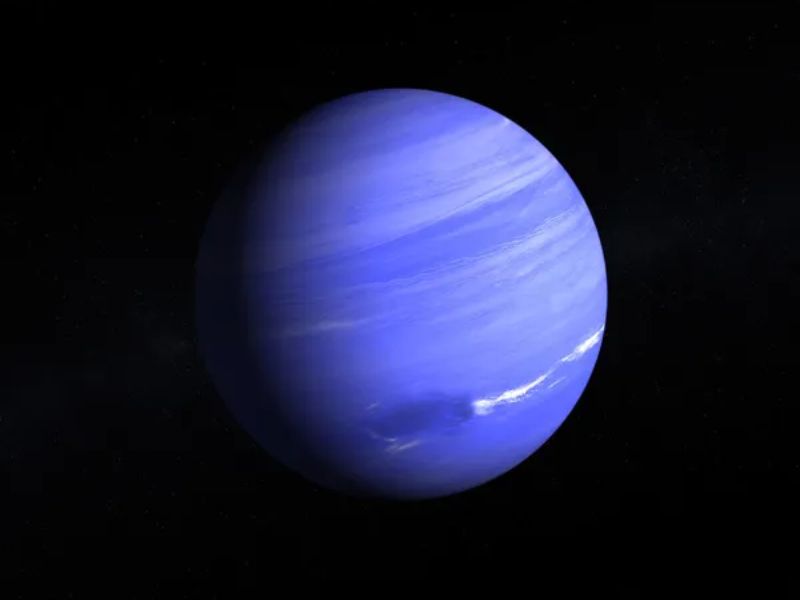

Challenging long-held assumptions, new NASA research reveals that Uranus isn’t as frigid as once thought. Contrary to previous beliefs, the ice giant actually generates internal heat, much like other planets in the solar system.
A Planet That Defies Expectations
In a planetary lineup filled with oddballs, Uranus still manages to stand out. As the seventh planet from the Sun, it has baffled astronomers ever since William Herschel discovered it in 1731. For centuries, Uranus remained largely mysterious — that is, until the 1986 flyby of Voyager 2 and the emergence of advanced Earth- and space-based telescopes began to shed light on its peculiarities.
We now know Uranus spins with an extreme axial tilt, essentially rolling through space on its side. This leads to bizarre seasons, with each pole basking in 42 years of continuous sunlight before plunging into 42 years of darkness. Its rotation is retrograde, spinning in the opposite direction of most other planets except Venus. To add to the weirdness, its magnetic field is tilted 60 degrees off-axis.

NASA/ ESA/ CSA/ STScI
There’s also speculation that it rains diamonds deep within its atmosphere, where high pressures may compress methane into carbon crystals.
The Coldest Atmosphere in the Solar System
And yes — it’s cold. Bitterly cold. In fact, Uranus holds the record for the coldest atmosphere among planets that still retain a gaseous envelope, dipping as low as -224 °C (-371.2 °F). It’s long been considered a planet that simply couldn’t retain or generate much heat.
At least, that was the prevailing theory.
For years, scientists believed Uranus lacked any internal heat source. When calculating the energy it receives from the Sun versus the amount it radiates back into space, the numbers balanced out — suggesting a net-zero energy profile. This was odd, considering that other gas giants like Jupiter, Saturn, and Neptune emit significantly more heat than they absorb.
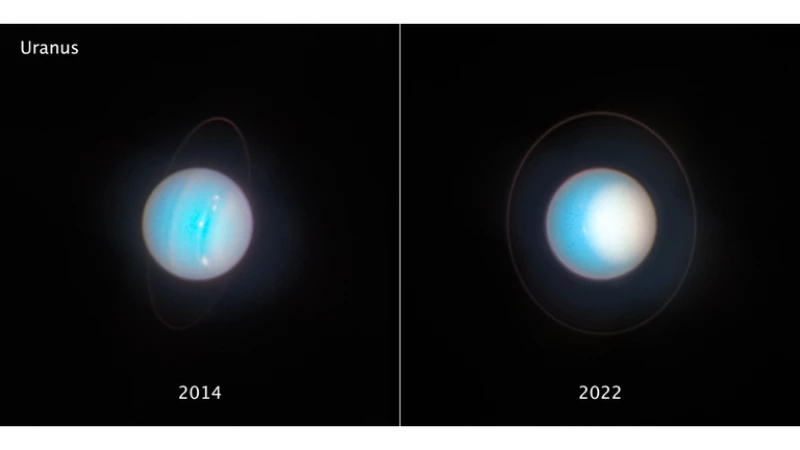
: NASA/ ESA/ STScI, A. Simon (NASA-GSFC)/ M. H. Wong (UC Berkeley)/ J. DePasquale (STScI)
This anomaly posed a scientific puzzle. If Uranus wasn’t producing internal heat, was it older than the rest of the planets? Could a colossal impact — the same one that possibly knocked it onto its side — have stripped away its heat?
But there was a major limitation: all these assumptions were based on a single brief dataset from Voyager 2’s flyby nearly 40 years ago.
A New Look at Uranus’s Energy Output
A fresh investigation led by Amy Simon of NASA’s Goddard Space Flight Center, in collaboration with Oxford University, has now cast serious doubt on those earlier conclusions. By incorporating decades of data from both ground-based and space observatories — including the Hubble Space Telescope and the Infrared Telescope Facility in Hawaii — the team built a more comprehensive picture of Uranus’s energy dynamics.
This new analysis factored in how Uranus absorbs, reflects, and emits radiation in all directions. The researchers also accounted for its atmospheric composition, cloud structures, and seasonal variations in a refined computer model.
In short, they re-ran the calculations — with much better input.
Their findings? Uranus actually emits about 15% more energy than it absorbs throughout its 84-year orbit. While this thermal excess is modest compared to its neighbor Neptune, it’s a notable shift from previous assumptions.
According to NASA, this discovery has broader implications. It not only challenges long-standing views about Uranus’s age and thermal history, but it also helps refine models of solar system formation and planetary migration. Furthermore, it offers valuable context for studying Uranus-like exoplanets beyond our solar system.
Read the original article on: New Atlas
Read more: We Were Wrong About Uranus: New Study Solves Long-Standing Mysteries