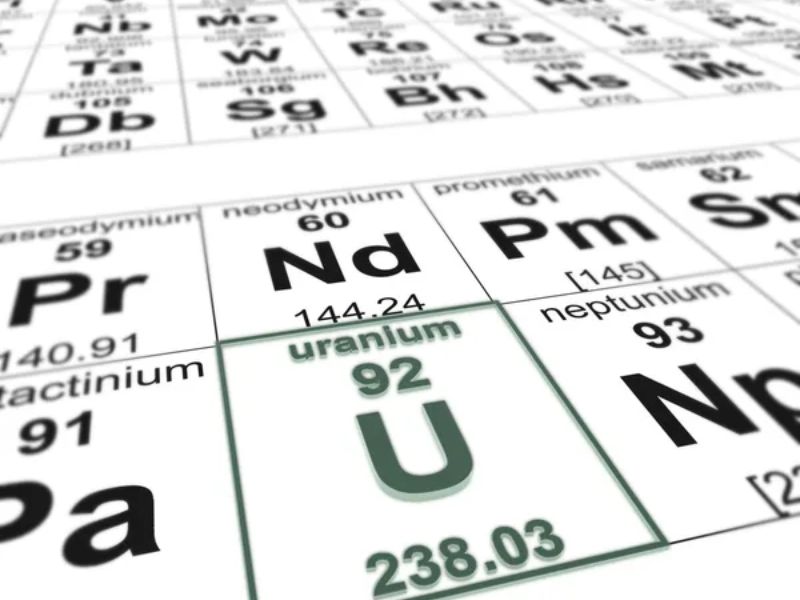

When people hear “uranium,” they often picture mushroom clouds, Cold War tensions, or glowing green rods straight out of science fiction.
But uranium is more than just a symbol of nuclear threat—it’s a relatively common element with vital uses in energy production, medical treatments, and global politics.
The element returned to international focus in June 2025, after U.S. military strikes targeted Iranian facilities suspected of storing highly enriched uranium—sparking renewed debate over nuclear proliferation.
News reports frequently cite Iran’s uranium being enriched to 60%, but what does that percentage actually signify?
As a biochemist, I’m keen to help clear up the confusion surrounding this frequently misunderstood element.
A Naturally Radioactive Element with Powerful Energy Potential
Uranium, number 92 on the periodic table, is a radioactive metal that naturally breaks down over time, releasing energy—a process known as radioactivity. This trait is shared with other elements like thorium and radium.
First identified in 1789 by German chemist Martin Heinrich Klaproth, uranium was named after the recently discovered planet Uranus. Its true potential, however, wasn’t realized until the 20th century, when scientists learned that uranium atoms could undergo nuclear fission—a reaction in which an atom’s nucleus splits into smaller parts, releasing a significant amount of energy.
Uranium is surprisingly widespread in nature, found in rocks, soil, water, and even trace amounts in plants and animals. The bulk of usable uranium is extracted from the Earth’s crust and then refined to increase the concentration of its most fissionable isotope: uranium-235.
A Unique Isotope with the Same Identity but a Different Mass
Uranium-235 is one of several isotopes of uranium—variations of the same element that differ slightly in mass. Think of it like apples from the same tree: some are larger, some smaller, but all are still apples. In the same way, isotopes share the same chemical identity but have different weights.
Naturally occurring uranium is mostly made up of uranium-238, with only about 0.7% consisting of uranium-235—the isotope most effective for sustaining nuclear fission. Because of this, uranium must be enriched to increase the concentration of uranium-235.
This enrichment process makes uranium more suitable for use in nuclear reactors or weapons, since the natural form doesn’t contain enough uranium-235 to be efficient. Typically, enrichment involves three main steps.
How Spinning Gas Distinguishes Uranium-235 from Uranium-238
The process begins by converting uranium into a gas known as uranium hexafluoride. Next, this gas is fed into a high-speed centrifuge—a device that spins rapidly. Since uranium-235 is slightly lighter than uranium-238, it doesn’t move outward as quickly during the spinning process, allowing the two isotopes to be separated.
It’s a bit like using a salad spinner to dry lettuce—the separation happens gradually. A single spin doesn’t do much, so the gas passes through a series of centrifuges to steadily increase the concentration of uranium-235.
For nuclear power plants, uranium is usually enriched to about 3% to 5%, which is sufficient to produce electricity. When enrichment reaches 20%, it’s classified as highly enriched uranium. Once it hits 90% or more, it becomes weapons-grade—suitable for use in nuclear weapons.


Weapons-grade uranium is effective in nuclear weapons because it can support a rapid, uncontrolled chain reaction, releasing far more energy than other isotopes.
Although uranium is often in the news for its military applications, it also serves important roles in everyday life. At low enrichment levels, it generates nearly 10% of the world’s electricity.
Powering Homes and Advancing Medical Treatments
In the United States, many nuclear power plants use uranium fuel to produce clean, carbon-free energy. Beyond power generation, uranium is also used in certain cancer treatments and diagnostic imaging tools in medicine.


In naval engineering, enriched uranium fuels nuclear-powered submarines and aircraft carriers, enabling them to run quietly and efficiently for extended periods without refueling.
Uranium represents a powerful duality. Mined from ancient geological formations, it holds the potential to either power entire cities or obliterate them. It’s not just a symbol from Cold War history or science fiction—it’s a very real and influential force in our world today, shaping everything from global politics and warfare to cancer treatments and clean energy production.
Ultimately, the true power of uranium lies not just in its energy, but in the choices humanity makes about how to harness it.
Read the original article on: Science Alert
Read more: New AI Weather Model Surpasses Leading Global Forecasting Systems