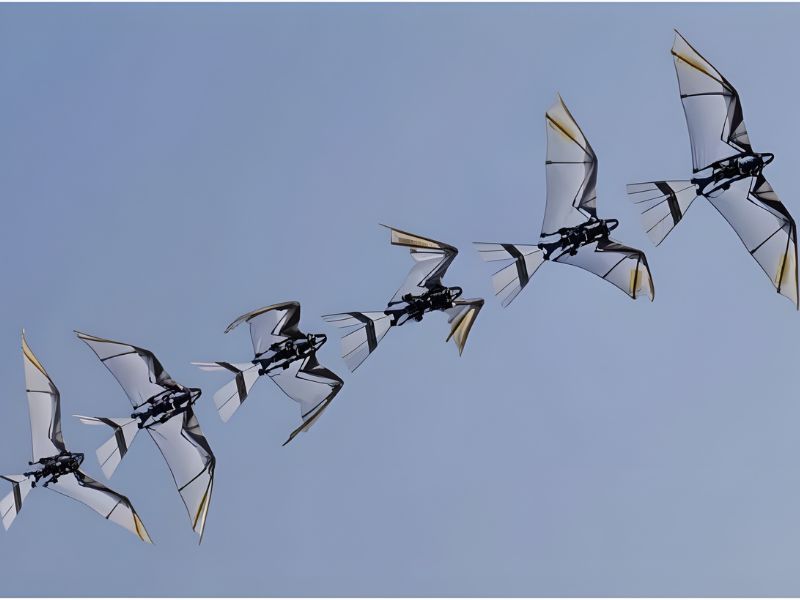

In 2021, Chinese scientists developed the RoboFalcon, a bird-inspired flapping-wing robot featuring a new mechanism that powered bat-like morphing wings for flight. Although effective at cruising speeds, the robot was unable to fly at lower speeds or take off independently.
The same research team has now refined their design, unveiling RoboFalcon 2.0 in Science Advances. This upgraded version features an 800 g body and reconfigurable wing mechanisms that integrate flapping, sweeping, and folding within a single wingbeat. The enhanced system enables unassisted takeoff and sustained low-speed flight.
Advancing from Single-DOF to Three-DOF Wing Kinematics
Previously, most bio-inspired flying robots relied on single degree-of-freedom (DOF) wing motion, mimicking the symmetrical hovering of insects or hummingbirds. In contrast, larger birds and bats employ three DOF kinematics—flapping, sweeping, and folding. The researchers built reconfigurable mechanisms with decouplers, enabling flapping, sweeping, and folding (FSF) in a single wingbeat.
The study notes that RoboFalcon 2.0 achieves bird-style takeoff by using ventral anterior downstrokes and tucked upstrokes to generate lift and thrust. The sweeping and folding amplitudes can also be adjusted to control pitch and roll during flapping.”
The researchers evaluated their design through wind tunnel experiments, simulations, and real-world flight tests. Wind tunnel and simulations showed that increased wing sweep boosts lift and pitching momentum, aiding takeoff and control. The team further confirmed these FSF wing motion capabilities during actual flight demonstrations.
Challenges and Future Improvements for RoboFalcon 2.0
Though RoboFalcon 2.0 achieves self-takeoff and advances life-like flight, improvements are needed—such as a tail elevator for high-speed stability, better takeoff efficiency, and yaw control for hovering.
The authors note that their mechanisms better replicate vertebrate low-speed flight, simplify control with underactuation, and enable a novel flapping takeoff—offering new insights for avian-inspired robotics and locomotion research.
Read the original article on: Techxplore
Read more:Innovative Label-Free Biosensor Boosts Progress in Monoclonal Antibody Manufacturing