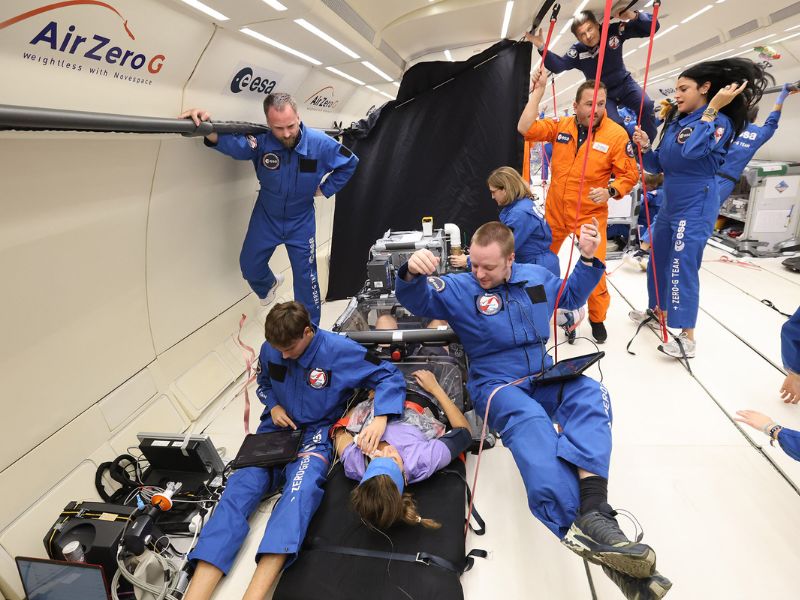

The microgravity encountered during spaceflight can threaten astronauts’ cardiovascular health. Finding effective ways to reduce these risks is difficult because countermeasures are typically evaluated under Earth’s gravity. But what if research could be conducted in microgravity conditions without having to leave the atmosphere?
Texas A&M Researchers Test Microgravity in France
Researchers from Texas A&M University are taking part in parabolic flights run by Novespace in Bordeaux, France, which generate short periods of microgravity through a sequence of upward and downward parabolic maneuvers.
“It’s like a rollercoaster drop lasting 22 seconds, but without the rushing wind,” said Huc Pentinat Llurba, the aerospace engineering student leading the project. “It was the most extraordinary experience of my life—you really feel like an astronaut.”
During each 22-second microgravity interval, the team tests countermeasures to reduce spaceflight health risks from fluid shifts.
Testing LBNP to Counteract Fluid Shifts in Microgravity
One method being tested is lower body negative pressure (LBNP). Using an LBNP chamber developed by Austin-based Technavance, Texas A&M researchers can expose participants’ lower bodies to a vacuum-like environment. This helps shift fluids from the upper body back down, reducing risks like jugular vein thrombosis and elevated blood pressure.

The Bioastronautics and Human Performance Laboratory, under the direction of Dr. Ana Diaz Artiles, has been evaluating how effectively LBNP can counteract fluid shifts in Earth-based microgravity simulations.
The parabolic flights, offered by the European Space Agency, allow for one of the most thorough and systematic investigations of this countermeasure in true microgravity conditions.
“Parabolic flights provide a chance to test LBNP in real microgravity, helping us confirm the results we observed in our Earth-based studies,” said Diaz Artiles, associate professor of aerospace engineering.
Initial findings are encouraging, showing LBNP produces the expected fluid shifts and shows promise as a spaceflight countermeasure.
Assessing LBNP’s Impact on Cardiovascular Health in Space
Researchers have completed one of the four parabolic flights scheduled over the next 18–24 months. They assess how different LBNP levels affect cardiovascular function by measuring jugular vein flow, heart rate, and blood pressure.
By studying spaceflight’s effects on cardiovascular health, the team can guide space agencies on needed astronaut countermeasures.
“Gaining a deeper understanding of the body’s physiological responses to LBNP in microgravity will allow us to develop personalized countermeasures for astronauts, tailored to their specific health risks and physiological profiles,” said Diaz Artiles.
This global collaborative project offers students like Pentinat Llurba a distinctive learning experience. Parabolic flights are a rare opportunity, and Diaz Artiles takes pride in giving her students access to them.
Other partners in the project include Universidad Carlos III de Madrid, the University of California Davis, the University of Florida, the Spanish Space Agency, Centro de Instrucción de Medicina Aeroespacial, and Lockheed Martin.
Read the original article on: Phys.Org
Read more: Scientists Create a Spacesuit with Artificial Muscles to Reduce Astronaut Strain