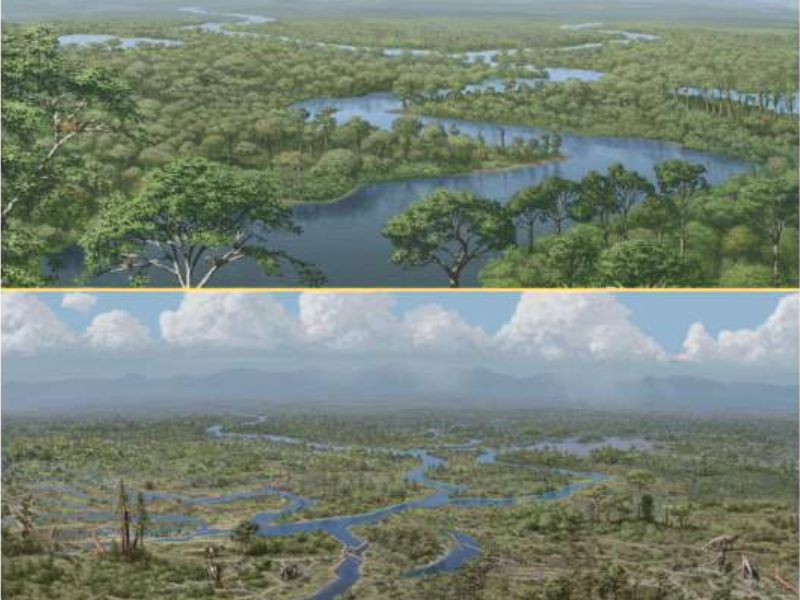

According to a study from the University of Michigan, dinosaurs influenced Earth so profoundly that their abrupt extinction caused widespread landscape transformations—including alterations in river patterns—which are now preserved in the geologic record.
Scientists have long noticed a sharp contrast in rock formations from the time just before and just after the dinosaurs’ extinction. Traditionally, they attributed these differences to factors like rising sea levels or other non-living (abiotic) causes. However, new research led by University of Michigan paleontologist Luke Weaver reveals a different story: the disappearance of dinosaurs allowed forests to thrive, which significantly altered river systems.
Weaver and his team studied sites across the western United States where dramatic geologic shifts occurred at the boundary between the age of dinosaurs and the age of mammals.
Dinosaurs as Ecosystem Engineers: Shaping Rivers Through Vegetation Disruption
Their analysis suggests that dinosaurs acted as powerful “ecosystem engineers,” heavily disturbing vegetation by trampling or consuming it, which left landscapes open and sparse. This, in turn, led to wide, unconfined rivers. When the dinosaurs went extinct, forests began to grow unchecked, stabilizing the soil and guiding rivers into broader, more winding paths.
Published in Communications Earth & Environment, their findings highlight how quickly Earth’s surface can transform in the wake of catastrophic events.
“We often think of environmental change as being driven by shifts in climate or tectonics,” said Weaver, assistant professor at U-M’s Department of Earth and Environmental Sciences. “But this study shows that life itself—like the presence or absence of large animals—can reshape both climate and landscapes. The influence goes both ways.”
The Impact of the Chicxulub Asteroid
Dinosaurs went extinct after a massive asteroid struck the Yucatán Peninsula. Scientists searching for evidence of this event observed a clear contrast between the rock layers above the impact debris and those beneath it.
Intrigued by this sudden geological shift, Luke Weaver, along with co-authors Tom Tobin from the University of Alabama and Courtney Sprain from the University of Florida, began studying the phenomenon in the Williston Basin—a region that covers eastern Montana, western North and South Dakota, and parts of north-central Wyoming’s Bighorn Basin.
Their curiosity about this geologic mystery was sparked during graduate fieldwork, where they first encountered unusual patterns in the rock layers while working on a different research project. This led them to investigate the Fort Union Formation, a rock layer deposited after the dinosaurs’ extinction.
The Fort Union Formation is visually striking, made up of colorful, layered rocks that Weaver described as resembling “pajama stripes.” These layers were once thought to represent pond deposits, possibly linked to a period of rising sea levels.
Soil Shifts Point to Dinosaur Extinction’s Impact on Landscapes
However, what caught the researchers’ attention was how different these rocks were from the ones below them, which showed signs of soggy, underdeveloped soils similar to those found on the fringes of a floodplain. This dramatic contrast led the team to suspect that the shift in geology was connected to the Cretaceous-Paleogene (K-Pg) mass extinction. They then turned their focus to understanding what kinds of environments each rock layer represented.
“We realized the ‘pajama stripes’ weren’t pond deposits, but point bar deposits from the inside bends of large, meandering rivers,” said Weaver, assistant curator of fossil mammals at the University of Michigan. “Instead of a quiet, stillwater setting, we were seeing signs of active river systems.”
These river deposits were flanked by lignite layers—low-grade coal from plant matter—which the team believes formed because dense forests, growing after the extinction, stabilized riverbanks and reduced flooding.
“When forests hold riverbanks in place, they block sediment from reaching floodplains, so organic material builds up instead,” Weaver explained.
To determine if this shift followed the K-Pg extinction, the team searched for a layer rich in iridium—a rare element on Earth but common in asteroids. The Chicxulub impact left behind a global, iridium-rich layer, marking the extinction boundary.
At a site in Wyoming’s Bighorn Basin, where the boundary hadn’t been located, Weaver sampled a thin red clay layer between dinosaur- and mammal-bearing rocks.
“The iridium anomaly was right at the transition,” he said. “It confirmed this change wasn’t just local—it likely happened across the Western Interior of North America.”
The Land Before Time
The mystery of dramatic landscape changes before and after the dinosaurs’ extinction puzzled scientists—until Weaver drew parallels with how modern animals like elephants shape ecosystems.
“That was the lightbulb moment,” he said. “Dinosaurs were huge and likely had a big impact on vegetation.”
Working with co-author Mónica Carvalho, who studies plant changes across the K-Pg boundary, the team proposed that the dinosaurs’ extinction allowed forests to flourish, stabilizing soil and reshaping rivers.
“Their disappearance isn’t just seen in fossils,” added Courtney Sprain. “It’s also recorded in the sediments.”
Weaver sees a warning in this ancient event: just like the K-Pg extinction, today’s human-driven changes to biodiversity and climate may leave a sudden, lasting mark in Earth’s geologic record.
Read the original article on: Phys Org
Read more: Sauropod’s Last Meal Sheds Light on Eating Habits