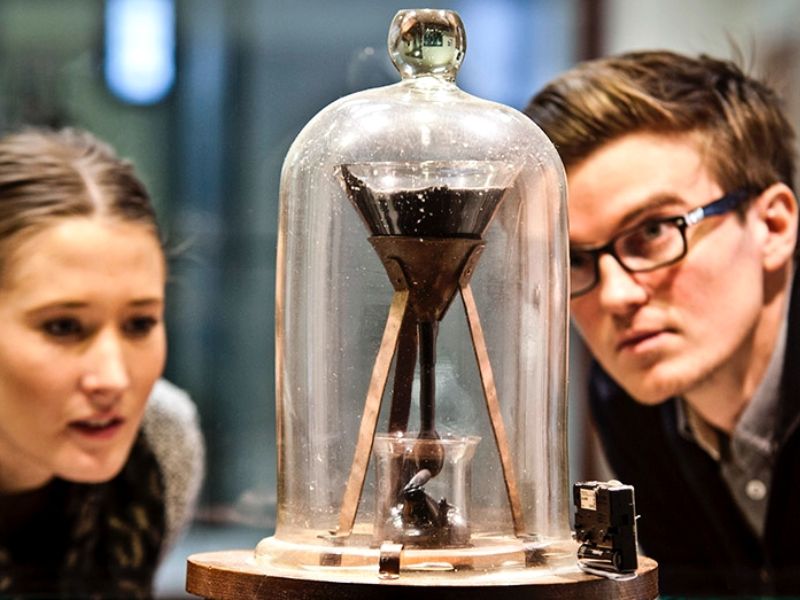

Science can sometimes move at a glacial pace. Data trickles in slowly, truth emerges gradually, and certainty is often hard-won.
The world’s longest-running lab experiment embodies this kind of extreme patience. It has been ongoing for nearly a century, overseen by successive custodians and observed by countless onlookers, as the experiment proceeds at an almost imperceptible pace.
It began in 1927 when physicist Thomas Parnell at the University of Queensland in Australia filled a sealed funnel with pitch, a tar-like substance once used to waterproof ships.
A Ribbon-Cutting Moment in 1930
Three years later, in 1930, Parnell cut the funnel’s stem—like cutting a ceremonial ribbon—initiating the Pitch Drop Experiment. The pitch began to flow.
Well, “flow” is relative. At room temperature, pitch appears solid, but it is actually an incredibly viscous fluid, some 100 billion times thicker than water.
It took eight years for the first droplet to finally fall into the beaker below. After that, drops appeared roughly every eight years, slowing only when air conditioning was added in the 1980s.
Nearly a century after the funnel was first cut, just nine drops have fallen in total, the most recent in 2014.
Scientists anticipate the next drop sometime in the 2020s, but it has yet to happen.
Never Seen in Real Time Despite Live Streaming
Remarkably, no one has ever witnessed a droplet fall in real time. The experiment is now live-streamed, yet past technical glitches have ensured each crucial moment has gone unseen.


After Parnell, physicist John Mainstone became the experiment’s caretaker in 1961. Sadly, neither he nor Parnell ever witnessed a droplet fall in person.
Mainstone oversaw the experiment for 52 years. In 2000, he missed a drop due to a thunderstorm interrupting the live feed, and he passed away just months before the next droplet fell in April 2014.
Today, physics professor Andrew White serves as the third custodian, patiently awaiting the long-anticipated 10th drop.
Read the original article on:Sciencealert
Read more:10,000 Brain Scans Explain How Aging Impairs Memory