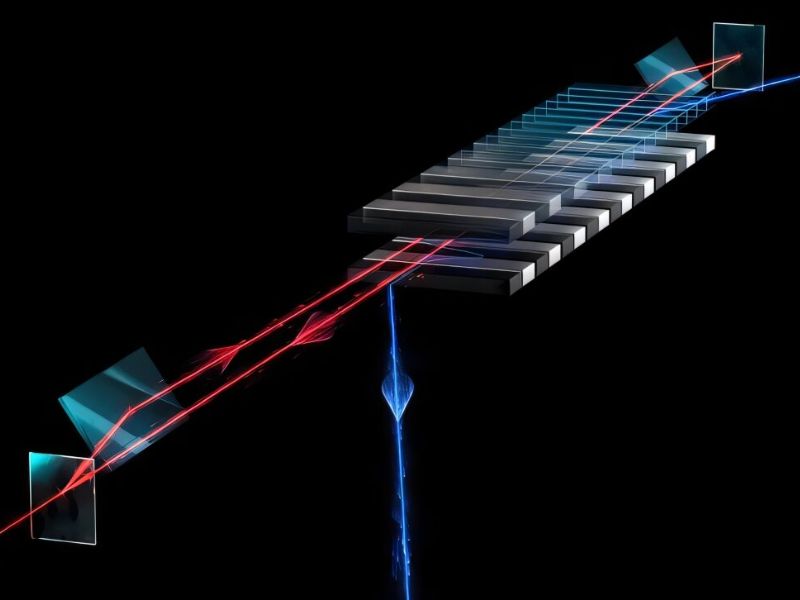

A group of engineers and scientists has demonstrated for the first time that a hard X-ray cavity can achieve net X-ray gain. In their experiment, crystal mirrors repeatedly reflected the X-ray pulses, amplifying them in a process similar to that of an optical laser. This proof-of-concept at the European XFEL produced an exceptionally coherent, laser-like beam with a level of quality never before achieved in the hard X-ray range.
Achieving lasing within a cavity has long been difficult for short-wavelength X-rays, for several reasons, including the fundamental challenge that such light is hard to reflect at large angles. The X-ray Free-Electron Laser Oscillator (XFELO) approach overcomes these limitations and enables new opportunities for research, ranging from the study of ultrafast chemical processes to high-resolution investigations of the smallest biological structures. The researchers report the findings in the journal Nature.
From an XFEL to an XFELO
Today’s free-electron lasers produce X-ray pulses using linear electron accelerators. Powerful electric fields accelerate bunches of roughly 100 billion electrons to nearly the speed of light. These electrons then travel through specialized magnetic devices known as undulators, which force them into a rapid, slalom-like motion. As the electrons constantly change direction, they emit intense, tightly focused X-ray radiation in the forward direction. At the European XFEL, as many as 27,000 electron bunches per second pass through the undulators, creating X-ray pulses at the same frequency.
Despite their outstanding quality, these X-ray pulses still exhibit a degree of energy spread. The newly developed XFELO approach significantly narrows this spread, producing X-ray light with a precisely defined energy—an essential feature for high-precision experiments.
In an XFELO setup, the X-ray beam circulates multiple times within a resonator cavity. This cavity consists of two sets of diamond mirrors with a series of undulators placed between them. During each round trip, the X-ray light interacts with a fresh electron bunch from the accelerator, progressively reinforcing and sharpening the beam. As Harald Sinn, X-ray optics expert and head of the Instrumentation Department at European XFEL, explains, “Each pass makes the light stronger and more focused.”
A Razor-Thin Peak
“With each round trip, the X-ray pulse sheds noise while the focused light sharpens,” explains DESY accelerator scientist Patrick Rauer, whose doctoral research laid the foundation for the resonator cavity and who now leads its implementation at DESY. “The signal grows more stable, and a single, distinct frequency begins to emerge—this spike.” That spike corresponds to a unique X-ray pulse with an exceptionally sharp definition.
Jörg Rossbach, then a physics professor at the University of Hamburg, originally suggested employing a resonator cavity at the European XFEL. Over the following decades, researchers extensively analyzed and modeled the concept, eventually enabling Rauer and his colleagues from DESY’s accelerator division, along with scientists and engineers from Harald Sinn’s instrumentation teams at European XFEL, to design a concrete resonator cavity system. Fittingly, during beamtime at the European XFEL dedicated to studying the resonator’s performance, it was Jörg Rossbach—now a professor emeritus—who first spotted the spike in the data.
Exceptional Level of Accuracy
The resonator cavity at the European XFEL stretches approximately 66 meters. High-quality diamond crystals reflect the X-ray light, guiding it repeatedly through the cavity, while optical mirrors provide extra focusing and stability. Key challenges included precisely positioning the crystals and synchronizing the X-ray pulses with the electron bunches. Maintaining the stability of the 1.7-kilometer accelerator—both in terms of energy, timing down to femtoseconds, and position down to micrometers—over several days was essential for the experiment’s success. “It took years to achieve this level of performance, which is now unmatched in the world of high-repetition-rate accelerators,” says Rauer.
“The successful demonstration proves that the resonator concept can be practically implemented,” says Sinn. “Compared to previously used methods, it produces X-ray pulses with much narrower wavelengths, as well as significantly improved stability and coherence.” This opens entirely new possibilities for highly precise experiments in physics, materials science, chemistry, and biology. “With this system, researchers can explore structures and processes that were previously barely measurable,” adds Thomas Feurer, managing director at European XFEL.
In the coming years, the team aims to further intensify the X-ray light, maintain stability over longer operating periods, and prepare the technique for use by a broader research community. DESY Accelerator Division Director Wim Leemans notes, “This collaborative effort has realized a long-envisioned way to enhance the laser-like properties of coherent hard X-ray pulses at the European XFEL, and users will benefit greatly from their work.” The ultimate goal is a new generation of X-ray sources offering extraordinary precision and brilliance, enabling unprecedented insights into the tiniest and fastest processes.
Read the original article on: Phys.Org
Read more: If an Asteroid Hits the Moon in 2032, Earth could be Affected