
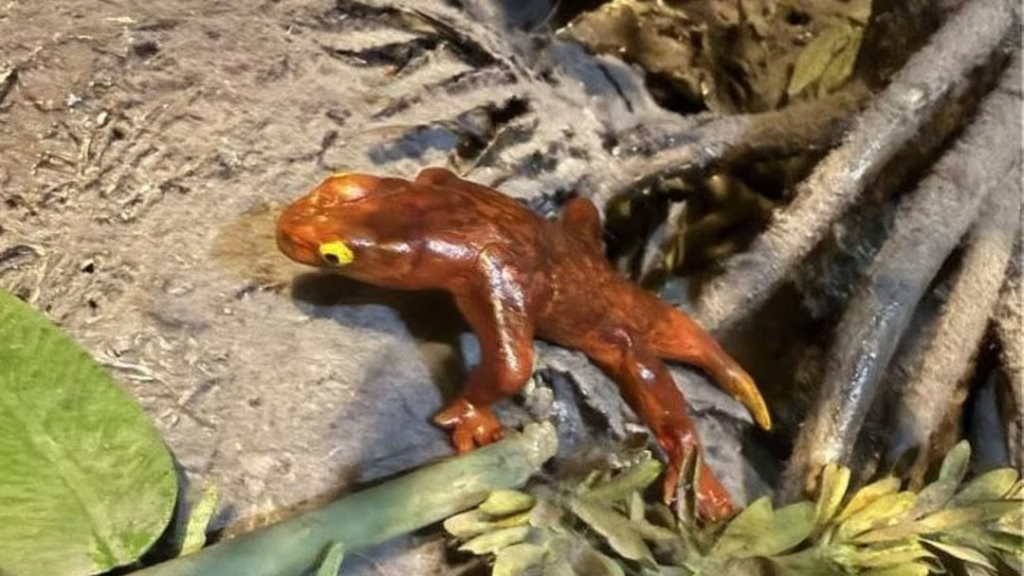
A fossil discovered in Illinois has been reexamined more than 60 years after it was collected, revealing that scientists had been looking at a different ancient animal all along.
Fossils can tell us a lot about life on Earth, but identifying them is not always easy. Sometimes, scientists need to return to old discoveries with new technology and a fresh perspective. That is exactly what happened with a remarkable fossil from Mazon Creek, Illinois. The specimen was collected in 1965 and was originally thought to belong to a known group of early amphibian relatives. Now, researchers have concluded that it represents a separate species called Jeanerpeton mazonensis.
An Ancient Animal Hidden in Rock
The fossil is about 309 million years old, dating to the Carboniferous Period, long before dinosaurs appeared on Earth. It was preserved inside two matching halves of a hard mineral formation called a siderite concretion. Remarkably, the fossil contains almost the entire skeleton, although the tail is missing.
The Mazon Creek region is especially valuable to paleontologists because fossils found there can preserve much more than just bones. In some cases, researchers can see impressions of soft tissues, scales, body outlines and even parts of the eyes. For Jeanerpeton, scientists could see scales along the back, tiny bones around the belly and an impression of the eye. These details helped researchers take a closer look at what kind of animal they were actually studying.

Why Scientists Changed Its Identity
For many years, the fossil was classified as an unusual example of Amphibamus grandiceps, an extinct four-legged vertebrate. However, a new examination revealed several important differences. The skull of Jeanerpeton had a narrower snout, while one of its skull bones extended farther backward around the eye. Its teeth were also different. Researchers found 11 visible teeth on part of the upper jaw, and the teeth had a similar, sharp shape. The animal also had 22 vertebrae in front of the hip, compared with 20 in the Amphibamus specimen used for comparison. When scientists considered all these features together, they concluded that the fossil was not simply an unusual Amphibamus. It represented an anatomically distinct animal.
CT Scans Reveal More Clues
Researchers also used computed tomography (CT) scanning to look inside the fossil without destroying the surrounding rock. The scan was not detailed enough to reveal every part of the skeleton perfectly, but it did expose bones hidden beneath the surface. Scientists then compared Jeanerpeton with other early amphibian relatives. Their analysis used 99 anatomical characteristics across 41 groups to investigate where the animal belonged on the evolutionary tree.The results placed Jeanerpeton close to Amphibamus and another extinct animal called Platyrhinops, although some relationships remain uncertain.
A More Diverse Ancient World
The discovery is important because it suggests that early amphibian relatives may have been more diverse than scientists previously thought. Researchers believe that several different forms may have lived around Mazon Creek. Some other fossils from the same area also show differences in the number of vertebrae and other anatomical features. This means that fossils once grouped under a single name may actually represent several different animals. The study also shows why old fossils can continue to produce new discoveries. A specimen collected decades ago can reveal something completely different when scientists examine it using modern methods.

What We Still Don’t Know
There are still many unanswered questions about Jeanerpeton. Because the species is currently known from a single defining fossil, scientists cannot say exactly how the animal behaved, what it ate or how it interacted with its environment.
Even so, the discovery adds another piece to the story of how early four-legged vertebrates evolved. More than 300 million years after Jeanerpeton lived, its fossil is helping scientists understand that Earth’s ancient ecosystems may have been far more diverse than previously recognized. Sometimes, discovering a new species does not require finding a new fossil. Sometimes, the discovery is already sitting in a museum collection, waiting for scientists to look at it again.
Read the Original: 300-million-year-old fossil was labeled as a completely different animal
Read Also: Your Belly May Help Control Blood Flow to Your Brain


