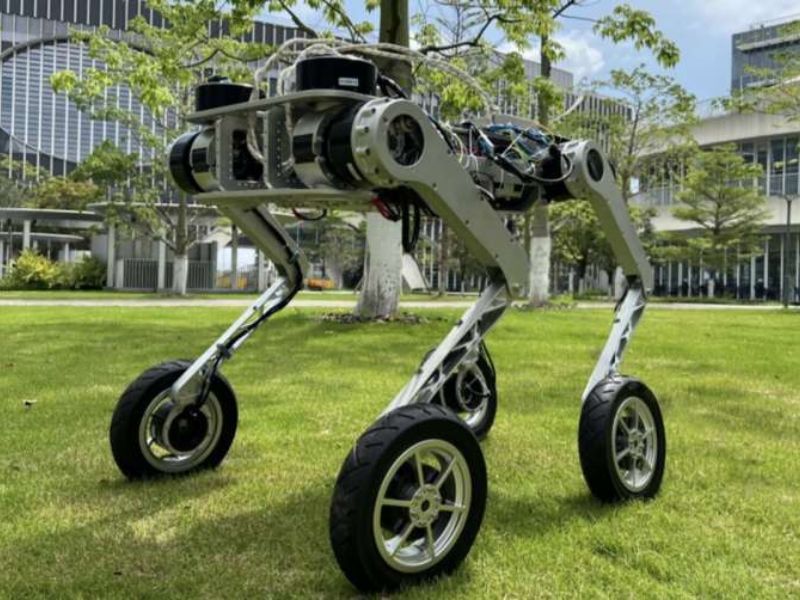

Most ground robots are built to use either wheels or legs, rather than both. However, robots capable of smoothly transitioning between wheeled and legged movement offer clear advantages, enabling more efficient travel across diverse terrains and increasing the likelihood of mission success.
A Wheel-Legged Robot That Adapts Smoothly to Any Terrain
Researchers at The Hong Kong University of Science and Technology (Guangzhou) have introduced FLORES, a wheel-legged robot designed to adapt more effectively to its environment and navigate various terrains with ease.
Detailed in a paper on the arXiv preprint server, FLORES uses its legs to handle uneven ground and switches to wheels for faster movement on flat surfaces, all while maintaining stability.
“In my recent work, I examined the design and development of wheel-legged robots, emphasizing the integration of the strengths of both wheeled and legged systems,” said Zhicheng Song, the paper’s lead author, in an interview with Tech Xplore.
“The models ANYmal and B2W, which integrate wheels into legged robots, as well as the wheeled robot mobED, which I regard as a form of wheel-legged robot due to its innovative design, inspired the idea.” Although mobED is primarily a wheeled system, I believe it integrates leg-like elements, bringing it closer to the wheel-legged concept.”
Two Distinct Pathways to Wheel-Legged Robot Design
The B2W and mobED prototypes, described in earlier studies, represent two approaches to wheel-legged design: B2W extends the structure and abilities of legged robots, while mobED originates from a wheeled platform enhanced with leg-inspired movement strategies.
“My goal was to redesign robots like B2W into a form closer to a car,” Song explained. “With FLORES, we aimed to achieve efficient movement on flat ground while still being able to handle obstacles like stairs. “This combination aims to create a more versatile and capable robotic platform.”
FLORES, developed by Song and his team, introduces a novel front-leg configuration that distinguishes it from previous wheel-legged designs. This feature enhances its mobility and adaptability across a wide range of environments.
“Our design replaces the standard hip-roll degree of freedom (DoF) in the front legs with hip-yaw DoFs, enabling smoother movement on flat terrain while preserving adaptability for more complex landscapes,” Song added.
“This design allows the robot to switch smoothly between legged and wheeled movement while optimizing performance across different terrains. Its unique joint structure supports new, highly efficient gaits that leverage the combined strengths of both locomotion modes.”
Prototype Testing Shows Superior Efficiency in Real-World Trials
The team built a prototype and evaluated it through real-world experiments, comparing its performance with earlier wheel-legged robots. Results showed that their system was significantly more efficient, especially when frequent turning and steering were required.
“In our straight-line and turning tests, our robot used just 30% and 35% of the energy consumed by other wheel-legged platforms,” Song reported.
He added, “I see FLORES as particularly suitable for working alongside humans in environments with mostly flat ground and stairs, where it can achieve excellent locomotion efficiency.”
The FLORES robot may soon undergo further enhancements and be evaluated in additional real-world scenarios. In their upcoming work, Song and his colleagues aim to equip the robot with a lightweight arm, enabling it to perform object manipulation tasks.
“I am also working on sim2real transfer for several bipedal locomotion strategies that can manage more extreme conditions,” Song noted.
“For example, when facing a very narrow single-plank bridge, most legged robots fail to cross. Our robot, however, can switch to bipedal mode, using its rear legs as lower limbs while aligning its wheels in a straight line to improve side-to-side stability and successfully navigate the bridge.”
Read the original article on: Tech Xplore
Read more: Photos From Beijing’s World Humanoid Robot Games Reveal The Need For A Human Touch