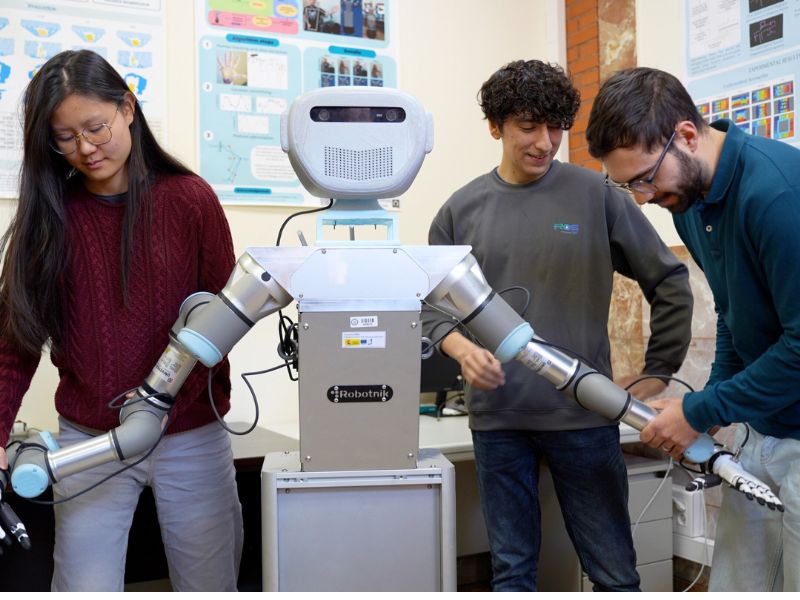

Researchers at Universidad Carlos III de Madrid (UC3M) have created a novel approach that enables a robot to autonomously learn arm movements by integrating observational learning with communication between its limbs. This advancement marks another step toward developing more intuitive and easily trainable service robots that can carry out household assistive tasks, such as setting and clearing the table, ironing, or organizing the kitchen.
The findings were recently showcased at the IROS 2025 robotics conference and published in the proceedings of the 2025 IEEE/RSJ International Conference on Intelligent Robots and Systems (IROS).
Dual-Arm Robots for Home Assistance
This study tackles one of the most challenging issues in modern robotics: coordinating two arms to work in unison. At UC3M, researchers are addressing this challenge with the ADAM robot (Autonomous Domestic Ambidextrous Manipulator), which can already carry out assistive tasks in household settings.
“For instance, it can set and clear the table, organize the kitchen, or bring a user a glass of water or medication at the scheduled time. It can also assist someone preparing to leave by fetching a coat or another item of clothing,” says Alicia Mora, a researcher from the Mobile Robots Group at the UC3M Robotics Lab involved in this project.
ADAM was designed to assist older adults with everyday activities at home or in care centers, explains Ramón Barber, director of the Mobile Robots Group and professor in the UC3M Department of Systems Engineering and Automation: “We all know individuals for whom simple actions—like bringing them a glass of water with medication or setting the table—can make a meaningful difference. That is the primary goal of our robot.”
Real-Time Robot Arm Coordination
In the paper presented at IROS 2025 in China by Mobile Robots Group researchers Adrián Prados and Gonzalo Espinoza, the team introduces an innovative strategy for coordinating the robot’s arms. Each arm is first trained separately using imitation learning, and then both are enabled to “communicate” through a mathematical framework known as Gaussian Belief Propagation.
This approach creates a continuous, invisible exchange between the arms, allowing them to coordinate in real time and avoid colliding with each other or nearby objects—without having to pause and recalculate their movements. The outcome is smooth, efficient, and natural motion, successfully validated in both simulations and real domestic-assistance robots.
Teaching robots to carry out everyday activities remains a major challenge in robotics. Traditionally, programming a robot required thousands of lines of code specifying every individual movement. By contrast, imitation learning offers a more intuitive solution, enabling the robot to observe how a person performs a task and then reproduce those actions.
From Imitation to Adaptive Robotic Manipulation
Within this framework, a person demonstrates the task—either by physically guiding the robot’s arm or by recording themselves performing the action—to teach it activities such as pouring water or arranging items on a shelf. However, merely replicating a motion is insufficient. If the robot learns to grasp a bottle in a specific spot and someone moves the bottle slightly, a system that relies solely on imitation will repeat the original motion and fail. The real objective of robotic manipulation, therefore, is not rigid repetition but adaptability and a deeper understanding of movement.
The methods developed by the researchers tackle this issue by making learned motions behave like an elastic band: when the target shifts, the trajectory adjusts smoothly to reach the new position while preserving the core characteristics of the action. In this way, the robot can respond to changing conditions without compromising essential aspects of the movement, such as keeping a bottle upright to prevent spilling.
“The ultimate aim is for robots to move beyond simply recording motions and instead become true collaborators—able to perceive their surroundings, anticipate actions, and operate safely alongside humans,” Prados explains.
Sensing, Decision-Making, and Execution
In practice, the robot functions in three stages. The first is perception, where it gathers environmental data through its sensors. Next is reasoning, where the data is processed to extract key information. Finally, in the action phase, the robot determines how to respond—whether by moving its base, synchronizing its arms, or carrying out a particular task. ADAM uses 2D/3D laser sensors and RGB-D cameras to detect objects, measure distances, and map its surroundings in 3D.
One of the key challenges is progressing from simply “seeing” objects to understanding their purpose and the user’s context. In the past, this type of comprehension relied on common-sense knowledge databases. Today, Alberto Méndez, another member of the Mobile Robots Group, actively integrates generative models and artificial intelligence to enable the robot to adapt its behavior to specific circumstances and real-time events.
Although ADAM remains a research prototype, costing an estimated €80,000 to €100,000, the technology has advanced enough that within 10 to 15 years, similar robots could enter everyday homes at a much more affordable price.
Beyond its technological progress, this research underscores the importance of robotics in addressing the challenges posed by an aging population—an increasingly pressing issue in modern society.
“As our society ages, there are more elderly individuals and fewer people available to care for them, making technological solutions like these ever more essential,” Barber concludes. In this regard, “assistive robots are becoming a vital resource for enhancing people’s independence and overall quality of life.”
Read the original article on: Tech Xplore
Read more: Adobe’s Digital Dress Impresses with Shifting Patterns and Colors
Leave a Reply