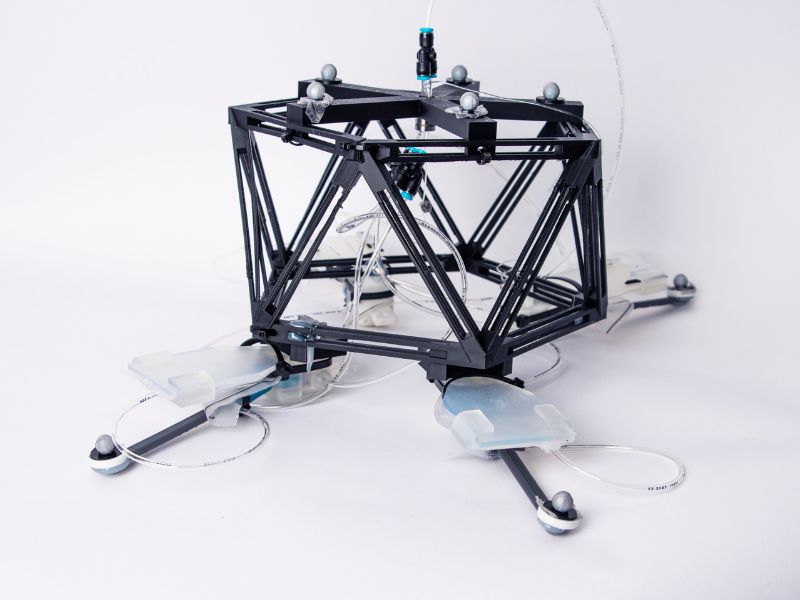

Researchers at the University of Oxford have created a new type of soft robot that functions without electronics, motors, or computers, relying solely on air pressure. Published in Advanced Materials, the study demonstrates that these “fluidic robots” can produce complex, rhythmic motions and even synchronize their movements automatically.
Professor Antonio Forte (Department of Engineering Science, University of Oxford, RADLab Lead) said, “We’re thrilled to observe that brainless machines naturally produce complex behaviors, distribute functional tasks to the peripheries, and free up capacity for more intelligent operations.”
Addressing a Major Hurdle in soft Robotics
Soft robots, made from flexible materials, excel at navigating uneven terrain and handling fragile objects. Soft robotics aims to embed behavior into a robot’s structure, making machines more adaptive and responsive.
Such automatic behavior—arising from interactions between the body and its environment—is hard to replicate with conventional electronic circuits, which rely on complex sensing, programming, and control systems.
To tackle this, the researchers drew inspiration from nature, where body parts often serve multiple functions and coordinated behavior can emerge without a central controller. Their key innovation was a small, modular component that uses air pressure to perform mechanical tasks, functioning similarly to how an electronic circuit directs electrical current. Depending on its configuration, this single block can either:
- Respond to air pressure changes by moving or deforming, acting like a muscle.
- Detect pressure changes or contact, functioning like a touch sensor.
- Control air flow by switching it on or off, similar to a valve or logic gate.
Modular, Self-Synchronizing Robots
Like LEGO blocks, small identical units combine to make different robots without changing the hardware. In the study, the team built tabletop robots, about the size of a shoebox, capable of hopping, shaking, or crawling.
“Researchers found that each unit could perform all three functions simultaneously, generating rhythmic motion under constant pressure.” When multiple responsive units connect, they naturally synchronize their movements without any computer control or programming.
Demonstrated in a shaker robot sorting beads and a crawler halting at table edges. In both cases, mechanical interactions entirely achieved the coordinated movements, with no external electronics.
Lead author Dr. Mostafa Mousa (Department of Engineering Science, University of Oxford) explained, “This spontaneous coordination requires no preset instructions; it emerges solely from how the units interact with each other and with their environment.”
Paving The way for Embodied Intelligence
Importantly, the robots only synchronize their behavior when they connect and maintain contact with the ground. The team applied the Kuramoto model—a mathematical framework describing how networks of oscillators synchronize—to explain this phenomenon.
Their analysis showed that coordinated movements can emerge solely from the robots’ physical design and environmental coupling. Here, the motion of each leg subtly influences the others via the shared body and ground reaction forces.
This interaction creates a feedback loop, where forces transmitted through friction, compression, and rebound link the limbs’ movements, resulting in spontaneous coordination.

Robots Achieve Natural Synchronization Through Physical Interaction
Dr. Mousa explained, “Like fireflies syncing flashes, the robot’s air-powered limbs rhythmically align through ground contact instead of sight.” This emergent behavior, seen in nature before, marks a significant advance toward programmable, self-intelligent robots.”
Although the current soft robots sit on tabletops, the researchers note that the design principles apply at any scale. They aim to study these systems to create energy-efficient, untethered robots for extreme environments requiring adaptability and low power use.
Professor Forte added, “Embedding decision-making and behavior directly into a robot’s structure could produce adaptive, responsive machines that don’t rely on software to ‘think.’ This represents a shift from ‘robots with brains’ to ‘robots that are their own brains,’ making them faster, more efficient, and better equipped to handle unpredictable environments.”
Read the original article on: Tech Xplore
Read more: Designed Proteins Allow Efficient, Green, and Biocompatible Energy Storage