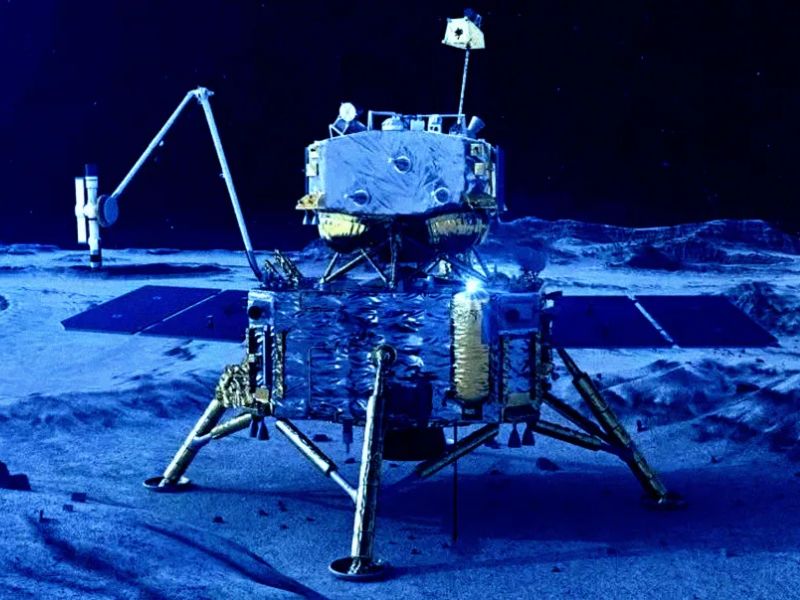

China’s Chang’e-6 mission — the first to bring back samples from the Moon’s far side — made an intriguing discovery last year.
After examining the lunar samples returned in June, scientists found fragments of CI chondrite — a rare, water-rich meteorite seldom surviving Earth’s atmosphere, ScienceAlert reports.
This marks the first detection of CI chondrite on the Moon, indicating that volatile-rich asteroids — known for their high porosity and hydrated minerals that can make up around 20% of their mass — are capable of reaching the lunar surface intact.
The Significance of the CI Chondrite Discovery
Because of their fragile, porous structure, such meteorites typically disintegrate upon impact or while entering an atmosphere. The Chinese Academy of Sciences reports that CI chondrites make up under one percent of Earth’s meteorites, making this lunar find especially notable.
“Given the rarity of CI chondrites on Earth, our approach offers a valuable way to reassess chondrite distribution in the inner solar system,” the team wrote in PNAS.
The Chang’e-6 samples were collected from the South Pole-Aitken Basin — one of the largest known impact craters in the solar system.
Unusual Isotope Ratios Found in Lunar Olivine
Using advanced microscopy and spectrometry, the scientists detected unusual isotope ratios in samples of olivine, a silicate mineral commonly found in volcanic rocks and meteorites.
These isotope signatures matched those of a CI chondrite asteroid that likely struck the Moon, melted upon impact, and then solidified — effectively preserving its material, as reported by ScienceAlert.
According to the researchers, the meteorite may have originated in the outer solar system, showing that such material can survive its journey inward toward the Sun.
Their analysis also suggests that these types of asteroids are far more abundant on the Moon than previously believed, potentially making up as much as 30% of the material gathered by the Chang’e-6 mission.
Unlocking the Moon’s Water Secrets
Coauthor Lin Mang says the discovery may reveal how water arrived and spread across the Moon.
The findings support theories that carbonaceous asteroids brought water to Earth through ancient impacts.
Read the original article on: futurism
Read more: Japanese Scientists Developed Tech to Record and View Dreams