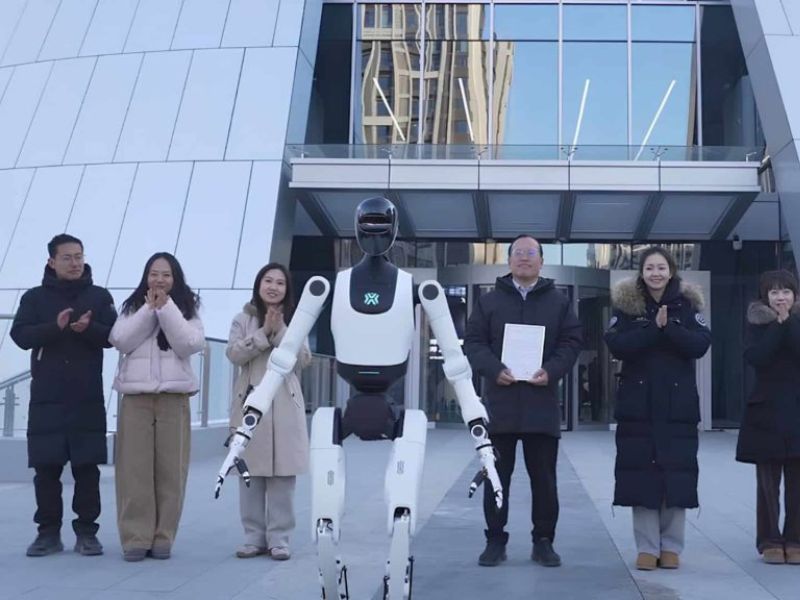

A China-developed humanoid robot has made history by directly connecting to a low Earth orbit satellite without relying on traditional ground networks. Known as Embodied Tien Kung, it became the first humanoid robot to autonomously carry out this type of satellite communication.
The achievement was unveiled by X-Humanoid on Friday (23) at the 3rd Beijing Conference on Promoting the High-Quality Development of the Commercial Space Industry, an event highlighting recent progress in China’s space sector.
Robot Achieves Real-Time Satellite Communication
During the test, the robot linked to a new GalaxySpace internet satellite fitted with an electronically scanned array antenna and a flat-panel system integrated into the satellite architecture. The connection enabled stable, real-time transmission of images and data, even in the absence of ground-based infrastructure.
Organizers said the demonstration marked China’s first multi-terminal, multi-link connection using a low-orbit satellite with this setup. Alongside the humanoid robot, smartphones and computers also successfully accessed the network during the test.
To demonstrate a real-world application, researchers assigned Embodied Tien Kung a task: retrieve a symbolic project completion certificate placed inside an autonomous vehicle. As part of the experiment, the unmanned car drove itself to the newly opened Avenue of Rockets.
When the satellite passed overhead, the robot independently determined the optimal time to communicate, ran system checks, and established a direct connection with the low-orbit satellite. Once connected, it approached the vehicle, collected the certificate, and delivered it to another building.
Humanoid Sends Real-Time Motion and Visual Data to Control Center
During the mission, the humanoid converted its movements, joint data, and images from its front camera into digital information and transmitted them to the satellite. The system relayed this data to the control center almost in real time, enabling operators to track the operation both from the robot’s viewpoint and through external monitoring tools.
The trial highlighted the potential of satellite-connected humanoid robots to carry out physical tasks in areas lacking conventional internet access. Such capabilities could prove vital in remote locations, disaster zones, and other high-risk environments.
Satellite-Linked Robots Expand Remote Operations
By overcoming geographic constraints, the technology opens new possibilities for technical inspections, emergency response, field exploration, and mining. In hazardous situations, robots could take on critical roles, improving both safety and efficiency.
This milestone builds on earlier accomplishments by Embodied Tien Kung. In February 2025, the robot drew attention after climbing 134 outdoor steps at Haizi Wall Park in Beijing, becoming the first humanoid to master such a demanding outdoor challenge.
Read the original article on: engenhariae
Read more:Scientists use a Spinach Leaf to Make an Artificial Heart