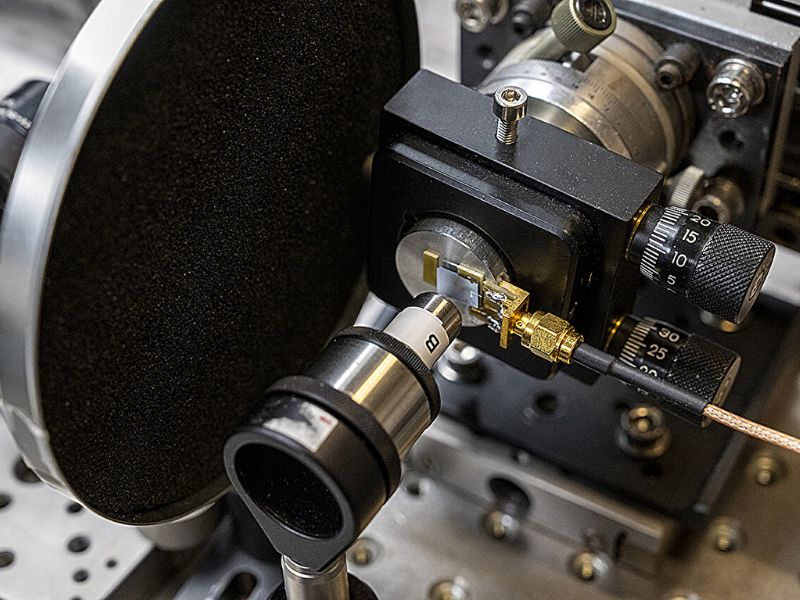

For the first time, a renowned 1801 light experiment has been recreated using sound. Leiden physicists conducted research revealing insights with potential for 5G and quantum acoustics. The findings are published in Optics Letters.
Ph.D. student Thomas Steenbergen explains that “sound waves in materials act similarly to light waves, though with some differences. Using a mathematical model, we can now describe and anticipate this behavior.”
Thomas Young’s Classic Experiment with Two Slits
Young’s famous double-slit experiment was the first to demonstrate that light can exhibit both particle-like and wave-like behavior. In this experiment, light passing through two slits created an interference pattern of bright and dark bands.
Later, the same experiment was performed using particles, revealing that all particles can also display both wave and particle characteristics. Over time, the double-slit experiment has been repeated with a wide variety of quantum objects, including electrons, neutrons, and even buckyballs—molecules composed of 60 carbon atoms.
Using Sound Instead of Light
Steenbergen and his colleague Löffler aimed to investigate the behavior of sound at a microscopic level. The double-slit experiment offered them important insights. Using this experimental setup, Steenbergen expanded on research initially conducted by physics undergraduate Krystian Czerniak.
For the experiment, the team employed gigahertz-frequency sound waves, oscillating a billion times per second—well beyond the range of human hearing.
The Research
The sound waves were aimed at a small piece of material: the semiconductor gallium arsenide, which is commonly used in electronic devices. Matthijs Rog, a colleague in Kaveh Lahabi’s research group, used an ion beam to carve two tiny grooves (slits) into the material.
Steenbergen explains, “We then detect the sound using an extremely precise optical scanner. This device can measure sound virtually everywhere, including inside and just in front of the slits. It can determine the amplitude of the sound waves with picometer-level precision—that’s one millionth of a micrometer.”
Commonalities and distinctions
Similar to the double-slit experiments with light, an interference pattern forms at the back, revealing areas where the sound is amplified and areas where it cancels out.
Steenbergen notes, “If you examine it closely, the pattern isn’t perfectly symmetrical. Sound waves don’t travel identically in every direction—their speed varies depending on the angle at which they move through the material.” By creating a mathematical model, the team was able to account for these variations and predict them with precision.
A Classic Experiment Reveals Fresh Insights
Gigahertz-frequency sound waves play a key role in telecommunications, particularly in 5G technology like mobile phones. This study offers fresh insights that could enhance these applications, as well as other microelectronic devices and sensors that rely on sound.
Additionally, it sheds light on the developing field of quantum acoustics, where sound waves at the quantum scale are harnessed to transmit information. In this sense, an experiment conducted centuries ago is once again inspiring new technological possibilities.
Read the original article on: Phys.Org
Read more: Humanoid Robots Still Can’t Replace Humans, Says a Robotics Expert