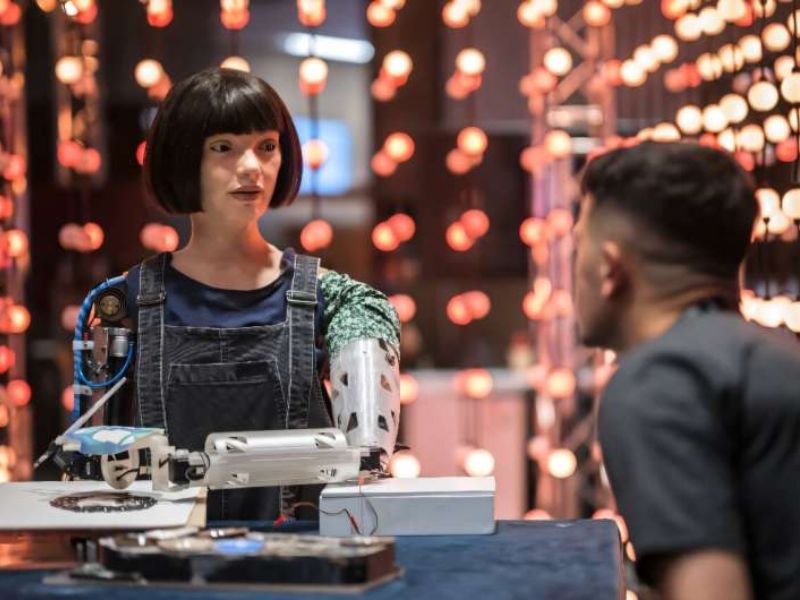

This week, humanoid robot and acclaimed artist Ai-Da revealed a new portrait of King Charles, explaining the inspiration behind the intricate work—and assuring it has no intention of “replacing” humans.
Engineers designed Ai-Da, one of the world’s most advanced humanoid robots, to resemble a human woman, giving her a lifelike face, expressive hazel eyes, and a brown bob haircut.
Interchangeable Robotic Arms for Artistic Versatility
Her arms, however, remain visibly robotic with exposed metal components and are interchangeable based on the type of art she’s creating.
In late 2023, Ai-Da made history when her portrait of British mathematician Alan Turing became the first artwork by a humanoid robot to sell at auction, earning over $1 million.
As Ai-Da revealed her latest piece—an AI-generated oil painting titled Algorithm King—the humanoid robot emphasized that its worth goes beyond monetary value.
Exploring Ethics Through Creative AI Expression
“I create my artwork to spark conversations about the ethical implications of emerging technologies,” she told AFP at the UK’s diplomatic mission in Geneva, where they will display the portrait of King Charles.
Speaking in a measured tone, Ai-Da explained that the goal is to “promote critical thinking and support responsible innovation aimed at creating fairer and more sustainable futures.“
While attending the United Nations’ AI for Good summit, Ai-Da—known for her sketches, paintings, and sculptures—shared insights into the techniques and inspiration behind her latest piece.
“I rely on a range of AI algorithms to produce my art,” the robot explained.

“I begin with a central idea or theme I want to explore, considering the message behind the artwork—what it aims to communicate,” the robot said.
Referring to the subject of the portrait, Ai-Da noted, “King Charles has used his influence to promote environmental conservation and interfaith dialogue. I created this portrait to honor those efforts,” adding, “I hope King Charles will appreciate my work.“
Aidan Meller, an expert in modern and contemporary art, led the team that developed Ai-Da in 2019, collaborating with AI experts from Oxford and Birmingham universities.
He explained to AFP that Ai-Da, named after pioneering computer programmer Ada Lovelace, was created as an ethical art project—not as a replacement for human painters.
Transforming Art and Human Expression
Ai-Da acknowledged that “AI is undeniably transforming our world—including the realms of art and human creativity.“
However, the robot emphasized, “I don’t believe that AI or my creations will replace human artists.”
Instead, Ai-Da explained that the goal is “to encourage people to reflect on how AI can be used for good, while staying aware of its potential risks and limitations.“
When asked whether a machine-made painting qualifies as art, the robot maintained, “My work is both original and creative.“
“Ultimately, whether humans consider it art is a meaningful and thought-provoking discussion,” she added.
Read the original article on: Techxplore
Read more:Jack Dorsey’s New Messaging App Works Without Internet