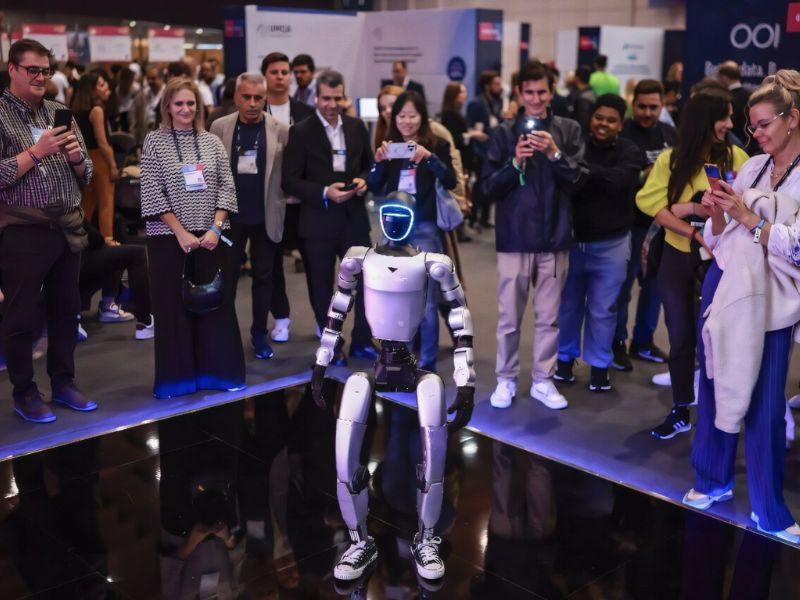

Amazon’s chief roboticist told AFP that the flashy humanoid robots impressing visitors at this week’s Web Summit in Lisbon are still a long way from transforming manual work in factories and warehouses.
Tye Brady commented in a Wednesday interview that “it’s somewhat technology for technology’s sake.” He explained, “When we consider robotics, we first ask, A, what problem are we solving?” And B, what function is needed? Form should follow function, and starting with form flips that logic.”
Meanwhile, Web Summit organizer Paddy Cosgrave highlighted Chinese manufacturer Unitree’s breakdancing robots on Monday, noting that “the era of Western tech dominance is fading.”
In contrast, Brady highlighted that Amazon has already deployed over a million robots in its e-commerce operations. These include robotic arms for picking and sorting products, as well as wheeled carriers that transport heavy loads throughout warehouses, all while detecting and avoiding human workers.
Amazon’s Small Robot Fleet with Domestic Support
According to a September report from the International Federation of Robotics, roughly two million industrial robots operate in China in 2024 and over 4.5 million worldwide, making Amazon’s fleet comparatively small.
The company also highlights the ecosystem and supply chain it has established in Massachusetts to design and manufacture its robots domestically.
Brady noted that the world is still “in the early stages of robotics and physical AI.”
He added that “100 percent automation doesn’t exist,” noting that Amazon’s machines aim “to assist and enhance human work” and “take over the tedious, routine, and repetitive tasks” from people’s jobs.
Tactile Perception
Brady recognized that certain aspects of a humanoid design could be beneficial—like walking on two legs to handle “uneven terrain or navigating stairs.”
However, while bipedal movement is impressive, a robot’s usefulness ultimately depends on what it can do once it arrives at its destination.
“I can get to a location… but once I’m there, there’s usually a task that needs to be done. And completing that task will require some form of touch and manipulation,” Brady explained.
The push to commercialize humanoid robots has prompted some companies to move faster than the technology can fully support.
Last month, California-based startup 1X sparked both enthusiasm and skepticism by opening pre-orders for a $20,000 home-assistant robot, which includes an “expert mode” allowing a human to control it for more complicated tasks.
Brady noted that robots still require further development before they can handle the full variety of objects they might encounter in real-world settings.
Introduced earlier this year, Amazon’s Vulcan robot features sensors that help it avoid damaging objects it handles or moves aside, and it can pick and stow roughly 75 percent of the items sold by the online retail giant.
For now, however, the system is a bulky, floor-based setup rather than a sleek humanoid.
Looking ahead, Brady suggested that “combining skills in mobility and manipulation, while prioritizing function over form, could lead to truly impressive results.”
Read the original article on: Tech Xplore
Read more: Robots Trained on Spatial Datasets Gain Better Awareness and Object Handling