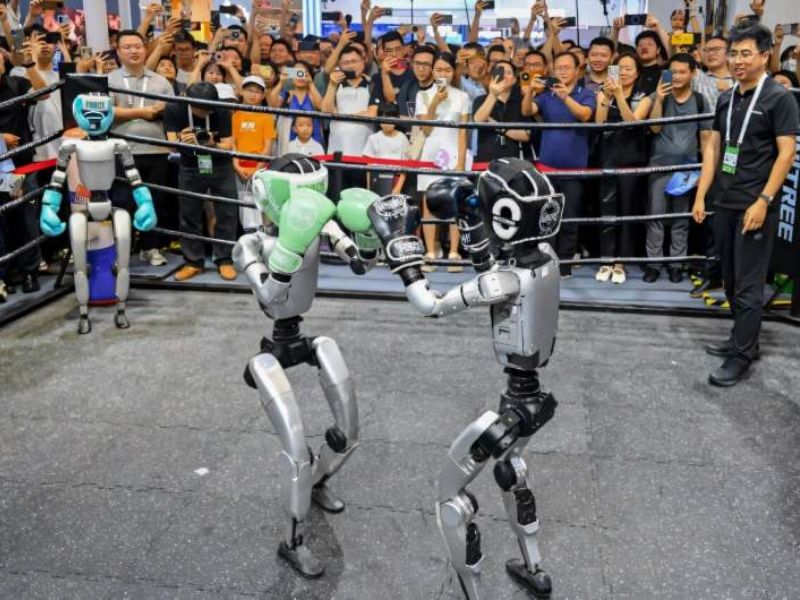

From serving craft beer and playing mahjong to stacking shelves and boxing, the dozens of humanoid robots at this weekend’s World AI Conference (WAIC) in Shanghai showcased China’s advancing AI capabilities and aspirations.
China Showcases AI Progress at Annual Event Amid Push to Rival U.S. in Tech and Regulation
The annual event serves as a platform to highlight China’s rapid advancements in artificial intelligence, as the government pushes to establish itself as a global leader not only in AI technology but also in its regulation—closing in on the United States.
At the event’s opening on Saturday, Premier Li Qiang announced plans to create a new body focused on international cooperation in AI governance, emphasizing the need to balance innovation with potential risks.
Yet just next door, inside the vast expo hall, the atmosphere was far more energetic than cautious.
Surging Demand Fuels AI Growth Across Sectors, Says Transwarp R&D Director
“There’s strong demand right now—across data, use cases, model training, and infrastructure,” said Yang Yifan, R&D director at Shanghai-based AI platform Transwarp. “The energy in every area is high.”
This year’s WAIC follows a major milestone in Chinese AI: the January debut of startup DeepSeek’s AI model, which matched top-performing U.S. systems at a significantly lower cost.
According to organizers, the forum featured over 800 companies and more than 3,000 products, with the humanoid robots and their quirky, almost theatrical demonstrations stealing the spotlight.

At one exhibit, a robot awkwardly drummed—slightly off rhythm—to Queen’s “We Will Rock You,” while a man in safety gear energized a laughing crowd.
Elsewhere, robots dressed in work uniforms or baseball caps operated assembly lines, challenged humans in games of curling, or clumsily poured soft drinks from dispensers.
Though many of the robots still moved with some stiffness, their growing sophistication compared to previous years was unmistakable.
China’s Government-Backed Robotics Push May Give It an Edge Over the U.S., Experts Say
Robotics has received significant backing from the Chinese government, with some experts suggesting China may already hold an edge over the U.S. in this field.
At the booth of Hangzhou-based Unitree, its G1 android—about 130 centimeters tall with a two-hour battery life—demonstrated impressive balance while kicking, pivoting, and throwing punches as it shadowboxed inside a ring.
Just before the conference began, Unitree also announced plans to release a full-sized humanoid robot, the R1, priced under $6,000.

Most cutting-edge assistants don’t require physical form.
At the expo, AI-powered virtual companions—taking the shape of middle-aged businessmen, scantily dressed women, and ancient warriors—greeted visitors from screens, asking about their day. Other booths featured demos where attendees could design their own digital avatars.
Baidu Unveils Next-Gen AI “Digital Humans” Capable of Decision-Making and Collaboration
On Saturday, tech giant Baidu unveiled the latest generation of its “digital human” technology—AI-driven personas modeled on real individuals, which the company claims can think, make decisions, and work collaboratively.
Baidu recently hosted a six-hour e-commerce livestream led by digital replicas of a popular streamer and another avatar. According to the company, the AI hosts outperformed the human streamer’s debut in several product categories.
More than 10,000 businesses already use this technology daily, said Wu Chenxia, head of the department, speaking to AFP.

When asked about AI’s impact on employment—a key concern surrounding its widespread use—Wu emphasized that AI should be viewed as a tool designed to enhance quality and efficiency, while still relying on human involvement.
In China, the adoption of AI in daily life is gaining momentum.
Baidu Approved to Launch Robotaxis in Central Shanghai’s Pudong
At WAIC, Baidu also revealed it had received approval to launch fully autonomous robotaxi services in parts of Shanghai’s vast Pudong district—marking the service’s first expansion into the city center.
At the expo, however, few attendees appeared concerned about the implications of the agile, back-flipping robotic dogs they eagerly watched.
“China has a relatively strong data foundation and a wide range of real-world applications for AI,” noted Yang from Transwarp.
Read the original article on: Techxplore
Read more:Primitive Cell Structures May Have Formed in the Lakes on Saturn’s Moon Titan