
Since the dawn of dreaming, humans have sought to understand the mind’s secrets. They have interpreted dreams as subconscious messages, glimpses into alternate realities, or fragments of memory woven together at night. But what if they were more—what if dreams could act as a bridge, a place where two minds connect, not while awake, but while asleep?
Since humans first dreamed, we have explored the secrets of the mind. People have interpreted dreams as subconscious messages, glimpses into alternate realities, or fragments of memory woven together at night. But what if they were more—what if dreams could act as a bridge, a place where two minds connect, not while awake, but while asleep?
The Experiment Behind Dream Communication
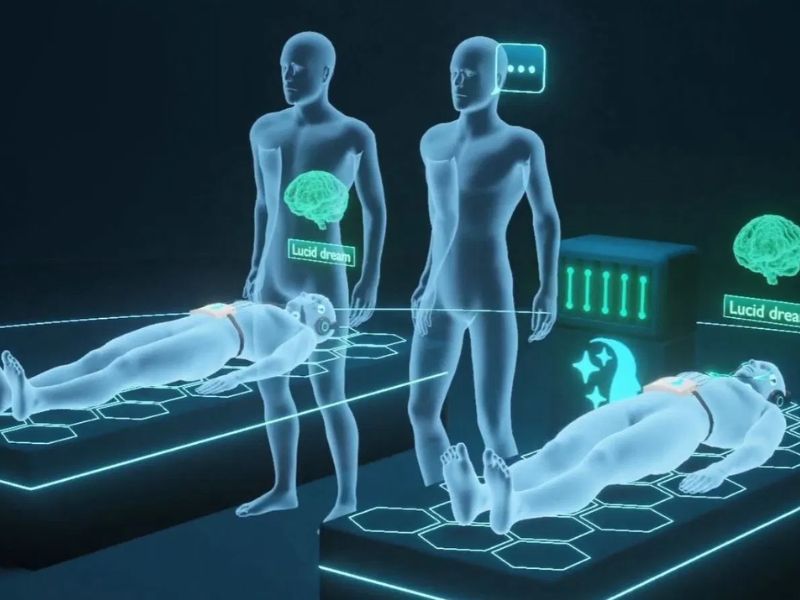
To enable communication between two dreamers, researchers designed an experiment combining advanced technology with the sleeping brain. Two lucid-dream-trained participants wore EEG devices that tracked brainwaves in real time, allowing monitoring of sleep stages and neural activity.
The experiment relied on precise timing: in lucid dreams, one participant sent messages via brainwave synchronization while the other received them. Sensory cues like light or sound triggered responses, which participants signaled through blinking or movements, detected by EEG.
By combining brainwave monitoring with lucid dream control, researchers achieved the first recorded communication between two dreamers. The experiment’s success highlights the potential for more advanced mind-to-mind interaction and offers new insights into brain activity during sleep.

This isn’t just about showing that dream communication works—it’s about the possibilities it opens.
For centuries, humans have viewed dreams as subconscious reflections, divine messages, or random mental noise. But what if they’re more than that? A space for connection, learning, and creativity?
Learning and Skill-Building Within Dreams
Imagine practicing a language, rehearsing a speech, or tackling complex problems—not while awake, but within a lucid dream. Research suggests that mental rehearsal in dreams can improve real-world skills. Could this technology make intentional learning during sleep possible?
Imagine exchanging thoughts in a dream instead of relying on speech or text—transforming long-distance relationships, therapy, and grief counseling. Dreams reveal unresolved emotions, and therapists could use them to help process trauma, face fears, or spark creativity.
Though still in its early stages, this technology has enormous potential. We’re only beginning to understand what dreams can reveal, and skepticism is the next challenge to tackle.

Every major discovery raises questions. Dream communication may sound groundbreaking, but how much is solid science, and how much is speculation?
So far, REMspace’s results haven’t been independently verified. No peer-reviewed studies have confirmed their findings, and replication—a key step in scientific validation—has yet to occur. Until other researchers reproduce similar results under controlled conditions, skepticism isn’t just expected; it’s necessary.
Unanswered Questions and Scientific Skepticism
Questions remain about how the technology works, as REMspace has shared few details, leaving room for doubt. Science is full of overhyped claims, so separating real potential from exaggeration is crucial.
Skepticism isn’t rejection—many breakthroughs, like flight and electricity, faced doubt. The next steps—independent studies, further trials, and rigorous validation—will show if this is a novelty or something revolutionary. The key question is whether we dare to move forward despite uncertainty..

Turning a single experiment into a scientific breakthrough takes time. REMspace has shown messages can be sent and received in dreams, but major challenges remain.
The next step is real-time dream communication—full conversations inside lucid dreams—requiring faster signals, better tracking, and a deeper understanding of brain processing.
The Need for Scientific Validation
Scientific validation is also needed. Without independent review or replication, skepticism persists. The future of dream communication depends on rigorous testing and transparent experiments.
Ethical questions also arise. If dream communication becomes common, how can we safeguard the subconscious from external influence? Could advertisers, corporations, or governments manipulate dreams? While the technology is still in its infancy, these concerns must be addressed before it becomes widespread.
For now, this remains an exciting possibility rather than a confirmed reality. But even at this early stage, REMspace’s experiment challenges a long-held assumption: that dreams are private, isolated experiences—a notion that may no longer hold true.
Blurring the Line Between Dreams and Reality
Dreams have long been mysterious, but this experiment suggests the line between dreams and reality may be blurrier than we thought. Refined, dream communication could open a new realm of interaction beyond speech, distance, or waking consciousness.
Skepticism is natural—verification and answers are still needed—but doubt shouldn’t halt exploration. Every major breakthrough faced resistance before becoming transformative.
The bigger question: what if the greatest frontier isn’t outer space, but our own minds? Dreams may not be mere illusions, but a space waiting to be explored—and the journey has only just begun.
Read the original article on:princeea
Read more:https://scitke.com/a-large-blimp-uses-rotating-blades-to-harness-wind-energy-from-the-sky/
Leave a Reply