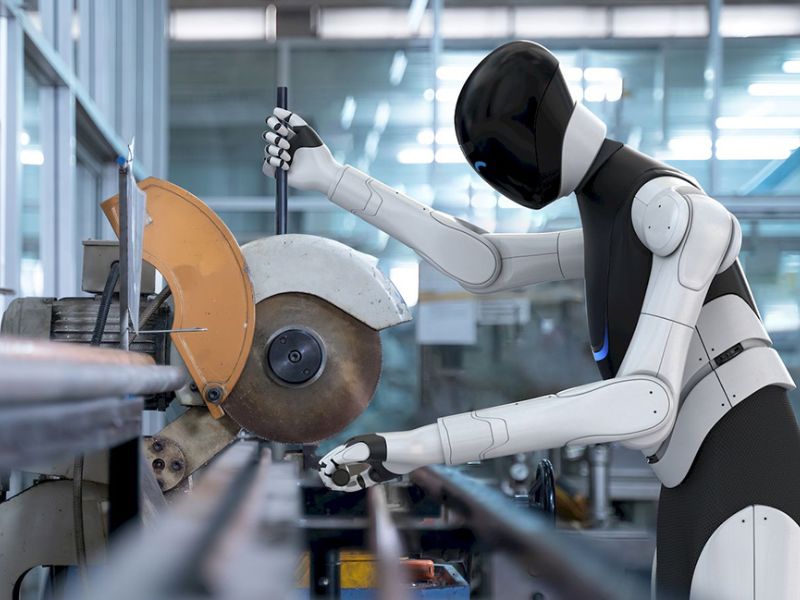

Humanoid robots have been drawing considerable attention in the robotics field over the past few years. Across the globe, robotics firms, private investors, and governments are actively working to refine this technology and find the most suitable applications for it.
“Futuristic humanoids in homes and workplaces capture public interest,” said Takayuki Ito, president of the IFR. “Since our world is built for humans, adaptable robotic assistants are a natural fit.”
However, he noted, It’s still unclear when or if humanoids will see widespread adoption. Humanoids likely won’t replace current robot models—they’ll enhance and build on today’s robotics technology instead.
China Sets Production Targets as U.S. and Europe Invest Heavily
China, currently the leading market for industrial robots, has outlined goals for large-scale production of humanoids. At the same time, U.S. and European tech firms are securing major investments with the aim of developing multipurpose robots that replicate human movement.
The IFR has published a report titled Vision and Reality, which explores current developments, possibilities, and challenges in the evolving field of humanoid robotics.
In the United States, major tech players like NVIDIA, Amazon, and Tesla are making substantial investments in artificial intelligence and robotics. In addition to military support, private capital is driving the growth of numerous startups working on humanoid robots.
According to the International Federation of Robotics (IFR), there is significant interest in deploying humanoid robots in logistics and manufacturing. These robots are primarily viewed as tools to boost productivity and efficiency, rather than as social companions. The focus in the U.S. is on functional, real-world applications, not social integration.
China Prioritizes Humanoids in National Tech Strategy with Focus on Service Industries
In contrast, China has made humanoid robots a central pillar of its national technology strategy. The government aims to highlight its technological strengths and global competitiveness by advancing humanoid development, particularly in customer-facing roles in the service sector.
The IFR noted that using humanoids in China to automate production lines and reduce dependency on human labor appears to be of secondary importance. A core element of China’s strategy involves building a scalable domestic supply chain for essential components.
Japan, a long-standing leader in humanoid robotics, introduced one of the earliest examples with Honda’s Asimo in 2000. The IFR noted that Japan often treats robots as companions rather than just machines. Schools, retail spaces, and elder care facilities use socially focused humanoids like Pepper and Palro to address the needs of an aging population. Japan’s focus is on integrating robots harmoniously into society. Companies like Kawasaki are developing humanoids for research and development purposes.
In Europe, the ethical dimensions of robotics and AI are a key concern, according to the IFR. There is a strong emphasis on collaborative robots designed to work safely alongside humans in industrial environments. The European approach centers on improving safety, enhancing human productivity, and complementing human labor — not replacing it.
European companies are also prioritizing human-centered design and assessing the social impact of robotics. There is a measured and cautious approach to deploying humanoids for automation in manufacturing and service industries, especially in the near to medium term.
Explore the Future of Humanoid Robotics at RoboBusiness 2025
Be sure to attend RoboBusiness 2025, taking place on October 15–16 in Santa Clara, California. The event will feature sessions on humanoid robot development, including the keynote “Lessons Learned from First Humanoid Deployments,” with speakers Katlyn Lewicke of GXO Logistics and Jim Fan of NVIDIA.
The humanoid-focused sessions at RoboBusiness will also cover topics such as:
- “Humanoids for Real Applications: Mastering Safety and Performance,” presented by Nikolai Ensslen, CEO of Synapticon
- “Advancements in Humanoid Actuation,” with Jordan Schaeffler, strategic business development engineer at Novanta
- “Integrating Behavioral Science into Humanoid Design,” led by Ram Devarajulu, VP and head of robotics for North America at Cambridge Consultants
RoboBusiness will also offer tracks on physical AI, enabling technologies, and robot design best practices. Attendees can expect over 60 expert speakers, a startup workshop, the annual Pitchfire competition, and ample networking opportunities.
More than 100 exhibitors will be present to showcase cutting-edge products, technologies, and services. Registration for RoboBusiness 2025 is now open.
Read the original article on: The Robot Report