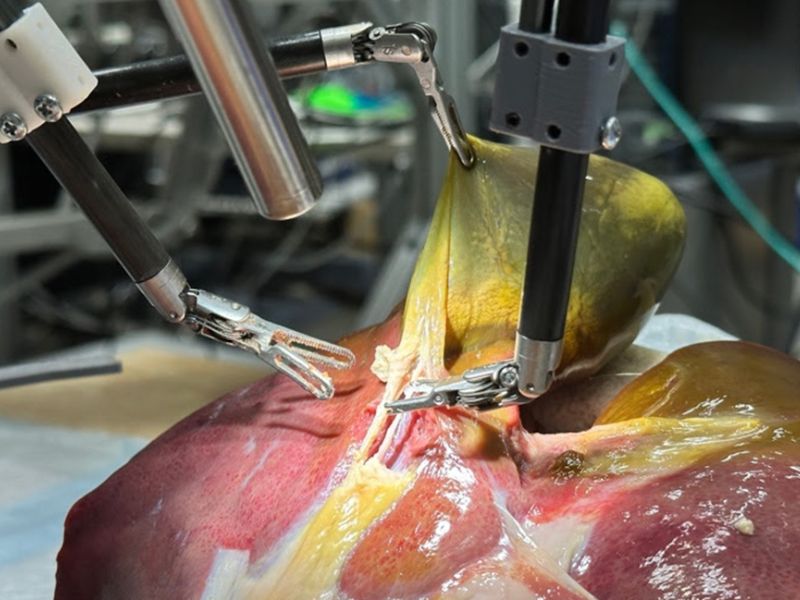

Johns Hopkins University announced today that a robot, trained using surgical videos, successfully performed a major portion of a gallbladder removal on a lifelike patient model without human intervention. During the procedure, the robot responded to voice commands from the medical team, similar to how a trainee surgeon learns from a mentor.
According to researchers, the robot demonstrated the skill level of an experienced human surgeon, even adapting to unexpected situations common in real-life emergencies. The federally funded project represents a major step forward in surgical robotics, combining mechanical precision with human-like adaptability, the university said.
“This takes us beyond robots that follow instructions to ones that truly comprehend surgical procedures,” said medical roboticist Axel Krieger. “It’s a key breakthrough toward autonomous surgical systems capable of operating in the unpredictable conditions of real-world care.”
Johns Hopkins System Adjusts To Anatomical Changes In Real Time
In 2022, Axel Krieger’s Smart Tissue Autonomous Robot (STAR) completed its first fully autonomous surgery on a live animal—a laparoscopic procedure on a pig. However, that early version needed pre-marked tissue, operated under tightly controlled conditions, and followed a fixed surgical script. Krieger compared it to teaching a robot to drive a car along a pre-planned route.
The new system, however, is far more advanced. “It’s like teaching a robot to handle any road, under any conditions, and respond intelligently to whatever it encounters,” Krieger said.
Called the Surgical Robot Transformer-Hierarchy (SRT-H), the latest model can truly perform surgery. It adjusts to each patient’s anatomy in real time, makes quick decisions, and corrects itself when something goes off plan.
Using the same machine learning architecture as ChatGPT, SRT-H is also interactive—it understands spoken instructions like “grab the gallbladder head” and corrections like “move the left arm a bit to the left,” learning from each interaction.
“This marks a significant leap over past attempts because it overcomes key challenges to bringing autonomous surgical robots into real-world use,” said Ji Woong “Brian” Kim, the study’s lead author and a former Johns Hopkins postdoc now at Stanford. “Our findings show that AI systems can be made dependable enough for real surgical autonomy—something once thought distant but now within reach.”
SRT-H Expands Upon Fundamental Surgical Functions
Last year, Krieger’s team trained their robotic system to perform three essential surgical tasks: needle handling, tissue lifting, and suturing—each completed in just a few seconds. This achievement earned Johns Hopkins a 2025 RBR50 Robotics Innovation Award.
In contrast, removing a gallbladder is far more complex, involving a sequence of 17 steps over several minutes. The robot needed to identify key ducts and arteries, grasp them precisely, apply clips in the right locations, and make careful cuts with surgical scissors.
To learn the procedure, the SRT-H system analyzed videos of university surgeons performing gallbladder removals on pig cadavers, supplemented by captions describing each step.
After training on these videos, the robot executed the procedure with 100% accuracy, according to Johns Hopkins. While it took longer than a human surgeon, its performance matched that of a skilled professional.
“This approach reflects how surgical residents often master parts of an operation at different paces,” said Jeff Jopling, co-author and Johns Hopkins surgeon. “It shows the potential of developing autonomous surgical robots in a similarly step-by-step, modular way.”
Robot Demonstrates Adaptability in Unpredictable Surgical Scenarios
The robot successfully operated under varying anatomical conditions and handled unexpected changes—such as shifts in its starting position and the introduction of blood-like dyes that altered the appearance of the gallbladder and nearby tissues.
“To me, this proves that fully autonomous execution of complex surgical procedures is possible,” Krieger said. “It demonstrates that imitation learning can be used to automate intricate operations with remarkable reliability.”
The research team aims to expand the system’s training to include additional types of surgeries and ultimately enable it to carry out entire procedures autonomously.
Read the original article on: The Robot Report
Read more: Manifold Tech’s Odin 1 Brings Spatial Intelligence to Robots