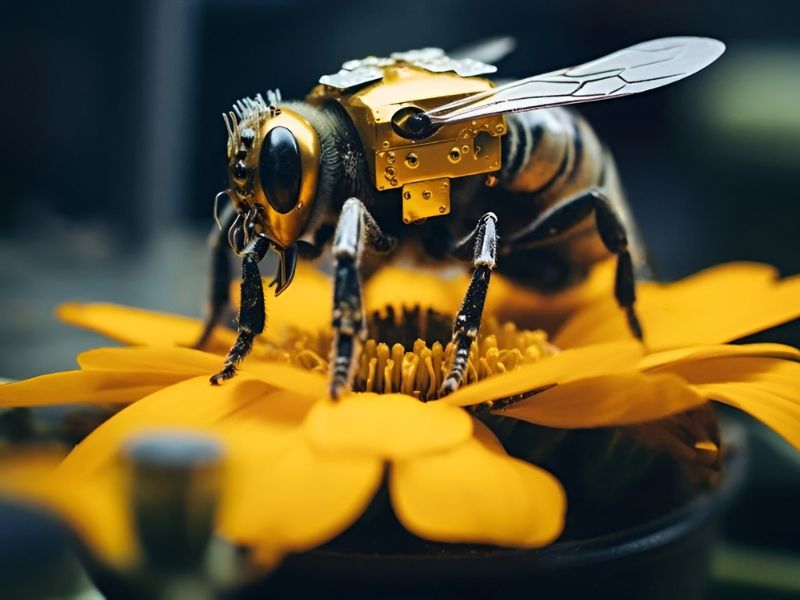

“Researchers at the Massachusetts Institute of Technology (MIT) in the United States are developing a robotic bee to transform pollination in environments too hostile for natural life—even on other planets.”
Lighter than a paper clip, the robot flaps its wings 400 times per second, flies at two meters per second, spins, and hovers. “We aim to mimic the impressive maneuvers of real bees,” says doctoral student Yi-Hsuan “Nemo” Hsiao.
The Future of Robotic Pollination
Researchers believe robotic bees could support pollination in vertical farms and even future space colonies, where real bees can’t survive.
“If you plan to grow crops on Mars, you probably wouldn’t want to rely on natural insects for pollination. That’s where our robot could play an important role,” explains Yi-Hsuan “Nemo” Hsiao.
Kevin Chen, associate professor at MIT and head of the Soft and Micro Robotics Laboratory, emphasizes that the aim is not to replace natural bees, but rather to complement their work in habitats where they are unable to function.
Nature-Inspired Robots Emerge Worldwide
MIT’s robotic bee isn’t the only project drawing inspiration from nature. Yale researchers created a gecko-like robot that sheds its limbs, a feature useful for rescue in hazardous areas.
In South Korea, a team at Chung-Ang University has developed a soft robot that mimics the movement of a caterpillar.
“Millions of years of evolution make insects the best models for movement,” says Yi-Hsuan “Nemo” Hsiao, who develops the bee robot’s flight algorithms.
The prototype itself relies on artificial muscles created by researcher Suhan Kim, which expand and contract to drive the motion of its laser-cut wings. The team also engineered tiny internal mechanisms—similar to watch components—directly in the lab.
Energy-Efficient Jumping Robots Conquer Challenging Terrain
The researchers are also developing a grasshopper-inspired model capable of leaping up to 20 centimeters and navigating diverse terrain, including ice, leaves, and grass. Compared to flying robots, this design is seen as more energy-efficient.
Because of their compact size, both prototypes could one day be applied in search-and-rescue operations or in inspections of difficult-to-access areas, such as pipelines and turbine engines.
For now, however, the robots still depend on external power through wires. “Integrating a miniature power source into such small machines is extremely challenging,” explains Kevin Chen. He predicts that fully autonomous versions may still be 20 to 30 years away.
Even so, the team is confident that studying insects offers a crucial advantage. “They’ve been refined by millions of years of evolution. Their movement, behavior, and structures provide invaluable lessons,” Chen adds.
Read the original article on: Fenati Org
Read more:Researchers Create a 3D Embryo Model that Makes Blood Cells