
Moving into a new home often feels like tackling a massive, three-dimensional puzzle when packing the moving truck. Every item must fit perfectly, and any instability or imbalance can make it shift and damage itself during the move.
Load Balancing: Humans vs. Robots
Humans naturally balance objects—whether a tray of food or a stack of boxes—through the coordination of their muscles and inner ear. For robots, however, staying balanced while carrying loads is much more complicated, requiring constant monitoring of both their own position and the object’s to make real-time adjustments.
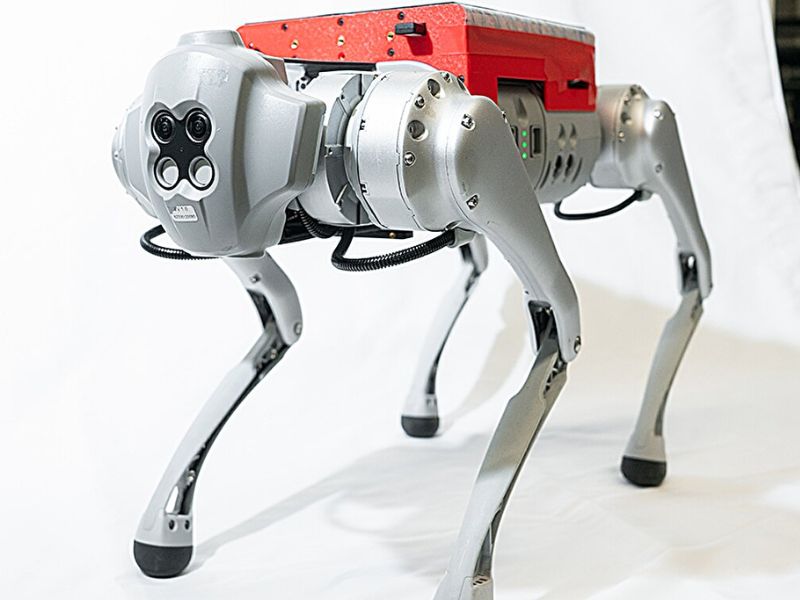
To address this, researchers at Carnegie Mellon University’s Department of Mechanical Engineering have created a tactile sensor that allows a four-legged robot to transport unsecured cylindrical objects over long distances.
Previously, quadrupedal robots relied on containers to hold items, restricting the types of objects they could move. LocoTouch, a high-density tactile sensor array covering the robot’s entire back, provides feedback on the object’s position, enabling the robot to adjust its movements and keep the load stable.
“The tactile sensor uses a piezoresistive film sandwiched between conductive fabric electrodes,” explained Changyi Lin, a Ph.D. candidate in the Safe AI Lab. “Each sensing element sits where the electrodes cross, so when an object shifts and bends the piezoresistive film, the electrodes detect the resulting change in resistance.”
Using over 4,000 digital twins of the robot dog combined with reinforcement learning, the team taught the robot to adapt to almost any movement of an object on its back. The abilities acquired in simulation transferred directly to the real world without additional fine-tuning. In lab tests, the robot navigated around cones, traversed obstacles, and responded to external disturbances—such as a person nudging the object—while carrying items of different shapes and sizes over a distance exceeding 60 meters.

Tactile Sensing: Giving Robots a Human-Like Touch
“Robots are meant to assist humans, so they must perceive and interact with the world as we do.” This is the first time tactile sensing has been implemented in quadrupedal robots, but it’s just the beginning,” said Ding Zhao, assistant professor of mechanical engineering. “With this feedback, robots will be able to perform more complex tasks. Our next goal is to scale the sensors to cover an entire robot.”
The team believes this technology brings us closer to practical home-helper robots. They also envision outdoor applications, such as carrying sensors to remote areas to monitor landslides. Beyond that, it could assist in hospitals, factories, or even on a truck bed, making it easier to move objects.
Read the original article on: Tech Xplore
Read more: Automation and Smart, Data-Driven Tech are Transforming Construction’s Future