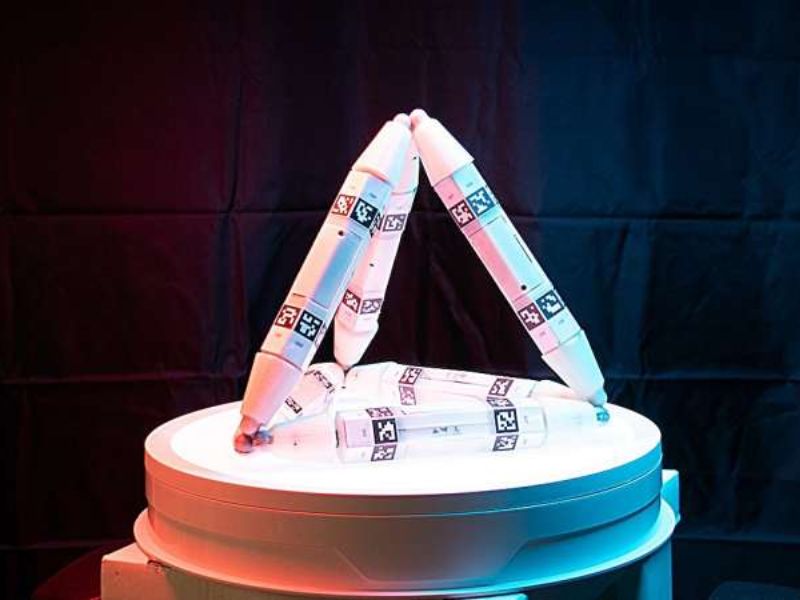

Modern robots are limited by rigid, closed bodies that can’t grow, self-repair, or adapt. But scientists at Columbia University have now created robots that can physically “grow,” “heal,” and enhance themselves by absorbing material from their surroundings or other robots.
A new study in Science Advances introduces “Robot Metabolism“—a process that lets robots take in and reuse materials from their environment or other machines.
Robots That Think, Grow, and Self-Repair
“True autonomy means robots must think and maintain themselves,” says Philippe Martin Wyder. “Like living beings, they grow, adapt, and repair using materials from their environment or other robots.”
The researchers showcase this new approach using the Truss Link—a robotic magnetic rod inspired by the Geomag toy. Each Truss Link is a simple, bar-like unit with versatile magnetic connectors that can extend, retract, and attach to other modules at various angles, allowing them to form more complex structures.
Self-Assembling Robots That Evolve and Improve Themselves
The researchers demonstrated how individual Truss Links could self-assemble into flat, two-dimensional shapes that then transformed into 3D robots. These robots further enhanced themselves by incorporating additional modules, effectively “growing” into more advanced machines. In one case, a tetrahedron-shaped robot added an extra link to use as a walking stick, boosting its downhill speed by over 66.5%.
“Robot intelligence has advanced, but their bodies remain rigid and non-recyclable,” says Hod Lipson, co-author and Columbia professor. He also leads the Creative Machines Lab where the research was conducted.
“In contrast, biological organisms are inherently adaptable—they grow, heal, and evolve. This flexibility comes from biology’s modular design, where components like amino acids can be reused across different lifeforms. To truly progress, robots must adopt a similar strategy—learning to utilize and repurpose parts from other machines. This emerging concept is what we call ‘machine metabolism.’”
A Vision of Self-Sustaining Robotic Ecosystems Inspired by Nature
Researchers envision robots in self-sustaining ecosystems, growing and adapting like nature’s modular systems, leading to resilient, self-improving machines.
“Robot Metabolism bridges digital intelligence and the physical world, letting AI evolve mentally and physically,” explains Wyder. At first, this capability will serve specialized roles, such as in disaster response or space missions. Eventually, AI could build physical machines as easily as it edits your emails.
Lipson offers a word of caution: “The idea of self-replicating robots can sound like something out of dystopian science fiction. As robots become more common—from cars to factories—the question is: who will maintain them? We can’t count on humans to do it all. Ultimately, robots will need to learn to sustain and repair themselves.”
Read the original article on: Techcrunch
Read more: Malaysia Will Require Official Approval To Trade AI Chips Made In The United States