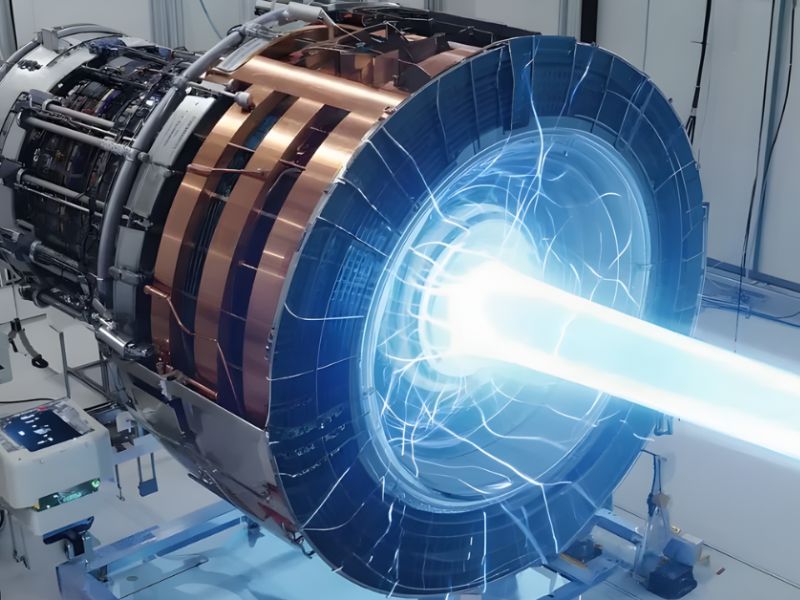

Scientists tied to Rosatom have revealed a plasma engine that could cut Earth–Mars travel to 30–60 days. The announcement has renewed discussion about the future of space exploration and whether such technology could realistically support interplanetary missions.
Developed by engineers at the Rosatom Research Institute, the project focuses on nuclear and advanced propulsion systems. Unlike chemical rockets, the plasma engine uses energized particles for efficient, long-lasting thrust.

The engine uses a plasma stream guided by electromagnetic fields, allowing continuous acceleration and much faster travel to Mars.
Laboratory Testing Shows Promising Stability and Efficiency
The prototype is still undergoing laboratory tests and has been examined inside vacuum chambers designed to mimic space conditions. During these trials, engineers assessed plasma stability, energy efficiency, and the ability to operate continuously. Rosatom reports that early results show stable long-term operation, a critical factor for extended missions.
Even so, specialists caution that a 30-day trip to Mars remains a theoretical estimate. Making this engine practical requires spacecraft integration, sustained power, and solutions for radiation, heat, and crew safety.
Power supply is another major issue. High-output plasma engines demand vast amounts of electricity, likely necessitating compact onboard nuclear reactors. Despite Russia’s nuclear expertise, such systems pose technical, safety, and political challenges for space use.
Global Research Continues, but No Operational Missions Yet
Analysts also note that similar propulsion concepts are being explored in countries like the United States and China, but all remain experimental. No space agency has yet completed a long-range mission—crewed or uncrewed—using high-power electric propulsion as the main drive.
Realistically, even if the technology performs as expected, its use in human missions to Mars is unlikely before the next decade. Extensive testing in Earth orbit, uncrewed demonstration flights, and full validation of life-support and protection systems would be required first.
The announcement reflects a trend toward faster, safer, and more efficient space travel, reducing risks and strain for astronauts.
Overall, the claims rest on credible scientific work but are far from immediate application. The engine currently exists only as a prototype, the timelines rely on simulations, and there is no official schedule for an operational mission using this propulsion system.
Read the original article on:Regisandrade
Read more:A Remarkable Sodium-Ion Battery Built Around a Core of “Wood.”