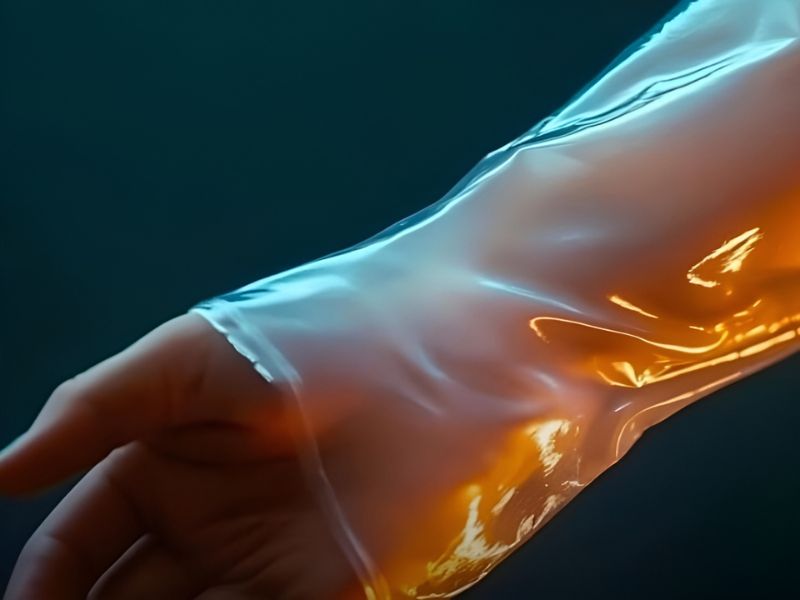

In a major scientific breakthrough, researchers from Aalto University and the University of Bayreuth have created a groundbreaking self-healing hydrogel that replicates the properties of human skin. This advanced material can restore itself by 90% in just four hours and completely within 24 hours, paving the way for innovations in wound care, regenerative medicine, and artificial skin development.
Mimicking the Complexity of Human Skin
Gels are common in daily products, but replicating human skin’s complexity has long been a challenge. Human skin is not only flexible and strong but also remarkable in its ability to heal. Until recently, scientists had been unable to design a material that matched both its elasticity and regenerative capabilities. This new hydrogel, created through the integration of nanosheet-reinforced polymers, finally achieves that balance.
This remarkable breakthrough was reported today (March 7) in the renowned journal Nature Materials. In the study, researchers improved a hydrogel by incorporating large, ultra-thin clay nanosheets. While hydrogels are usually soft and pliable, this new version forms a tightly organized network where polymers are densely interlaced between the nanosheets. This structure not only enhances the hydrogel’s strength but also enables it to repair itself after sustaining damage.
Balancing Strength and Self-Healing in Synthetic Materials
“Many biological tissues possess both strength and rigidity while maintaining the ability to recover from damage. However, synthetic hydrogels struggle to balance strength and self-healing, as stiffening methods limit molecular movement, the researchers explained.
The self-healing gel marks a significant step forward in fields such as wound care, drug delivery, soft robotics, and prosthetics. Its rapid and efficient healing capabilities make it a strong candidate for medical innovations, potentially enabling faster recovery for burn victims, surgical patients, and individuals with chronic wounds.
Read the original article on: Espalhe Boas Noticias
Read more: Medically, What Does Sleep Talking Signify?