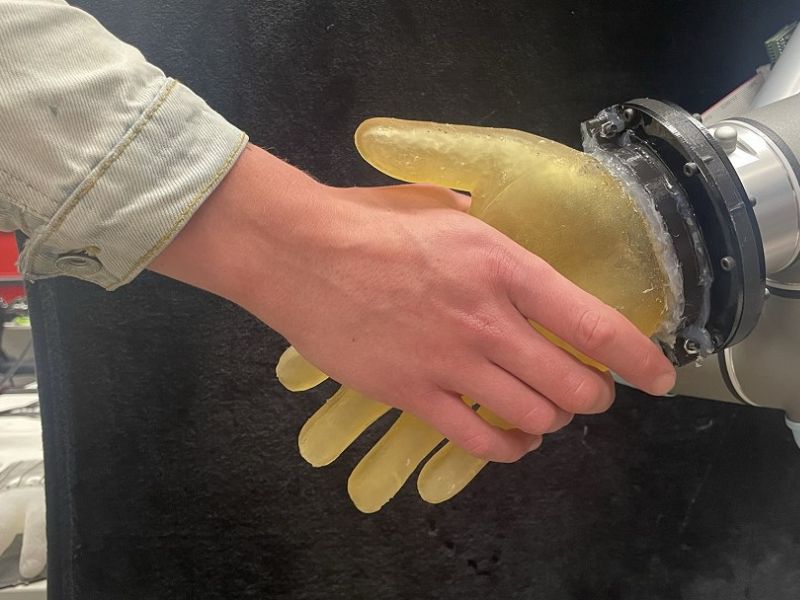

Replicating the touch and sensitivity of human skin—known as robotic touch—might not require advances in flexible electronics or the integration of thousands of miniature sensors.
Researchers have developed a new type of robotic skin that is low-cost, durable, and highly sensitive. This innovative skin delivers exceptional precision and fits onto robotic hands like a glove.
Moldable Conductive Polymer Offers Versatile Foundation for Robotic Skin
David Hardman and his team at the University of Cambridge and University College London created a conductive polymer they can melt and mold into complex shapes.
Although it doesn’t match the sensitivity of human skin, the material can process signals from over 860,000 microscopic channels, enabling it to detect various types of touch and pressure—such as a finger’s contact, temperature differences, cuts or punctures, and multiple simultaneous touches.
Remarkably, all of this is achieved using a single material, greatly simplifying the design. By reading physical inputs, this tech helps robots interact more like humans.

Most current robotic touch technologies rely on small, localized sensors and require separate components to detect different kinds of touch. In contrast, the newly developed electronic skin functions as a single, unified sensor—closer in function to human skin.
One Material, Many Sensations
“Using different sensors for each type of touch makes the manufacturing process more complex,” explained David Hardman. “Our goal was to create a single material that could detect multiple types of touch at once.”
The researchers achieved this using a sensor material capable of multimodal sensing—responding differently to various forms of touch. Though pinpointing each signal is tricky, the materials are easier to make and more durable.overall.
To interpret the signals, the team experimented with different electrode layouts to identify which configuration yielded the most detailed data. With only 32 wrist electrodes, they collected over 1.7 million data points from the hand via the material’s fine conductive network.
From Gentle Contact to Physical Damage
They tested the prototype with a variety of stimuli, including light touch, multiple simultaneous touches, heat exposure from a heat gun, and physical damage from a scalpel. Data collected from these tests was then used to train a machine learning model that can accurately interpret future touch inputs.
Robotic skin hasn’t yet matched human capabilities, said Professor Thomas Thuruthel, but this is the most advanced and easiest to produce so far—and it works well across real-world tasks.
Read the original article on: Inovacaotecnologica