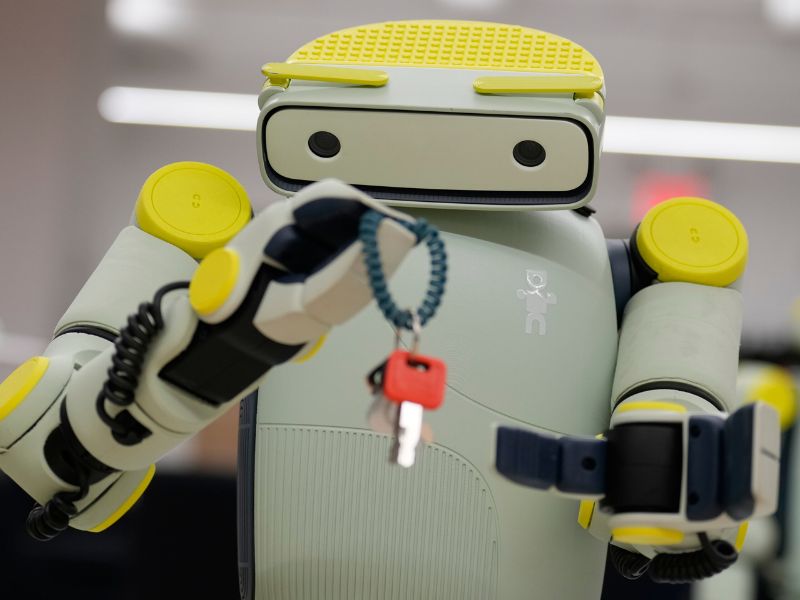

As a new robot named Sprout roams a Manhattan office—bobbing its boxy head, flicking its windshield-wiper-style “eyebrows,” and extending its grippers for a handshake—it bears little resemblance to the sleek, imposing humanoids produced by companies like Tesla.
Sprout’s appeal is intentional. This humanoid stands just 3.5 feet (1 meter) tall, meets a 5-year-old at eye level, and wears a soft, padded layer of sage-green foam that makes it feel approachable.
Developed in secrecy over two years by the stealth startup Fauna Robotics, Sprout made its public debut Tuesday with the goal of kick-starting an entirely new industry focused on creating “approachable” robots for homes, schools, and shared social environments.
In many respects, the robot is a first of its kind in the United States, arriving at a moment when rapid progress in artificial intelligence and robotics has finally made such designs feasible. And if Sprout’s expressive movements and blinking lights feel familiar, they may echo the lovable, slightly clunky robotic companions long imagined in Star Wars films, animated worlds, and children’s books.

“Most people in this field draw inspiration from the science fiction we grew up watching,” said Rob Cochran, co-founder and CEO of Fauna Robotics. “Some look to Westworld or The Terminator. We look to WALL-E, Baymax, and Rosie from The Jetsons.”
Making the Case for Robots Beyond Car Assembly Lines
The common assumption about humanoid robots is that they will enter the workforce in warehouses or factories long before they ever reach homes. Prominent prototypes like Tesla’s Optimus—CEO Elon Musk touts it as central to the company’s future—and Boston Dynamics’ Atlas, which Hyundai plans to deploy in car manufacturing by 2028, follow that envisioned trajectory.
Fauna, however, aims to bypass that stage and target a very different audience: robot builders and developers. Just as early personal computers and later smartphones fueled communities of programmers to create new software and apps, Sprout aims primarily to serve developers rather than act as a standalone robot. It is also a highly complex machine, carrying a price tag of $50,000.

That price point is one that some university research labs and tech founders are already paying for Unitree, a Chinese company that sells a lightweight humanoid frequently showcased at robotics conferences and competitions. Others, however, have steered clear of Chinese-made hardware because of tariffs and wider security worries.
Cochran says Fauna is “the first American company to be actively shipping robots as a developer platform,” noting that he has personally delivered the initial units. Among the early buyers are Disney and Boston Dynamics.
“You can take it straight out of the box and start walking it around right away,” said Marc Theermann, Boston Dynamics’ chief strategy officer, in a recent interview. “The first time you see their robot, it gives you a glimpse of the future. And if you look closely, you can imagine how something like that could feel at home with people.”
Inside the Testing Lab for a “Friendly Humanoid” Robot
Sprout may not be able to lift heavy items, but it can dance the Twist or the Floss, pick up a toy block or teddy bear, and even pull itself out of a chair for a leisurely walk across the wooden floors of Fauna’s headquarters in Manhattan’s Flatiron District.

Cochran and co-founder Josh Merel, Fauna’s chief technology officer, showcased the robot to The Associated Press in mid-January ahead of its public debut. Employees and an AP reporter controlled Sprout using a video game controller, a smartphone app, and a virtual-reality headset. The robot also has enough awareness of the office layout to carry out simple tasks, like checking the inventory of the break room fridge.
Recovering Gracefully Like a Human
Sprout moves slowly but steadily across uneven surfaces. It nearly stumbled once when it sharply turned to avoid a person and accidentally hit its foot on a low, protruding table wheel that its cameras couldn’t detect. Built to handle what engineers call perturbations, the robot quickly regained its balance and continued walking—much like a clumsy human would.
“If you step in front of it, it won’t crash into you—it will plan a new route around you,” said Ana Pervan, a Fauna research scientist responsible for the robot’s mapping and navigation. She joined Fauna as one of its first 50 employees. She loved sci-fi author Isaac Asimov and previously worked on self-driving cars, but the startup attracted her with the chance to help build a robot that could one day act like a personal assistant.
“It’s cute, and not overly humanoid, which I think makes it more fun,” Pervan added. “It doesn’t veer into creepy territory or try too hard to seem human. It’s more like a buddy or a pal—a completely different experience.”

Why Fauna Sees Now as the Time for Humanoid Robots
Launching a robot company is a tough endeavor, especially for those creating personal robots. Even one of the few long-term successes, iRobot—the maker of Roomba vacuums—filed for bankruptcy protection last month after decades in business.
Many others didn’t survive nearly as long. Anki, known for the playful Cozmo robot, and Jibo, which made Time Magazine’s 2017 “best inventions” cover, both went under within a few years.
“There were many brilliant efforts, but the technology just wasn’t ready,” Cochran said. “Now, I believe we’re on the verge of being able to build a companion that’s present, engaging, delightful, and can navigate a space like nothing before.”
From AI Research to Robotics Startup
Merel, a specialist in robot locomotion, previously worked at Google’s DeepMind, where he used AI learning techniques in simulated environments to train robots—a method once controversial but now increasingly common in robotics. His research on an AI-powered virtual rat, co-authored with Fauna research scientist Diego Aldarondo, was published in the journal Nature.
Cochran and Merel later collaborated at CTRL-labs, a wearable neurotech company acquired by Facebook in 2019. Cochran jokes that he then “spent a misguided four years at Goldman Sachs” before the two decided to join forces again.
Advances in AI, motors, and batteries have sped up humanoid development. Still, Fauna’s founders agreed that the stark, dystopian look of many prototypes—what Cochran calls “industrial automotive machismo”—might project strength and confidence but wouldn’t be suitable for personal, human-centered spaces.
“They were generally large and physically risky to be near,” Cochran said. “Strong, heavy. If one fell on you, it would be a serious problem.”
The team brought in Anthony Moschella, who had designed Peloton’s exercise bikes, treadmills, and rowers, and who admires the abstract, playful designs of Star Wars droids like R2-D2 and BB-8.
“Let’s create a system that people actually want to be around,” said Moschella, now Fauna’s vice president of hardware. “It’s surprising how many robotics companies overlook the cultural context of what it means to share space with a robot.”
Moschella noted that Sprout’s future will be shaped by how developers experiment with it and what they discover. For Cochran, some of the most important critics have already weighed in: a home video on his phone shows his 2-year-old twins jumping with excitement as Sprout greets them.
Read the original article on: Tech Xplore
Read more: A Futuristic Keyboard with Snap-On Modules for Editing, Modeling, and Productivity