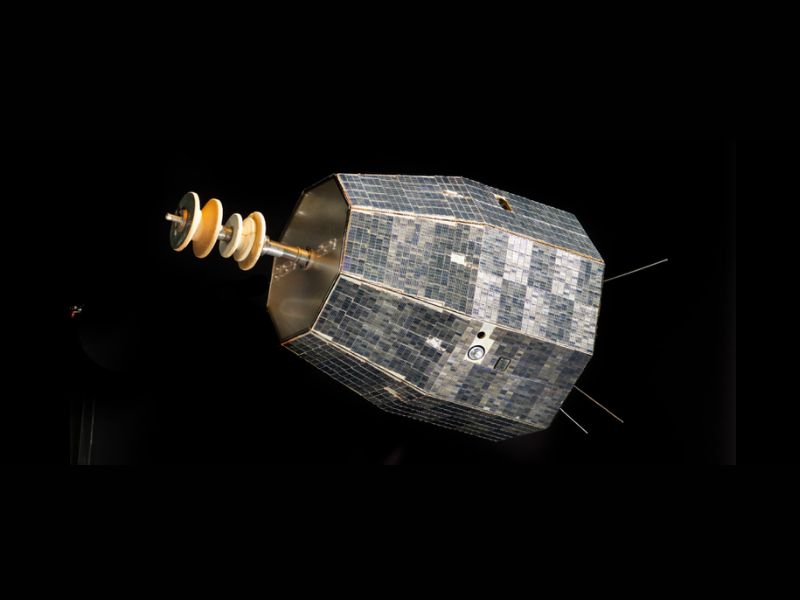

A fast radio burst observed last year has been linked to an unexpectedly peculiar origin. While scientists usually detect such signals from deep space and classify them as natural rather than artificial, the burst recorded on June 13, 2024, stood out—it came from a human-made source.
Specifically, it came from a long-defunct NASA satellite that has been silently orbiting Earth for over five decades.
“We detected a burst of emission spanning 695.5 to 1031.5 megahertz using the Australian Square Kilometre Array Pathfinder (ASKAP),” reported a research team led by astronomer Clancy James from the Curtin University branch of the International Centre for Radio Astronomy Research.
“By analyzing near-field time delays, we traced the signal back to the decommissioned Relay 2 satellite.”
As our capabilities in astronomy and our presence in space continue to advance, it’s increasingly vital to identify human-made signals, understand their origins, and assess any potential risks they may pose.
When Space Junk Masquerades as Cosmic Phenomena
Scientists have already traced some mysterious signals back to everyday terrestrial technology—famously identifying a passing truck and even a microwave oven as the sources. However, orbiting debris can also mislead scientists and instruments—just as when sunlight reflecting off an old rocket stage fooled researchers into thinking they had detected a gamma-ray burst.
The case of Relay 2 raises particular concern. NASA launched the satellite in 1964 and operated it briefly before decommissioning it in 1967. Since then, it has remained in a high, drifting orbit between 1,867 and 7,648 kilometers (1,160 to 4,752 miles) above Earth.
Fast radio bursts are a mysterious cosmic event that astronomers are working to understand. These flashes are incredibly intense, lasting just milliseconds but releasing as much radio energy as 500 million Suns in that brief moment.
Rare Visitors from Afar
These signals typically travel vast distances—millions to billions of light-years—through intergalactic space. So far, scientists have pinpointed only one fast radio burst source within our galaxy—a magnetar that erupted 30,000 light-years from Earth.
So when Clancy James and his team began tracing a nanosecond radio signal detected on June 13, 2024, they were surprised to find that it came from much closer—just 4,500 kilometers above Earth’s surface.
Clearly, that ruled out a magnetar as the source. The most likely explanation was an Earth-orbiting satellite.
“Using ASKAP’s coordinates, the burst’s timing, and the Skyfield Python module, we looked for a time and positional match with known Earth satellites,” the team wrote.
“We found a strong candidate in NORAD ID 737 (Relay 2) … Based on this, we conclude the burst originated from Relay 2.”
The burst couldn’t have been caused by sunlight reflection. The researchers narrowed the cause to two likely scenarios: either an electrostatic discharge or a plasma event triggered by a micrometeoroid strike.
While micrometeoroids are a recognized risk in Earth’s orbital environment and could explain the signal, the team leans toward an electrostatic discharge as the more probable cause.
Read the original article on: Sciencealert
Read more: SpaceX’s Starship Explodes Before Completing 10th Test Flight