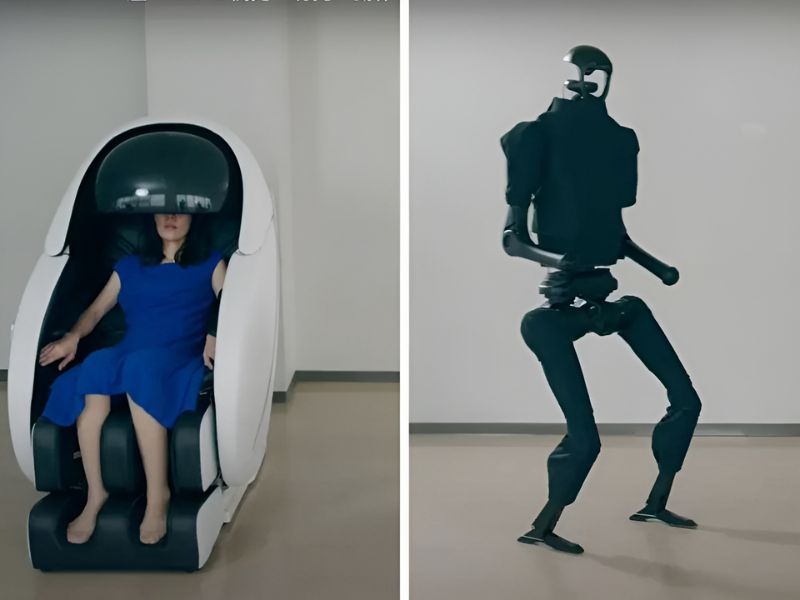
Image Credits:The system’s muscle-focused design enables robots to replicate not only a user’s actions but also the intensity behind them.
A Japanese tech startup has created a device that can transmit a person’s full-body movements and physical force.
H2L’s Capsule Interface enables immersive shared experiences between humans, robots, and avatars, expanding remote interaction possibilities.
Resembling a massage chair, the system turns the user’s body into a control interface that can operate a humanoid robot. The Tokyo-based company demonstrated its capabilities in a short video.
Real-Time Human Motion Replication in Humanoid Robots
In May 2025, researchers from Stanford University and Simon Fraser University introduced TWIST, an AI system that allows humanoid robots to accurately replicate human movements in real time.
In a video released by H2L, a woman remotely operates a humanoid robot from Unitree Robotics using the Capsule Interface system.
The robot performs tasks such as cleaning, lifting a box, and interacting with another person, demonstrating the system’s ability to transmit precise body movements and physical force.
Capturing Intent and Force Through Muscle Sensors
The Capsule Interface uses advanced muscle-displacement sensors that detect even the slightest changes in muscle tension. The technology captures a user’s intent and force by tracking subtle muscle movements in real time.
This differs from traditional teleoperation systems, which typically use motion sensors—such as IMUs, exoskeletons, or optical trackers—to replicate a user’s movements.
H2L argues that motion data alone cannot capture the subtle details required for realistic physical and emotional interaction. While syncing visuals and positions can create a basic sense of control, it does not reproduce the forces applied or the effort felt during the action.
The Capsule Interface maps real-time muscle activity to robots, enhancing force awareness, haptic realism, and embodiment.
Replicating Movement and Effort for Enhanced Immersion
This muscle-focused method enables robots to replicate not only a user’s movements but also the intensity behind them. For example, when lifting a heavy object, the robot reflects the level of effort the user exerts. This feedback enhances immersion and empathy by conveying both motion and force.
H2L envisions teleoperation as more than simple imitation—turning it into a deeply shared, physical experience.
The Capsule Interface marks a new step in remote interaction, allowing users to transmit full-body movements and physical force to robots or avatars while sitting or lying down.
Equipped with speakers, a display, and muscle-displacement sensors, the device detects subtle muscle movements to relay a user’s intent and effort in real time.
Seamless, Low-Effort Integration into Everyday Furniture
H2L says the Capsule Interface provides a low-effort, natural experience that fits into beds or chairs, unlike complex traditional systems.
According to the company, the technology has many potential uses. In business settings, people could attend meetings or complete tasks in distant locations by remotely operating humanoid robots from home or nearby offices.
It could also allow delivery workers to lift and transport items remotely, reducing physical strain, and enable safe robot operation in dangerous environments such as disaster zones.
The approach could support dual-income households, assist older adults, and help with everyday chores such as cooking and cleaning. Farmers could also remotely control agricultural robots and share expertise, helping reduce labor demands.
The interface may also enable more immersive avatar communication in virtual environments, opening possibilities in healthcare, entertainment, and education. In the future, H2L plans to add proprioceptive feedback to enhance realism and expand shared experiences between humans and machines.
Image Credits:Divulgação/Universidade de Ciência e Tecnologia Pohang
Researchers at Pohang University of Science and Technology in South Korea have designed a paper-thin robot that can exert tremendous force. Published in Nature Communications in July, the study suggests it may have applications in surgery or industrial machinery.
The robot mimics the proteins that drive human muscle movement. In humans, the motor protein myosin powers most motions, from organelle transport to muscle contraction. Inspired by myosin, scientists created a robot with surface protrusions that attach to various materials, enabling movement in multiple directions.
Paper-Thin Yet Powerful: A Blade-Shaped Robot That Crawls
Though as thin as paper, the blade-shaped device generates substantial force. It contains dozens of small, overlapping 3D air chambers and a network of pneumatic circuits. Even when folded, it can “crawl like a caterpillar” using just its protrusions.
The robot’s design enables it to navigate confined spaces and handle objects. Scientists say it could be applied in fields ranging from surgery to industrial operations. “By adjusting the pressure sequence, the robot can move across surfaces in six directions, at varying speeds and distances,” the study notes.
Image Credits:Reprodução/Nature Communications… – Veja mais em https://www.uol.com.br/tilt/noticias/redacao/2025/08/09/coreia-do-sul-robo-com-pele-macia-e-flexivel.htm?cmpid=copiaecola
Traditional robots are usually made from rigid metal parts, which provide strength but restrict delicate movements and operation in tight spaces.
The new study offers a different approach, combining power with flexibility. The actuator performs tasks like clearing pipes, handling objects, and transporting items underwater, the study reports.
Navigating the Human Body with Finger-Like Accuracy
The South Korean-developed technology can operate within the human body. As demand rises for robots that can perform delicate internal procedures, this robot offers finger-like precision, allowing medical teams to use it through small surgical openings.
The team also created a mathematical model to forecast the robot’s movements, laying the groundwork for future projects and applications. Researchers aim to deploy the technology in surgery, industry, and exploration
After all, gray hair isn’t just a sign of aging. A new study from the University of Tokyo suggests it results from how pigment-producing stem cells react to DNA damage. So, what does this imply?
As we age, the emergence of gray hair is a natural and inevitable sign of time passing. Because of this, it might seem that gray hair and melanoma—a type of skin cancer—have little in common.
The Hidden Link Between Gray Hair and Cancer
Yet, new research from the University of Tokyo indicates that both may stem from how pigment-producing stem cells respond to DNA damage.
In essence, these cells—found within hair follicles—face a pivotal choice when exposed to genotoxic stress:
Differentiate and exit the system, contributing to aging; or
Continue dividing, which can eventually lead to tumor formation.
Throughout life, our cells are continually subjected to environmental and internal factors that can harm DNA.
Unraveling the Missing Link Between DNA Damage, Aging, and Cancer
Although it’s well established that DNA damage plays a role in both aging and cancer, the precise link—particularly how damaged stem cells influence tissue health over time—remains unclear.
Image Credits:Folículo capilar, uma estrutura complexa localizada na derme, responsável pela produção e crescimento dos fios de cabelo.
Melanocytic stem cells (McSCs) are specialized tissue-resident cells that give rise to mature melanocytes—the pigment-producing cells responsible for hair and skin color.
In mammals, McSCs are located in the bulge and subbulge areas of hair follicles, where they exist as immature melanoblasts and sustain pigmentation through repeated cycles of regeneration.
Tracking Stem Cell Behavior
In the recent study, researchers employed long-term in vivo lineage tracing and gene expression analysis in mice to explore how McSCs react to various forms of DNA damage.
Led by Professors Emi Nishimura and Yasuaki Mohri, the team identified a unique process called senescence-coupled differentiation. In this process, McSCs undergo irreversible differentiation and are subsequently lost, resulting in the graying of hair.
Conversely, when exposed to certain carcinogenic agents, McSCs can evade this protective differentiation mechanism. Despite the presence of DNA damage, they retain their self-renewal ability, proliferate into clones, and ultimately follow a tumor-prone trajectory.
Redefining Hair Graying and Melanoma as Two Sides of the Same Process
Nishimura emphasized that this finding “redefines hair aging and melanoma not as separate phenomena, but as different results of how stem cells respond to stress.”
Although the study is significant, it does not imply that hair graying directly prevents cancer.
Rather, it reveals that both processes may stem from the way McSCs handle DNA damage—either by differentiating and exiting the system, which leads to aging, or by continuing to divide, where the persistence of damaged cells can eventually give rise to tumors.
Thus, the research suggests that senescence-differentiation serves as a stress-induced protective mechanism that helps remove potentially dangerous cells.
Ultra-processed foods (UPFs) — like sodas, snacks, and processed meats — are heavily altered, additive-filled products low in nutrients. They now account for nearly 60% of adults’ and almost 70% of children’s diets in the U.S.
Designed to last longer and be more appealing, UPFs reduce overall nutritional quality and often lead to overeating. In the U.S., they contribute to roughly 60% of daily calorie intake. Regularly consuming UPFs increases the risks of obesity, cancer, cardiovascular and metabolic disorders, mental health issues, and even early death.
High UPF Consumption Tied to Elevated Inflammation Marker
Recent research from Florida Atlantic University’s Charles E. Schmidt College of Medicine found that high UPF consumers have significantly higher hs-CRP levels — a key inflammation marker and predictor of heart disease.
Until now, few studies using nationally representative U.S. data have examined the relationship between UPF intake and hs-CRP levels.
Published in The American Journal of Medicine, the study showed that participants got a median of 35% of their daily calories from UPFs. Intake levels ranged from 0–19% in the lowest group to 60–79% in the highest. After accounting for lifestyle and health factors, those with the highest UPF intake were 11% more likely to have elevated hs-CRP levels. Moderate consumers saw a 14% increase, while lower-level consumers showed a smaller, non-significant 7% rise.
Certain groups were at even greater risk. Adults aged 50–59 had a 26% higher chance of elevated inflammation compared to those aged 18–29. Obese individuals had an 80% higher risk, and smokers saw a 17% increase. Surprisingly, lack of physical activity did not significantly affect risk.
“These findings clearly show that high UPF consumers have significantly higher hs-CRP levels, a key marker of inflammation,” said Allison H. Ferris, M.D., FACP, senior author and chair of FAU’s Department of Medicine. “They highlight key implications for healthcare, public policy, and future research on reducing UPF-related health risks.”
Study Links Ultra-Processed Food Intake to Increased Inflammation
Researchers analyzed data from 9,254 U.S. adults in a national survey, measuring diet, hs-CRP levels, and other health factors. Ultra-processed food intake was calculated as a percentage of total calories and divided into four groups. Statistical methods showed a clear link between higher UPF consumption and inflammation.
“hs-CRP is a low-cost, highly sensitive marker of inflammation and future heart disease,” said co-author Dr. Charles H. Hennekens. “Healthcare providers should talk to patients about the dangers of UPFs and the benefits of whole foods.”
The team also noted rising colorectal cancer rates in younger adults and suggested UPFs may play a role, along with other digestive disorders.
They compared UPFs to tobacco, noting that industry influence may slow policy change. Still, efforts to improve labeling, cut additives, and provide healthier options show promise, though wider public health support is needed.
During sleep, the body releases ‘growth hormone‘ to repair and strengthen muscles and bones — though the exact mechanisms behind this process have long been unclear.
Now, through detailed analysis of brain circuits in mice, a research team led by scientists at the University of California, Berkeley (UC Berkeley) has uncovered specific mechanisms and feedback loops that control the release of growth hormone during sleep.
Unlocking Sleep’s Role in Growth Hormone Release for Better Treatments
These discoveries may improve treatment for conditions linked to sleep disturbances, such as type 2 diabetes and Alzheimer’s disease. Gaining insight into sleep is essential for understanding many different facets of our overall health.
“While people know that sleep closely influences growth hormone release, researchers have mostly observed this by measuring hormone levels in the blood during sleep,” explains UC Berkeley neuroscientist Xinlu Ding.
“Our approach involves directly recording brain activity in mice to understand the process in real time. We’re laying the groundwork for future research that could lead to new treatment options.”
The researchers analyzed the release of growth hormone in mice during sleep/wake cycles. (Ding et al., Cell, 2025)
Distinct Growth Hormone Release Patterns During REM and Non-REM Sleep
Tracking brain activity over several sleep-wake cycles in mice, researchers showed that growth hormone releases differently during REM (rapid eye movement) and non-REM sleep.
Although levels of the hormone rose in both stages, the balance of neurons that stimulate or suppress its release changed depending on the sleep phase. Researchers also identified a feedback loop involving neurons in the locus coeruleus, a brain region associated with wakefulness.
“This indicates that sleep and growth hormone work together in a closely regulated system,” says neuroscientist Daniel Silverman. “Not getting enough sleep can lower growth hormone levels, while excessive growth hormone may actually nudge the brain toward being awake.”
Sleep triggers the release of growth hormone, which in turn helps regulate wakefulness — a balance that’s vital for growth, tissue repair, and overall metabolic health.
Growth Hormone’s Role in Metabolism and the Potential for New Sleep Disorder Treatments
Beyond its primary role in supporting growth, growth hormone also plays a key part in managing how the body processes glucose and fat. When insufficient sleep disrupts hormone levels, it can increase the risk of conditions like obesity, diabetes, and heart disease. These findings further highlight the important connection between sleep and overall well-being.
Additionally, the locus coeruleus helps regulate alertness during wakefulness, suggesting that the mechanisms uncovered in this study may also influence daytime cognitive function.
However, much more research is required to confirm these findings. While there’s strong reason to think that these processes are similar in humans and mice, that assumption still needs to be verified. In the long run, though, this research could lead to new treatments for sleep disorders — a challenge that many people face.
“By understanding the neural pathways involved in growth hormone release, we may eventually develop new hormone-based therapies to enhance sleep quality or restore healthy growth hormone levels,” says Silverman.
“There are experimental gene therapies that focus on targeting specific types of cells. This newly identified circuit could offer a unique way to reduce the overactivity of the locus coeruleus — something that hasn’t been explored before.”
A Nature Neuroscience study found that observing signs of illness—like coughing or rashes—prompts the brain to anticipate infection risk and trigger immune defenses.
In an interview with Nature, he explained: “The findings highlight the brain’s ability to anticipate events and choose the right response to address them.”
To safely mimic an infectious threat, the team used Oculus Rift virtual reality headsets.
Virtual Avatars Simulating Illness Symptoms
Participants encountered virtual human avatars displaying flu-like symptoms—such as coughing or visible rashes—that entered their field of vision without making physical contact.
Meanwhile, a control group only received an actual flu vaccine, without exposure to avatars.
Researchers tracked participants’ brain and immune activity through electroencephalograms (EEG), functional MRI scans (fMRI), and blood analyses.
When sick avatars came near, brain regions tied to the “peripersonal space”—the area immediately surrounding the body—became active. This system acts as an early-warning mechanism for nearby threats.
Activation of the Salience Network and Stress Response Pathways
The response also engaged the salience network, which detects critical stimuli like danger. The hypothalamus then received signals and activated the hypothalamic-pituitary-adrenal (HPA) axis, which regulates stress and immune-related hormones.
Ultimately, this cascade boosted levels of innate lymphoid cells (ILCs), fast-acting immune cells that serve as the body’s frontline defense.
Volunteers who interacted with sick virtual avatars showed stronger activation of these immune cells compared to those who only received the vaccine.
Notably, the immune response occurred only when infection-related cues were present. Avatars displaying fear but lacking illness symptoms did not trigger the same brain or immune activity.
The researchers highlight that this “early brain alert” reveals a key, previously underexplored, connection between the central nervous system and the immune system—even without direct pathogen exposure.
Neural Anticipation Triggers Immune Responses Similar to Real Infections
“We demonstrate that potential contact with infectious avatars in the peripersonal space, within virtual reality, is anticipated by sensorimotor regions and activates the salience network. This forward-looking neural response alters the activity and frequency of innate lymphoid cells, closely resembling reactions to real infections,” they explained.
The study also supports the idea of a “behavioral immune system”—an evolutionary drive to avoid sick individuals to lower infection risk—something made especially evident during the COVID-19 pandemic.
However, the authors note that the research is preliminary and has limitations. Immune effects were tested with only one vaccine (FluarixTetra 2018–2019), and participants were healthy young adults (average age 26), restricting the findings’ generalizability across different age groups.
It remains unclear whether still images of sick people would provoke the same response as moving avatars. Emotional influences, such as disgust, may also play a role in shaping brain activity and warrant further study.
The researchers stress that the brain’s ability to detect infection cues—even in simulations—functions as a highly adaptive “early warning system,” much like a smoke detector: it is preferable to raise a false alarm than to miss a genuine threat.
The earliest robot I recall is Rosie from The Jetsons, followed not long after by the polished C-3PO and his loyal partner R2-D2 in The Empire Strikes Back. My first encounter with a bodiless AI, however, was Joshua from WarGames—the computer that nearly triggered nuclear war before discovering the logic of mutually assured destruction and opting to play chess instead.
At seven, everything shifted for me. Could a machine truly grasp ethics, emotions, or what it means to be human? Did AI require a body to achieve that? These questions grew stronger as portrayals of artificial intelligence became more nuanced—through figures like Bishop the android in Aliens, Data in Star Trek: TNG, and later Samantha in Her or Ava in Ex Machina.
These questions are no longer just hypothetical. Roboticists are actively debating whether artificial intelligence requires a body—and, if it does, what form that body should take. Beyond that lies the challenge of “how”: if embodiment is essential for achieving true artificial general intelligence (AGI), could soft robotics be the breakthrough that makes it possible?
The Boundaries Of Bodiless AI
Recent research is starting to reveal flaws in today’s most advanced – and notably bodiless – AI systems. A new Apple study looked at so-called “Large Reasoning Models” (LRMs), language models designed to generate reasoning steps before producing an answer. While these models outperform standard LLMs on many tasks, the paper shows that their performance collapses once problems reach higher levels of complexity. Instead of simply plateauing, they break down, even when supplied with ample computing resources.
More troubling, they don’t reason in a consistent or algorithmic way. Their “reasoning traces” – the step-by-step process they follow – often lack internal coherence. And as tasks become harder, the models appear to put in even less effort. The authors conclude that these systems don’t truly “think” in a human-like manner.
Nick Frosst, a former Google researcher and co-founder of Cohere, told The New York Times that today’s systems are essentially designed to take words as input and predict the most probable next word — a process he noted is quite different from how humans think.
Cognition Is More Than Just Computation
How did we arrive at this point? For much of the 20th century, artificial intelligence was guided by GOFAI—“Good Old-Fashioned AI”—which viewed cognition as symbolic logic. The early assumption was that intelligence could be created by manipulating symbols, much like a computer runs code. In that framework, abstract reasoning didn’t require a body.
But cracks began to show when early robots struggled in unpredictable, real-world environments. This pushed researchers in psychology, neuroscience, and philosophy to reconsider the problem, drawing on insights from studies of animal and plant intelligence—systems that adapt, learn, and respond to their surroundings through direct physical engagement rather than symbolic representations.
Even in humans, the enteric nervous system—the so-called “second brain” in the gut—demonstrates this principle. It relies on the same cells and neurotransmitters as the brain to manage digestion, much like an octopus tentacle uses those same components to sense and act independently within a single limb.
Paraphrase: This leads to the question—what if true adaptable intelligence comes from being spread across the whole body, rather than existing only in the brain, cut off from the physical world?
Paraphrase: This is the core principle of embodied cognition: perception, action, and thought form a single, unified process. As Rolf Pfeifer, Director of the University of Zurich’s Artificial Intelligence Laboratory, explained to EMBO Reports: “Brains have always evolved within bodies that must engage with the world to survive. They don’t emerge in some abstract, algorithmic void.”
Embodied Minds: An Alternative Form of Thought
We may need more adaptable bodies to match advanced AI — and Cecilia Laschi, a leading figure in soft robotics, argues that adaptability comes from softness. After years of working on rigid humanoid robots in Japan, she turned her focus to soft-bodied designs, drawing inspiration from the octopus, a creature without a skeleton whose limbs operate semi-independently.
“With a humanoid robot, every movement has to be precisely controlled,” she told New Atlas. “If the ground changes, you need to adjust the programming.”
By contrast, animals don’t consciously calculate every step. “Our knees naturally yield,” Laschi notes. “We handle uneven surfaces through our bodies’ mechanics, not our brains.” This illustrates embodied intelligence — the notion that parts of cognition can be delegated to the body itself.
From an engineering standpoint, embodied intelligence offers clear benefits: by shifting perception, control, and decision-making into a robot’s physical design, the central processor has less work to do — enabling robots to operate more reliably in unpredictable conditions.
In a May issue of Science Robotics, Laschi explains that motor control isn’t handled solely by a robot’s computing unit—external forces acting on the body also shape its movements. In other words, behavior emerges from interaction with the environment, and intelligence develops through experience rather than being fully pre-coded into software.
From this perspective, progress in intelligence isn’t about faster processors or larger models, but about engagement with the world. Soft robotics plays a central role here, using materials like silicone and advanced fabrics to create flexible, adaptive machines. Such robots can adjust in real time—like a soft robotic arm modeled on an octopus tentacle, which can grasp, explore, and react without calculating every step in advance.
Living Matter and Loops: Teaching Materials To Think
To create soft robots as capable as an octopus tentacle, engineers must move beyond coding for every scenario and instead develop novel methods for sensing and response. Achieving lifelike independence in machines is driving research toward a new idea: autonomous physical intelligence (API).
At UCLA, Associate Professor Ximin He has advanced this field by developing soft materials—such as adaptive gels and polymers—that not only respond to external stimuli but also control their own movement through inherent feedback mechanisms.
He explains to New Atlas that their research focuses on building decision-making into the materials themselves. These materials don’t just shift shape when stimulated — they can also ‘decide’ how to adapt or fine-tune that response based on their own deformation, effectively adjusting their next movement.
Back in 2018, his team showcased this with a gel capable of self-regulating its motion. Since then, they’ve demonstrated that the same concept extends to other soft materials, such as liquid crystal elastomers that perform well in air.
Building Intelligence into the Material Itself
The foundation of API lies in nonlinear, time-delayed feedback. Unlike conventional robots, where sensors feed data to a controller that then issues commands, He’s method weaves this decision-making process directly into the material itself.
“In robotics, you need sensing, actuation, and a way to choose between them,” He says. “We’re building that choice physically through feedback loops.”
He likens the idea to biology: negative feedback stabilizes systems, as in glucose regulation or a thermostat, while positive feedback reinforces change. Nonlinear feedback blends the two, enabling stable yet dynamic patterns of motion – such as pendulum swings or walking cycles.
“Much of natural movement – walking, swimming, and so on – depends on rhythmic, repeating patterns,” He explains. “By using nonlinear, delayed feedback, we can engineer soft robots that step forward, step back, and continue moving – all without constant outside control.”
This marks a significant leap from earlier soft robots that depended entirely on external triggers. As He and colleagues noted in a recent review, embedding sensing, control, and actuation within the material itself pushes robotics toward systems that don’t just respond passively, but can choose, adjust, and act independently.
Softness Is The New Smart
Soft robotics is still emerging, but its potential is immense. Laschi highlights early applications such as surgical instruments—like endoscopes—that can both explore and respond to delicate human tissue, or rehabilitation devices that adjust and move in harmony with a patient’s needs.
To progress from AI to AGI, machines might require bodies—flexible and adaptive ones in particular. After all, most living beings, humans included, learn through movement, contact, trial, and correction. We navigate an unpredictable, messy world with ease, whereas today’s AIs still falter. Our understanding of an apple doesn’t come from reading its definition, but from holding, tasting, dropping, bruising, slicing, squeezing, and watching it decay.
This kind of knowledge—embodied, sensory, and contextual—is difficult to instill in a system trained only on text or images. By interacting directly with the physical world, AI can overcome the limits of language that constrain today’s LLMs and begin to form its own model of reality. That model wouldn’t mirror a human perspective, but could be something altogether different. A soft robot, equipped with unique sensory abilities—like infrared sight, deep-frequency hearing, or detecting diseases through smell—might cultivate a novel (and potentially very valuable) way of perceiving life on Earth.
As Giulio Sandini, Professor of Bioengineering at the University of Genoa, explains: “To create human-like intelligence in a machine, it must gather its own experiences. Like children, it has to learn through doing—and that almost certainly means having a body.”
Alcohol can take a serious toll on your health, sometimes in ways you might not expect. From immediate effects like headaches and anxiety to long-term risks such as cancer, its impact can be wide-ranging.
If you’re considering a break from drinking, you’ll likely notice both short-term improvements and lasting health benefits.
But how soon can you expect to feel the positive changes?
We’ve created a timeline—backed by scientific studies—that outlines what you might experience in the days, weeks, months, and even years after cutting out alcohol.
Many benefits begin right away, meaning each alcohol-free day brings a boost to your health.
Just 24 Hours Later
It takes about 24 hours for alcohol to fully clear from your system, so positive changes can begin within a day.
Alcohol increases urination, which leads to dehydration. However, your body can rehydrate quickly, absorbing water almost instantly. Once the alcohol is gone, reduced dehydration helps improve digestion, brain function, and energy.
(pixelshot/Canva)
Alcohol interferes with the liver’s ability to manage blood sugar, but once it’s out of your system, blood sugar levels begin to stabilize.
If you drink daily, the first few days without alcohol might feel challenging as your body adapts. You could experience sleep disturbances, mood swings, sweating, or tremors. However, these symptoms typically ease within a week of staying alcohol-free.
After One Week
Although alcohol can initially make you feel drowsy, it actually disrupts your sleep cycle. After a week without drinking, you may find yourself waking up with more energy thanks to deeper, more restful sleep.
Your liver, which plays a key role in filtering blood, processing nutrients, and producing bile for digestion, bears much of the burden when it comes to alcohol. Even moderate drinking can harm it. Fortunately, the liver has a strong ability to heal. In cases of mild damage, just seven days without alcohol may reduce liver fat and begin repairing scar tissue.
Alcohol also affects brain function, even in small amounts. Stopping drinking can lead to improved brain health in just a few days for light to moderate drinkers, and within a month for heavy users.
After One Month
Alcohol can interfere with mood regulation and often worsens symptoms of anxiety and depression. After a few weeks without alcohol, most people begin to feel emotionally better—even heavy drinkers often report improved mood within one to two months.
As sleep quality and emotional health improve, you’re also likely to experience increased energy and an overall boost in well-being.
(AJ_Watt/Getty Images Signature/Canva)
After One Month of No Alcohol
Many regular drinkers begin to feel more confident about changing their relationship with alcohol after a month of abstinence.
You might also notice weight loss and a reduction in body fat. Alcohol is high in kilojoules and can activate hunger signals, often leading to overeating or poor food choices.
Your skin may appear healthier, too—alcohol contributes to dehydration and inflammation, which can age your appearance. Quitting helps reverse these effects.
Digestive health also improves. Alcohol can irritate the gut, causing bloating, indigestion, heartburn, and diarrhea—all of which typically begin to clear up within four weeks.
Additionally, insulin resistance—which can lead to high blood sugar—drops by about 25% after a month. Blood pressure tends to fall by around 6%, and levels of cancer-related growth factors decline, reducing your long-term cancer risk.
After Six Months
The liver begins healing within weeks of stopping alcohol, and for moderate drinkers, liver damage may be completely reversed by the six-month mark.
Even heavy drinkers often notice improved immune function and overall health by this point, feeling stronger and more resilient.
After One Year or More Alcohol is a contributing factor in many chronic illnesses, including heart disease, stroke, type 2 diabetes, several cancers, and mental health conditions. Cutting back or quitting significantly lowers your risk for these conditions.
Alcohol raises blood pressure, one of the leading global causes of death. Even a small 2mmHg increase above the normal level (120mmHg) can raise the risk of death from stroke by 10% and coronary artery disease by 7%.
Reducing alcohol to fewer than two drinks per day can noticeably lower blood pressure, which in turn reduces the risk of stroke, heart disease, kidney disease, vision problems, and erectile dysfunction.
Long-term abstinence also decreases cancer risk. A study of over 4 million people over 3–7 years found that quitting alcohol lowered the risk of alcohol-related cancers by 4% for light drinkers and by 9% for heavy drinkers who reduced to moderate consumption.
Making a Change
Cutting back on alcohol—even slightly—can lead to immediate and noticeable improvements in your brain function and overall health. The less you drink and the more time you put between drinks, the better it is for your well-being.
Whether you’re reducing your intake or quitting entirely, here are some helpful strategies to stay on track:
Set clear goals along with manageable steps to reach them.
Track the positive changes you experience after reducing or stopping alcohol.
Use a Drink Tracker to monitor your progress.
Seek support from resources like Hello Sunday Morning’s Daybreak app (anonymous), SMART Recovery, CounsellingOnline, or Sober in the Country.
If you’re still unsure about whether to make changes, you can assess your drinking risk through online tools.
That refreshing sensation you experience when breathing in fresh air in nature might involve more than just the absence of pollution.
While we typically associate nutrients with our diet, a closer examination of scientific studies reveals compelling evidence that humans can also absorb certain nutrients directly from the air.
In a recent perspective article in Advances in Nutrition, we introduce the term “aeronutrients” to describe nutrients absorbed through inhalation, distinguishing them from “gastronutrients,” which are absorbed via the digestive system.
We suggest that breathing can complement our diet by providing essential nutrients like iodine, zinc, manganese, and certain vitamins.
This concept is well-supported by existing research, so why hasn’t it gained widespread attention until now?
Breathing Exposes Us to Nutrients Constantly Over a Lifetime
We inhale roughly 9,000 liters of air daily and about 438 million liters over a lifetime. Unlike eating, breathing is constant. This continuous exposure to the components of air, even in trace amounts, accumulates significantly over time.
So far, most research on air’s impact on health has focused on pollution, emphasizing the need to filter out harmful substances rather than exploring potential benefits. Additionally, since a single breath contains only tiny amounts of nutrients, the significance has often been overlooked.
For centuries, many cultures have recognized the health benefits of nature and fresh air. The concept of aeronutrients provides scientific support for these beliefs. Oxygen, for instance, is technically a nutrient—a chemical essential for sustaining the body’s basic functions.
We don’t usually refer to it as a nutrient because we inhale it instead of consuming it.
Aeronutrients enter the body through small blood vessels in the nose, lungs, olfactory epithelium (where smell is detected), and oropharynx (the back of the throat).
The lungs are capable of absorbing much larger molecules than the gut—specifically, 260 times larger. These molecules pass directly into the bloodstream and brain without being broken down.
Inhaled substances like cocaine, nicotine, and anesthetics enter the body almost instantly and are effective at much lower concentrations compared to when consumed orally.
In contrast, the gut breaks down substances into their smallest components using enzymes and acids before they enter the bloodstream, where they are then metabolized and detoxified by the liver.
The Gut’s Limitations Drive Innovation in Oral Drug Development
While the gut is highly effective at absorbing starches, sugars, and amino acids, it’s less efficient at taking in certain drugs. As a result, scientists are continually working to improve oral medications for better absorption.
Many scientific insights that seem obvious in hindsight have been right in front of us all along. Research from the 1960s showed that laundry workers exposed to iodine in the air had higher levels of iodine in their blood and urine.
More recently, Irish researchers studied schoolchildren living near coastal areas rich in seaweed, where iodine gas levels in the air were significantly higher. These children had notably more iodine in their urine and were less likely to be iodine-deficient compared to those living in areas with less seaweed or rural locations. Diet alone didn’t explain these differences.
This suggests that airborne iodine, particularly in seaweed-rich areas, could help supplement dietary iodine, making it a potential aeronutrient absorbed through breathing.
Manganese and zinc can enter the brain through the neurons in the nose that detect smell. While manganese is essential for health, excessive amounts can be harmful, as seen in welders exposed to high levels of airborne manganese, leading to dangerous buildup in the brain.
Specialized Receptors in the Respiratory System Detect Key Aeronutrients
The cilia in the olfactory and respiratory systems have special receptors that can bind to a variety of aeronutrients, including nutrients like choline, vitamin C, calcium, manganese, magnesium, iron, and even amino acids.
Research from over 70 years ago showed that aerosolized vitamin B12 could treat vitamin B12 deficiency, which is especially important for those at higher risk, such as vegans, older adults, people with diabetes, and those with excessive alcohol consumption.
There are still many unanswered questions. First, we need to identify which components of air promote health in natural environments like forests, green spaces, oceans, and mountains. So far, most research has focused on pollutants, particulate matter, and allergens like pollen.
Next, we need to determine which of these air components qualify as aeronutrients.
Since aerosolized vitamin B12 has already been shown to be both safe and effective, further studies could investigate whether other micronutrients, such as vitamin D, could be converted into aerosols to help address common nutrient deficiencies.
We need to conduct controlled experiments to examine these potential aeronutrients, focusing on their dosage, safety, and their contribution to our diet. This is especially important in environments with highly filtered air, such as airplanes, hospitals, submarines, and space stations.
It’s possible that aeronutrients could play a role in preventing some of the modern diseases associated with urbanization. In the future, nutrition guidelines might suggest inhaling certain nutrients, or recommend spending more time in nature to naturally absorb aeronutrients, complementing a healthy, balanced diet.
We use cookies on our website to give you the most relevant experience by remembering your preferences and repeat visits. By clicking “Accept All”, you consent to the use of ALL the cookies. However, you may visit "Cookie Settings" to provide a controlled consent.
This website uses cookies to improve your experience while you navigate through the website. Out of these, the cookies that are categorized as necessary are stored on your browser as they are essential for the working of basic functionalities of the website. We also use third-party cookies that help us analyze and understand how you use this website. These cookies will be stored in your browser only with your consent. You also have the option to opt-out of these cookies. But opting out of some of these cookies may affect your browsing experience.
Necessary cookies are absolutely essential for the website to function properly. These cookies ensure basic functionalities and security features of the website, anonymously.
Cookie
Duration
Description
cookielawinfo-checkbox-analytics
11 months
This cookie is set by GDPR Cookie Consent plugin. The cookie is used to store the user consent for the cookies in the category "Analytics".
cookielawinfo-checkbox-functional
11 months
The cookie is set by GDPR cookie consent to record the user consent for the cookies in the category "Functional".
cookielawinfo-checkbox-necessary
11 months
This cookie is set by GDPR Cookie Consent plugin. The cookies is used to store the user consent for the cookies in the category "Necessary".
cookielawinfo-checkbox-others
11 months
This cookie is set by GDPR Cookie Consent plugin. The cookie is used to store the user consent for the cookies in the category "Other.
cookielawinfo-checkbox-performance
11 months
This cookie is set by GDPR Cookie Consent plugin. The cookie is used to store the user consent for the cookies in the category "Performance".
viewed_cookie_policy
11 months
The cookie is set by the GDPR Cookie Consent plugin and is used to store whether or not user has consented to the use of cookies. It does not store any personal data.
Functional cookies help to perform certain functionalities like sharing the content of the website on social media platforms, collect feedbacks, and other third-party features.
Performance cookies are used to understand and analyze the key performance indexes of the website which helps in delivering a better user experience for the visitors.
Analytical cookies are used to understand how visitors interact with the website. These cookies help provide information on metrics the number of visitors, bounce rate, traffic source, etc.
Advertisement cookies are used to provide visitors with relevant ads and marketing campaigns. These cookies track visitors across websites and collect information to provide customized ads.