The U.S. government has prohibited WhatsApp on devices used by staff in the House of Representatives, citing security concerns, according to a memo obtained by Reuters.
Reuters reports that the House Office of Cybersecurity labeled WhatsApp a high-risk app due to unclear data protection practices, lack of encryption for stored data, and other potential security vulnerabilities.
Recommended Secure Messaging Alternatives
The memo recommends alternatives such as Signal, iMessage, FaceTime, and Microsoft Teams.
In January, Meta reported uncovering and blocking a hacking operation that targeted roughly 90 WhatsApp users, including journalists. The attack was linked to Paragon Solutions, an Israeli spyware company acquired in December by U.S.-based private equity firm AE Industrial Partners.
A May research report suggested that governments in Australia, Canada, Cyprus, Denmark, Israel, and Singapore are likely clients of Paragon.
Meta has not yet responded to a request for comment.
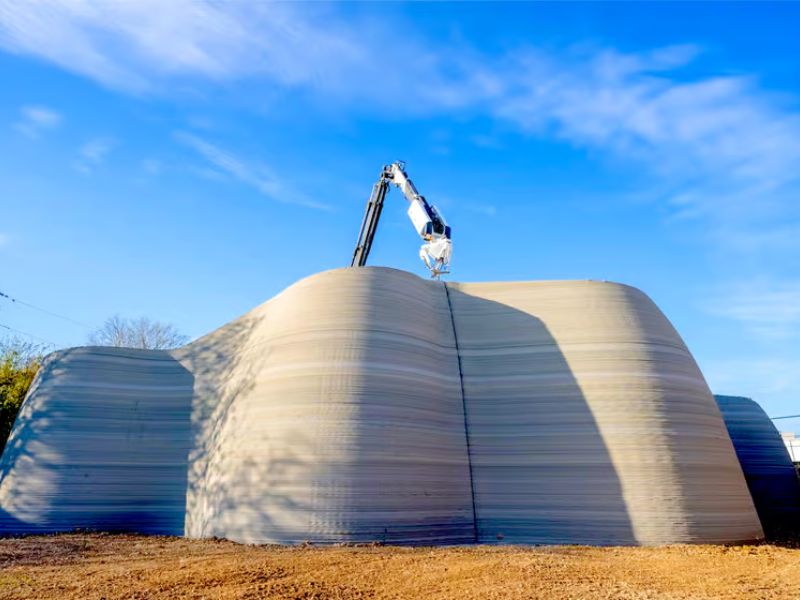
The 27-ft-high curvy Phoenix House is now on display in Austin, Texas Icon
Icon’s latest 3D construction printer can construct two-story concrete buildings quicker and more cost-effectively than its previous Vulcan printer. This technology has been utilized to erect a 27-foot-high structure named Phoenix House, currently showcased in Austin, Texas.
Since debuting its inaugural 3D-printed house at the SXSW festival in Austin in 2018, Icon, based in Texas, has emerged as a frontrunner in the creation of 3D-printed structures. Utilizing its Vulcan 3D construction printer, the company has constructed over 130 homes throughout the United States and Mexico. Additionally, it has ambitions to construct the world’s largest 3D-printed neighborhood within its home state. Icon has also contributed to a NASA initiative, collaborating on the construction of a model habitat for Mars. Additionally, the company actively develops 3D-printed structures on the Moon, including landing pads, roads, and habitats, as part of Project Olympus.
Advancements in 3D Construction Printing: Introducing the Phoenix Printer
The company has recently made significant strides in the field of 3D construction printing with the introduction of its Phoenix printer. According to the Icon team, their aim was to design a 3D printer that offers easier setup and portability between sites, reduces the need for operators, and enhances efficiency for larger projects. The Phoenix printer differs from the company’s previous Vulcan model by integrating a sizable articulated arm mounted on a rotating base, instead of being fixed within a pillar and cross-beam framework.
Designing a 3D construction printer with a movable arm presented a key challenge in ensuring the precision required for building habitable structures. Icon addressed this challenge by developing a stabilization system to prevent the extruding nozzle at the arm’s end from swaying due to its movements or environmental factors like wind. This enhanced system not only improves mobility but also enables the printing of larger structures, including multi-story buildings such as Phoenix House.
27 Ft-tall 3D-printed Structure Built by New Robot | ICON’s Multi-Story Robotic Construction System
As per the company’s statements, the updated Phoenix printer reduces costs by half compared to the capabilities of the Vulcan printer. Icon estimates that utilizing the system will incur expenses of approximately US$25 per square foot for wall systems, or US$80 per square foot for structures incorporating a foundation and roof. According to Icon, this could potentially result in savings of around US$25,000 for the construction of a standard American home.
Automating Construction with Robots and AI
“In the future, I foresee most construction being automated by robots, with AI systems managing construction-related data,” said Jason Ballard, Co-Founder and CEO of ICON. “This approach is crucial for cutting construction costs and time in half while creating higher-quality homes that better reflect inhabitants’ values.”
In line with this vision, ICON has launched Vitruvius, an AI-powered system enabling anyone to design homes compatible with the company’s technology.
“Vitruvius aims to translate human inputs into detailed architecture, plans, and budgets,” the company explained. “It allows users to design homes and generate floor plans, renders, and budgets in minutes.” ICON expects Vitruvius to produce complete construction documents and permit-ready designs by year’s end.
We use cookies on our website to give you the most relevant experience by remembering your preferences and repeat visits. By clicking “Accept All”, you consent to the use of ALL the cookies. However, you may visit "Cookie Settings" to provide a controlled consent.
This website uses cookies to improve your experience while you navigate through the website. Out of these, the cookies that are categorized as necessary are stored on your browser as they are essential for the working of basic functionalities of the website. We also use third-party cookies that help us analyze and understand how you use this website. These cookies will be stored in your browser only with your consent. You also have the option to opt-out of these cookies. But opting out of some of these cookies may affect your browsing experience.
Necessary cookies are absolutely essential for the website to function properly. These cookies ensure basic functionalities and security features of the website, anonymously.
Cookie
Duration
Description
cookielawinfo-checkbox-analytics
11 months
This cookie is set by GDPR Cookie Consent plugin. The cookie is used to store the user consent for the cookies in the category "Analytics".
cookielawinfo-checkbox-functional
11 months
The cookie is set by GDPR cookie consent to record the user consent for the cookies in the category "Functional".
cookielawinfo-checkbox-necessary
11 months
This cookie is set by GDPR Cookie Consent plugin. The cookies is used to store the user consent for the cookies in the category "Necessary".
cookielawinfo-checkbox-others
11 months
This cookie is set by GDPR Cookie Consent plugin. The cookie is used to store the user consent for the cookies in the category "Other.
cookielawinfo-checkbox-performance
11 months
This cookie is set by GDPR Cookie Consent plugin. The cookie is used to store the user consent for the cookies in the category "Performance".
viewed_cookie_policy
11 months
The cookie is set by the GDPR Cookie Consent plugin and is used to store whether or not user has consented to the use of cookies. It does not store any personal data.
Functional cookies help to perform certain functionalities like sharing the content of the website on social media platforms, collect feedbacks, and other third-party features.
Performance cookies are used to understand and analyze the key performance indexes of the website which helps in delivering a better user experience for the visitors.
Analytical cookies are used to understand how visitors interact with the website. These cookies help provide information on metrics the number of visitors, bounce rate, traffic source, etc.
Advertisement cookies are used to provide visitors with relevant ads and marketing campaigns. These cookies track visitors across websites and collect information to provide customized ads.