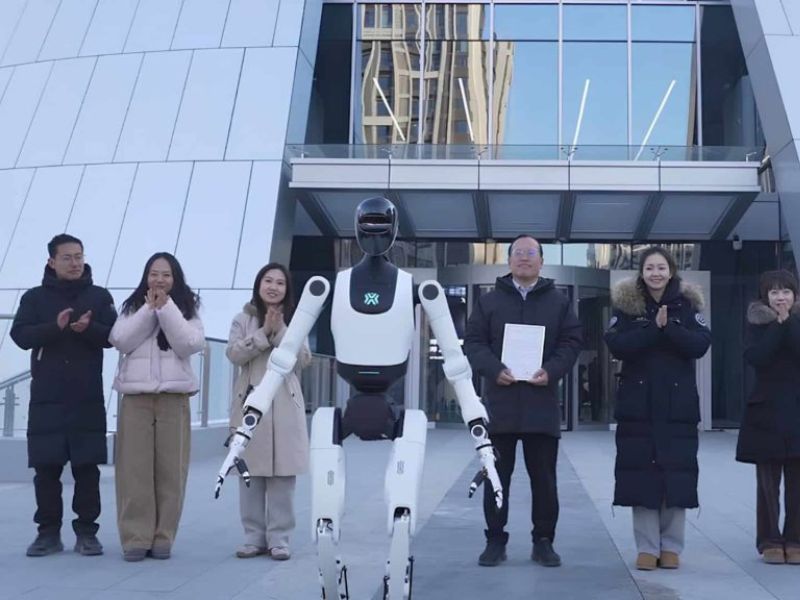
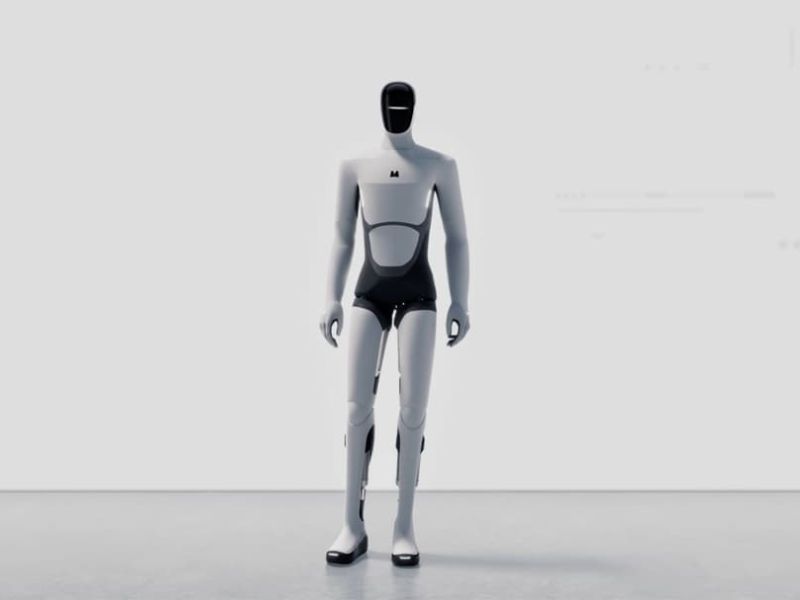
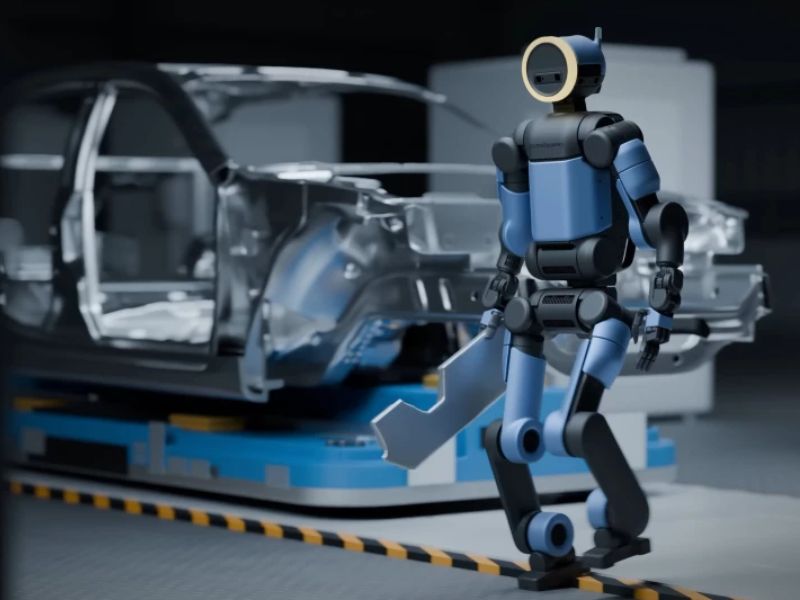
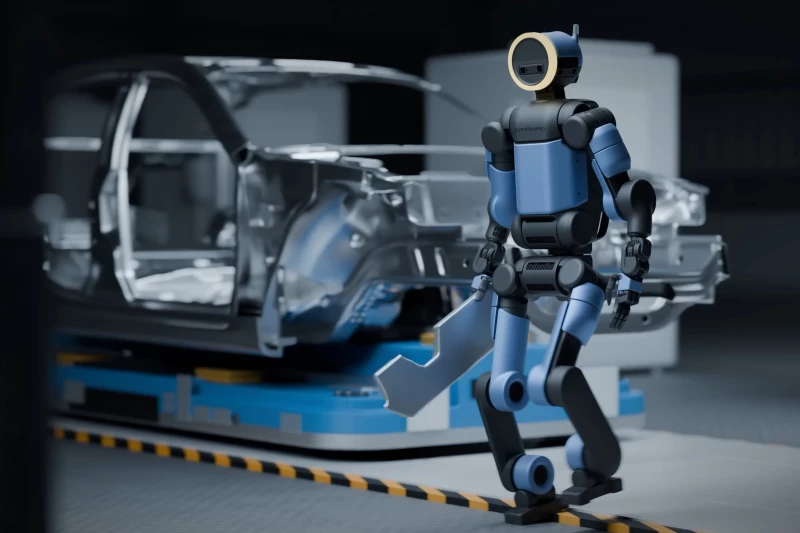
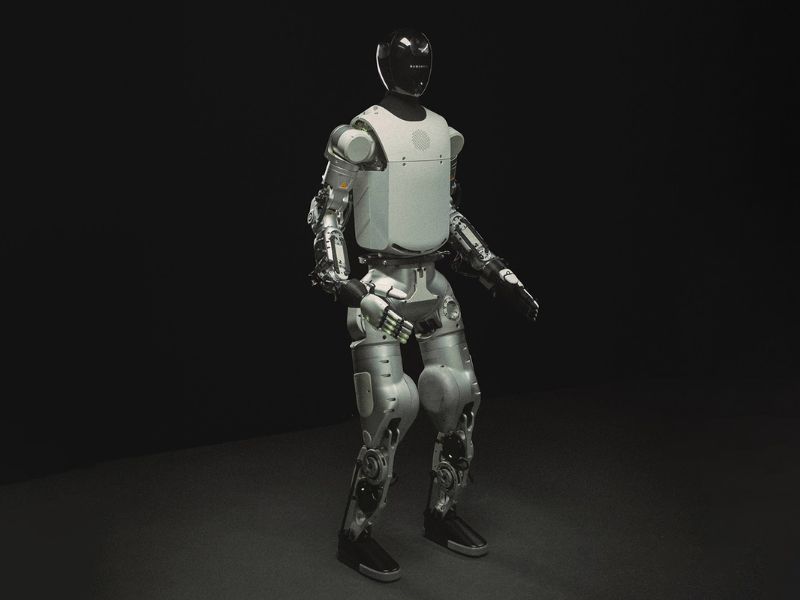
A China-developed humanoid robot has made history by directly connecting to a low Earth orbit satellite without relying on traditional ground networks. Known as Embodied Tien Kung, it became the first humanoid robot to autonomously carry out this type of satellite communication.
The achievement was unveiled by X-Humanoid on Friday (23) at the 3rd Beijing Conference on Promoting the High-Quality Development of the Commercial Space Industry, an event highlighting recent progress in China’s space sector.
Robot Achieves Real-Time Satellite Communication
During the test, the robot linked to a new GalaxySpace internet satellite fitted with an electronically scanned array antenna and a flat-panel system integrated into the satellite architecture. The connection enabled stable, real-time transmission of images and data, even in the absence of ground-based infrastructure.
Organizers said the demonstration marked China’s first multi-terminal, multi-link connection using a low-orbit satellite with this setup. Alongside the humanoid robot, smartphones and computers also successfully accessed the network during the test.
To demonstrate a real-world application, researchers assigned Embodied Tien Kung a task: retrieve a symbolic project completion certificate placed inside an autonomous vehicle. As part of the experiment, the unmanned car drove itself to the newly opened Avenue of Rockets.
When the satellite passed overhead, the robot independently determined the optimal time to communicate, ran system checks, and established a direct connection with the low-orbit satellite. Once connected, it approached the vehicle, collected the certificate, and delivered it to another building.
Humanoid Sends Real-Time Motion and Visual Data to Control Center
During the mission, the humanoid converted its movements, joint data, and images from its front camera into digital information and transmitted them to the satellite. The system relayed this data to the control center almost in real time, enabling operators to track the operation both from the robot’s viewpoint and through external monitoring tools.
The trial highlighted the potential of satellite-connected humanoid robots to carry out physical tasks in areas lacking conventional internet access. Such capabilities could prove vital in remote locations, disaster zones, and other high-risk environments.
Satellite-Linked Robots Expand Remote Operations
By overcoming geographic constraints, the technology opens new possibilities for technical inspections, emergency response, field exploration, and mining. In hazardous situations, robots could take on critical roles, improving both safety and efficiency.
This milestone builds on earlier accomplishments by Embodied Tien Kung. In February 2025, the robot drew attention after climbing 134 outdoor steps at Haizi Wall Park in Beijing, becoming the first humanoid to master such a demanding outdoor challenge.
For years, humanoid robots have been built to be strong, precise, and durable. They rely on cameras for vision, sensors to gauge force, and highly accurate systems to carry out tasks. What they’ve long lacked is the ability to sense and respond to their own bodies. That gap is now starting to close thanks to a breakthrough by researchers from universities in Shanghai and Hong Kong.
The team has created a flexible robotic skin that can detect touch, impact, and physical damage, effectively acting as an artificial nervous system. This development enables robots to identify potentially harmful situations, serving a role similar to how humans experience pain or discomfort.
Image Credits:tmeier1964
Unlike conventional sensors that focus on specific spots, this new skin envelops the robot’s entire body, making the arms, legs, and torso act as a single continuous sensor.
The system relies on flexible, pressure-responsive materials that can detect small changes caused by impacts, deformation, or wear. Rather than depending only on cameras or motor force readings, the robot gains a direct awareness of what is happening to its own body.
This heightened sensitivity enables quicker and smarter reactions to unexpected events, which is especially important for robots working close to humans.
Practical Benefits in Everyday Scenarios
The advantages are easy to imagine in everyday situations. For example, if a robot is carrying heavy furniture and an object drops on its foot, a traditional robot might keep moving, unaware of the damage, increasing the risk of falling or further harm.
With the new skin, the impact would be sensed instantly. The robot could stop, adjust its position, or activate safety measures to reduce danger to itself and to nearby people.
Such responsiveness is essential in settings like homes, hospitals, factories, and logistics hubs, where mechanical failures can result in serious accidents.
Another key advantage is the ability to detect minor, nearly invisible damage. Tiny cracks or deformations in the outer layer can let dust or moisture seep in, gradually harming internal components.
Early Detection and Modular Design for Easy Maintenance
The new robotic skin can spot these issues early, before they escalate. It also features a modular design, letting users replace damaged sections with simple “patches” instead of swapping the entire skin.
This approach lowers maintenance costs, extends the robot’s operational life, and makes humanoid robots more practical for long-term, real-world use.
Image Credits: koshinuke_mcfly
While the research is currently centered on humanoid robots, the team notes that the technology has much broader potential. Advanced prosthetics, for instance, could gain from responsive surfaces that deliver tactile feedback to users.
Other possible applications include protective gear, rescue tools, and medical devices. In high-risk situations, the ability to sense excessive pressure, heat, or impact can be critical for preventing injuries or system failures.
The researchers stress that the aim is not to give robots human-like emotions. The concept of “pain” in this context is purely functional, not a conscious or subjective sensation.
Enhancing Safety and Reliability Around Humans
The ultimate goal is to develop safer, more dependable machines that can operate alongside people in a predictable manner. By detecting risks and damage early, robots can respond proactively, reducing accidents and building trust in these technologies.
As humanoid robots move beyond the lab and into everyday environments, innovations like artificial skin may play a crucial role—not in humanizing machines, but in making them more physically aware and better adapted to the human world.
Image Credits:MATRIX-3 moves humanoid robots from pre-set tasks to adapting and understanding the real world, ready for everyday life.
Chinese startup Matrix Robotics has officially introduced MATRIX-3, its third-generation humanoid robot, representing a significant advance in physical AI.
The platform is a complete from-scratch overhaul of algorithms, hardware, and applications, moving humanoid robots beyond rigid task performance toward flexible, real-world interaction.
Built to be safe, autonomous, and highly adaptable, MATRIX-3 integrates biomimetic perception, precise manipulation, natural human-like motion, and a new cognitive core that supports zero-shot learning.
The company says the robot is designed to operate beyond factories, extending into commercial, healthcare, and household environments.
Advancing Adaptive, Human-Like AI
MATRIX-3 is framed as a significant step forward in physical artificial intelligence. Designed as a safe, autonomous, and adaptable platform, it handles complex, human-like tasks in real-world conditions.
“Our vision with MATRIX-3 is to bring machine intelligence into human environments in the most natural and secure way possible,” said Allen Zhang, CEO of Matrix Robotics, in a statement.
MATRIX-3 features a biomimetic interface with “skin” and touch, covered in flexible 3D fabric that houses an underlying sensor network. This design absorbs physical contact and monitors impact forces in real time, enhancing safety during close interactions with people.
Advanced Visual–Tactile Perception for Precise and Safe Manipulation
A multimodal perception system combines high-sensitivity fingertip sensors with advanced vision, creating a visual–tactile loop that lets MATRIX-3 safely handle fragile and flexible objects.
MATRIX-3 also marks a major advance in mobility and manipulation. Its dexterous 27-DOF hand mimics human anatomy with lightweight, cable-driven actuation for fast, precise motion. This allows the robot to handle everyday tools, operate delicate equipment, and manipulate soft materials like fabrics.
Whole-body movement uses a natural gait generated by a motion control model trained on human motion-capture data. Built-in linear actuators deliver high power density with minimal noise, allowing for stable, agile, and well-coordinated full-body motion.
Matrix’s intelligence division built a new cognitive core that underpins these abilities. Its neural network enables zero-shot learning, letting MATRIX-3 perform new tasks from natural-language instructions without task-specific training.
Using universal intelligent manipulation, the robot can autonomously plan its grasps, modulate force in real time, and navigate around obstacles through smooth hand–eye coordination.
Real-World Performance Yet to Be Verified
So far, videos show MATRIX-3’s capabilities, but researchers have not yet verified its real-world performance; consistently replicating its hand dexterity would mark a major robotics breakthrough.
Matrix Robotics has launched an early access program for select industry partners, with pilot deployments of MATRIX-3 expected to begin in mid-2026.
Image Credits:Atlas is to be trained using new AI foundation models for a wide variety of industrial tasks, beginning in the automotive sector Boston Dynamics
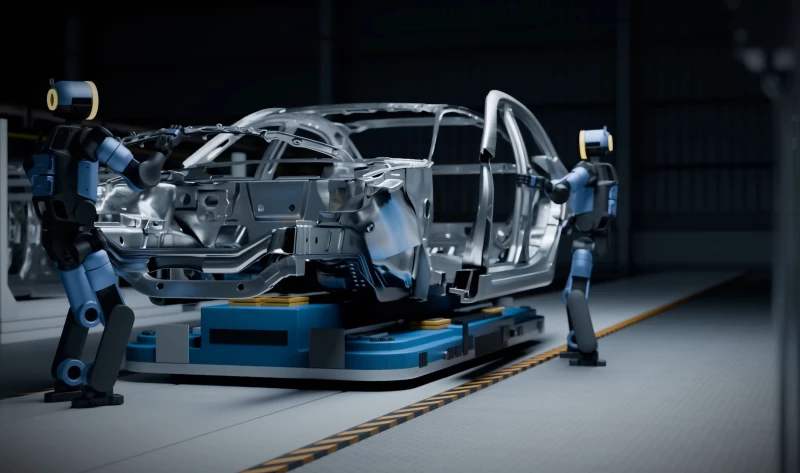
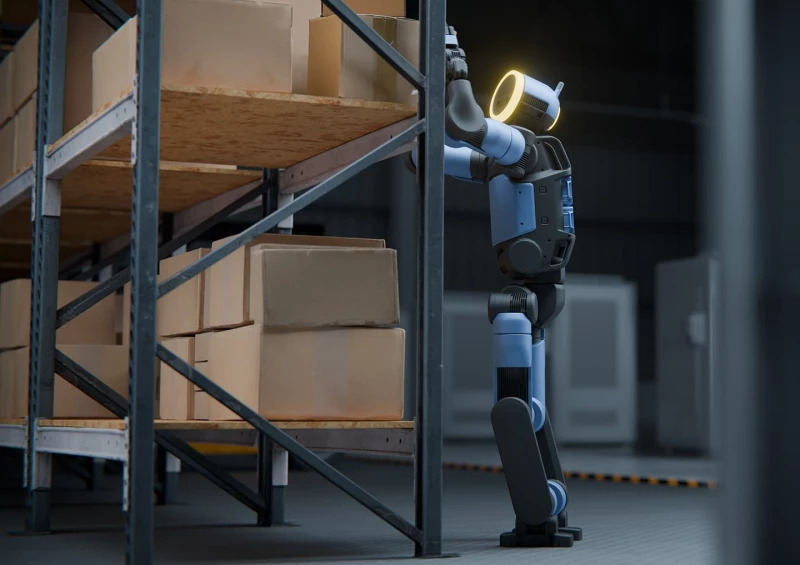
Boston Dynamics has introduced an industry-ready version of Atlas, a humanoid built for real-world use in warehouses and factories. Designed to work nonstop in harsh conditions, Atlas uses AI to adjust to its surroundings, and production is already underway.
After an attention-grabbing debut filled with eerie visuals, flips, and dance routines, Boston Dynamics is now focusing on practical applications. The company has revealed the production version of Atlas, a humanoid robot designed for demanding industrial tasks. The first units will ship this year, with Atlas taking on its first role at a Hyundai facility—its initial real-world industrial deployment.
Boston Dynamics CEO calls Atlas the company’s most advanced robot
“In over 30 years, Boston Dynamics has built some of the world’s most advanced robots,” said CEO Robert Playter. This is the finest robot we’ve ever made. Atlas aims to revolutionize industry and pave the way for robots that enhance safety, efficiency, and daily life at home.
The newest Atlas measures 6.2 ft (1.9 m) in height and offers 56 degrees of rotational movement throughout its joints. It can rotate its head and hips, move fingers independently, and bend knees and ankles, giving Atlas a 7.5 ft (2.3 m) reach for tight industrial spaces.
Designed to work alongside people, Atlas tackles environments that would quickly exhaust human workers. It endures –4 °F to 104 °F (–20 °C to 40 °C), lifts 66–110 lb (30–55 kg), runs four hours per charge, and swaps its battery in under three minutes on its own.
Atlas offers versatile operation and intelligent adaptability
Atlas supports three modes of operation: fully autonomous, remotely controlled by a human operator, or supervised via a tablet. Powered by AI, it moves smoothly, adapts to its environment, and collects data to boost operational efficiency.
Image Credits:The production-ready Atlas comes with a four-hour battery, which it can swap out for a fresh one in under three minutes Boston Dynamics
Boston Dynamics has also revealed a collaboration with DeepMind, Alphabet’s British-American AI research lab, aimed at rapidly advancing Atlas’s abilities. The partnership will focus on faster task learning and better understanding of industrial environments. Once a single Atlas masters a skill, it can instantly share that capability across the entire fleet.
This Atlas handles industrial tasks and reconfigures for new roles within 24 hours. Production has begun in Boston, with initial deployments set for 2026 at Google DeepMind and Hyundai.
Hyundai plans large-scale robotics facility with expanded Atlas production
Hyundai, Boston Dynamics’ majority owner, plans a new facility to produce up to 30,000 robots annually, including Spot and other models. Additional Atlas customers will join starting in 2027.
Image Credits:”This enterprise-grade humanoid robot offers impressive strength and range of motion, precise manipulation, and intelligent adaptability – designed for manufacturability, reliability, and serviceability. Atlas is built to power the new industrial revolution.” Boston Dynamics
Hyundai will supply Atlas’s actuators, strengthening its hardware-AI integration. “This Atlas is our most production-ready yet,” said GM Zack Jackowski, highlighting its reduced parts and full compatibility with automotive supply chains. With the support of Hyundai Motor Group, we expect to deliver industry-leading reliability and cost efficiency at scale.
The launch of production signals that U.S. industrial humanoid robotics is now catching up with China. Chinese company UBtech recently showcased its Walker S2 robots deployed across automotive, smart factories, logistics, and AI data centers. UBtech says the deployment will proceed in phases, with robots gradually entering active industrial settings.
This timing shows that the push to deploy humanoid robots on factory floors no longer favors a single player, as American and Chinese companies pursue careful, step-by-step strategies for large-scale adoption.
Image Credits:We can assure you this is an accurate “stop” signal used by Chinese traffic police officers YouTube/CCTV
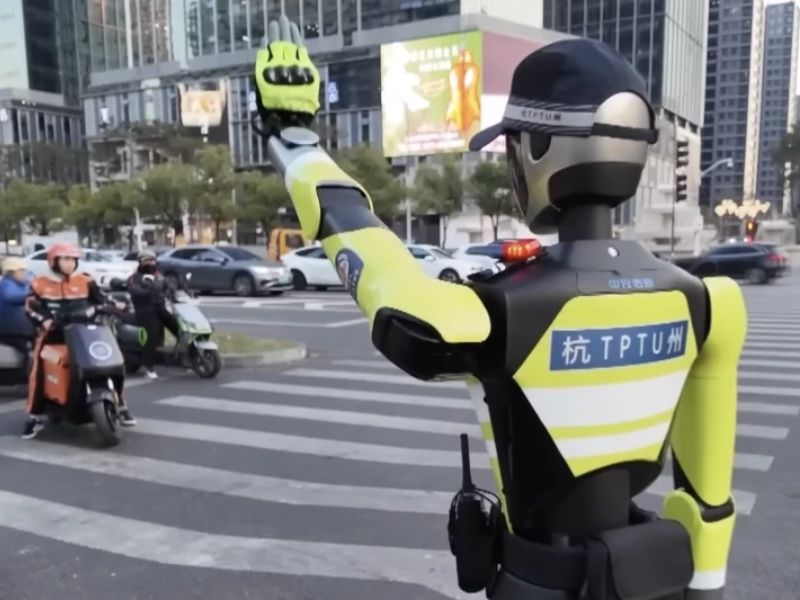
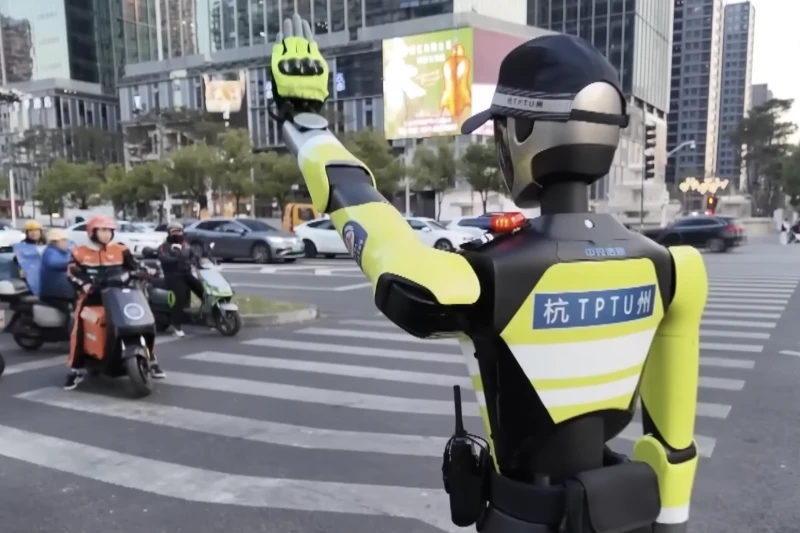
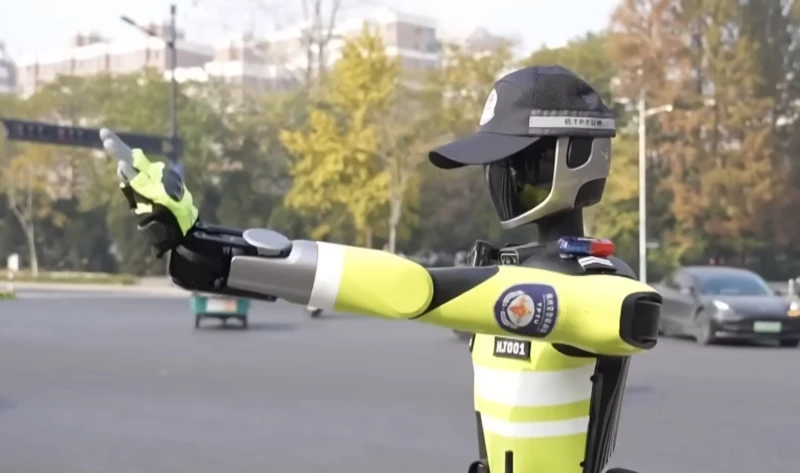
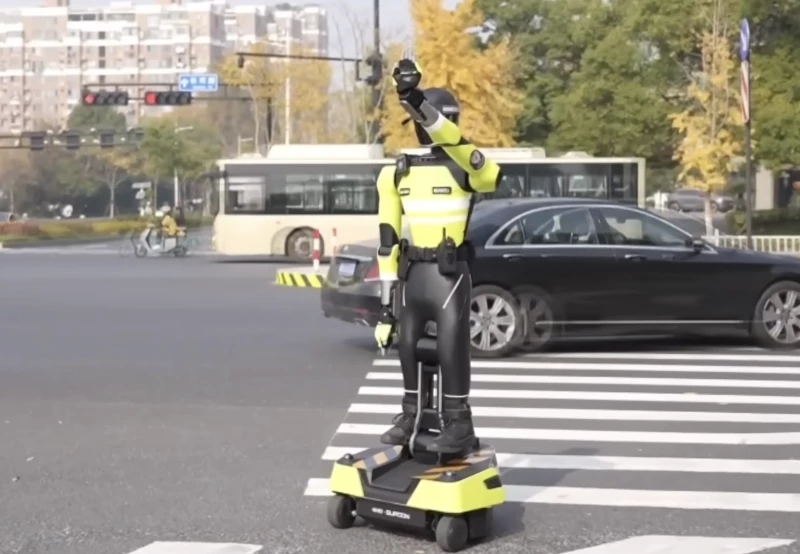
Hangzhou has become the newest Chinese city to upgrade traffic control by deploying an AI-powered robotic police officer that manages vehicles and pedestrians at a busy intersection and politely warns those who break the rules.
The 1.8-meter humanoid Hangxing No. 1 directs traffic, spots violations, and issues warnings at a busy Hangzhou intersection, using cameras, sensors, a whistle, and synced traffic lights.
Image Credits:Good to see the new recruit is staying sun-smart, too YouTube/CCTV
AI Robot Assists Police, With Smarter Capabilities Planned
The robot currently supports human officers, with plans to add LLM features for directions and interaction. At present, it carries out basic stop-and-go gestures and can spot helmetless riders, jaywalkers, and others who violate intersection rules.
Image Credits:Hangxing No. 1 moves around on omnidirectional wheels and is synced-up to the traffic light system YouTube/CCTV
Hangxing No. 1 began operating in early December as part of a pilot program by the Hangzhou Traffic Police Tactical Unit to test robotic officers, and it has already become a favorite among pedestrians.
China Expands Use of Robotic Police Officers Nationwide
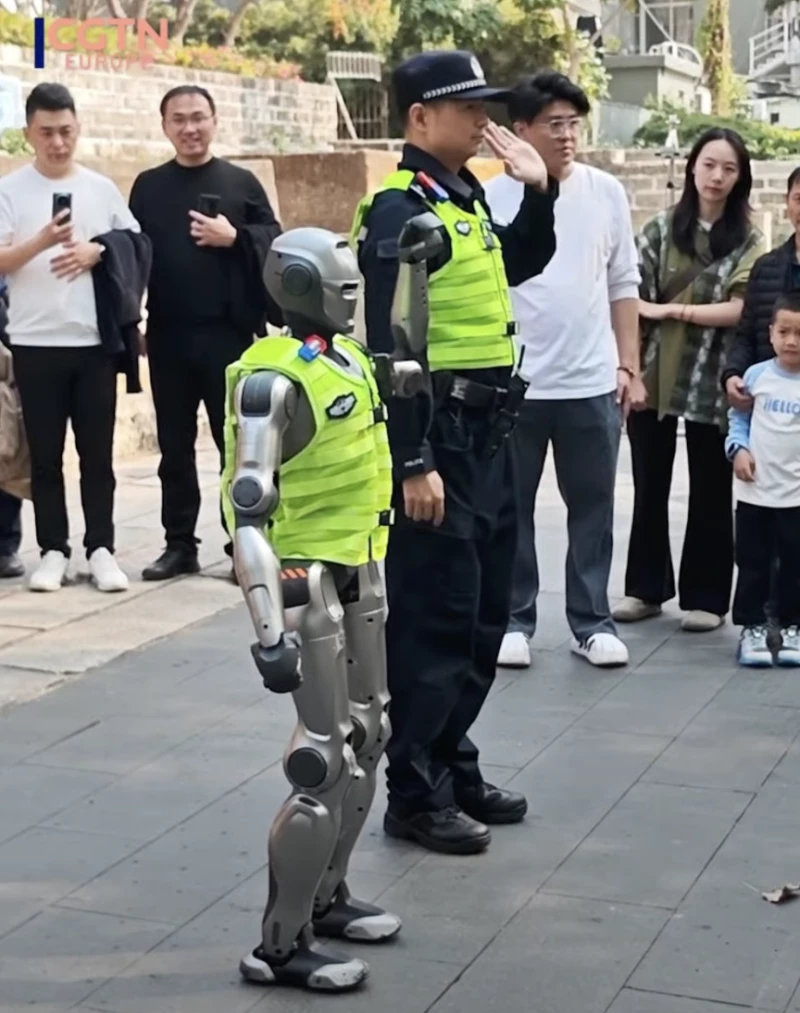
China has already deployed other robot officers on its streets. EngineAI’s PM01 aided traffic in Shenzhen, Logan Technology’s RT-G rolled out in Wenzhou last December, and Chengdu added a humanoid traffic cop in June.
Image Credits:One of China’s earlier robocops, the PM01 YouTube/CGTN
It’s clear how far the technology has advanced since AnBot began operating at Shenzhen Airport in September 2016. That Dalek-like unit set the standard, but Hangxing No. 1 could become outdated within a year or two.
The HMND 01 Alpha Bipedal is Humanoid’s second commercial system, following its mobile manipulator. | Image Credits: Humanoid
London-based robotics company Humanoid has unveiled the HMND 01 Alpha Bipedal, its first humanoid robot. The company developed the robot from initial concept to functioning prototype in just five months. According to Humanoid, the Alpha Bipedal was able to walk steadily only 48 hours after its final assembly.
Advanced Capabilities
Artem Sokolov, the company’s founder and CEO, said the robot can walk along straight or curved paths, turn on the spot, sidestep, squat, hop, run, and carry out precise manipulations.
He added to The Robot Report that the robot can recover from pushes, work alongside other humanoid robots, and engage with people using its head display, LEDs, speakers, and audio sensors. “When paired with our VLM/VLA-based framework, it’s capable of advanced reasoning and executing complex tasks,” he explained.
The Alpha Bipedal stands 179 cm (5 ft. 10 in.) tall and has 29 degrees of freedom (DoF), not counting the end effectors. The robot can carry a bimanual payload of up to 15 kg (33 lb.). Its modular end effectors can be equipped with either 12-DoF, five-fingered hands or 1-DoF parallel grippers.
For visual and sensory input, the robot’s head includes six RGB cameras, two depth sensors, and a six-microphone array. The body is outfitted with haptic sensors, force/torque sensors, and joint torque feedback. The robot’s processing is powered by NVIDIA Jetson Orin AGX and Intel i9 processors. Its battery offers three hours of swappable power, allowing for prolonged use during testing and development.
What Tasks will Alpha Bipedal Perform?
To build its bipedal robot, Humanoid utilized highly precise 3D modeling to create prototypes that closely align with simulations. The company claims this approach reduces the “sim-to-real” gap, which often hinders progress in robotics development.
By using NVIDIA’s Isaac Sim and Isaac Lab, the team was able to train over 52.5 million seconds of reinforcement-learning locomotion data in just two days—equivalent to nearly 19 months of traditional training. The robot successfully took its first steps in the real world after just 3.2 million seconds, requiring only minimal adjustments to cope with external pushes of up to 350 Newtons.
Humanoid stated that Alpha Bipedal was designed for consistent and reliable performance across a variety of applications.
“Alpha Bipedal is designed to pave the way for a wide range of home and service applications,” said Sokolov. “In the initial phase, we’ll focus on research and development, safety validation, and AI training across industrial, household, and service environments. Our primary focus has been on hardware durability and upper body strength to ensure that the robot can deliver real value in the use cases we target.”
Expanding Deployment
Regarding deployments, Humanoid explained that the robot will expand its role from industrial and logistics tasks—such as warehouse automation, picking, and palletizing—into domestic support applications. Once the robot begins deployment in commercial settings, Humanoid will closely track its performance.
“We’ll gauge success based on key performance indicators like task completion rates, throughput (units per hour, items inspected, etc.), autonomy levels, and error rates,” Sokolov noted. “We’ll also measure the value it provides to customers. The platform is designed to offer a low total cost of ownership with a high payload-to-cost ratio. We’ll look for reductions in operational costs, including labor savings, lower training and recruiting needs, and enhanced shift coverage.”
Humanoid Transitions from Mobile Manipulators to Bipedal Robots
Founder and CEO of Humanoid Artem Sokolov. | Image Credits: Humanoid
Serial entrepreneur Sokolov launched Humanoid in 2024, and since then, the company has secured $50 million in founder-led funding.
In September, Humanoid introduced its first robot, the HMND 01 Alpha. According to Sokolov, the company initially developed a wheeled robot to accelerate bringing a product to market. This approach also allowed them to address mobile manipulation challenges separately from balance-related issues.
“A stable wheeled robot is quicker to market because it’s a safer, simpler solution,” Sokolov explained. “It builds on AMR safety principles, separating balance from manipulation to significantly reduce technical risks, especially the risk of falling.”
“For many industrial settings, a wheeled humanoid is more than adequate,” Sokolov noted. “Most warehouses and factory floors are flat, smooth, single-level spaces with wide aisles and freight elevators. “Most items in these environments weigh under 15 kg, so legs aren’t needed for most tasks.”
The company also gained valuable insights from developing its mobile manipulator.
“We learned a lot from creating our wheeled Alpha robots, and applied those lessons to the HMND 01 Alpha Bipedal,” Sokolov said. “From the start, we designed our subsystems for modularity, so components like the head, torso, and arms could be reused across platforms.”This helped us move quickly when transitioning from a wheeled to a bipedal design.”
“We also reused and optimized many of the processes and tools that enabled us to develop the wheeled version so efficiently,” he continued. “Furthermore, building our first-generation robots provided valuable experience in integrating and testing complex systems in real-world conditions. These lessons played a key role in shaping how we built the HMND 01 Alpha Biped.”
How does Humanoid Guarantee the Safety of its Robots?
Sokolov emphasized that safety is a top priority for Humanoid. “Safety is one of our core competitive advantages,” he said. “Our robots are designed and tested to meet safety, machinery, electrical, EMC, radio, battery, waste, and workplace regulations.”
The company also places a strong emphasis on data security, according to Sokolov.
“We take AI and data safety very seriously,” he stated. “Throughout data collection and model development, we adhere to the EU AI Act, GDPR/Data Protection Act, Network & Information Security Directive, and consumer and product liability regulations.” Sokolov added, “As a second mover in humanoid robotics, our team’s experience helps us avoid early mistakes and speed up safe commercialization.”
What are Humanoid’s next Steps?
Earlier this year, Humanoid formed a partnership with QSS AI & Robotics to fast-track the development, production, and deployment of humanoid robots throughout Saudi Arabia. The company also has several exciting projects in the works, according to Sokolov.
“We’ve received 19,500 pre-orders, completed four POCs, with three more in progress—this is the highest at our stage, surpassing anyone else in the market,” he said. “Humanoid is already fully booked for early-year POCs in 2026, and we’re focused on securing long-term partnerships and increasing pre-orders.”
“On the product front, our goal is to advance both the wheeled and bipedal platforms to their beta stages and prepare them for broader deployment,” he added.
Image Credits:Chinese firms have soared ahead in the race to develop AI-powered robots that could one day
Over 150 Chinese companies are developing humanoid robots, but a Beijing official has warned that the rapidly growing industry risks forming a market bubble. Strong government support and robust supply chains are helping firms advance AI-powered robots for everyday tasks, yet overcapacity is a concern as production expands faster than actual demand, according to Goldman Sachs.
At a National Development and Reform Commission briefing, official Li Chao said that balancing “speed” and “bubble” risks is crucial for frontier industries, including humanoid robotics. While the sector is seeing explosive growth, it remains immature in technology, commercialization, and practical use.
Startups Boost Innovation, Overcrowding Risks R&D
More than half of China’s humanoid robot companies are startups or entrants from other industries, boosting innovation, but Li warned against market overcrowding that could stifle R&D. A report by Leaderobot projects the industry could reach 82 billion yuan ($11.6 billion) by 2025, half of global sales.
Real-world applications are still limited, though some ambitious trials have made headlines. Shanghai’s AgiBot recently set a Guinness World Record by walking 100 kilometers in three days. Beijing also hosted the world’s first humanoid robot games in August, featuring over 500 “athletes” competing in events from basketball to competitive cleaning.
XPeng, the Chinese company known worldwide for its electric vehicles and autonomous mobility technologies, has expanded into robotics by releasing a new video of its humanoid robot, Iron.
Although the model was publicly demonstrated earlier this month, its lifelike movements made some viewers doubt they were fully mechanical. To clarify, the company released footage with the exterior removed, revealing the internal engineering behind its smooth gestures.
In the material released by XPeng, the Iron robot is shown performing a choreographed sequence before being partially disassembled. The teardown reveals actuators, servos, and cables arranged in a system designed to mimic the human body. CEO He Xiaopeng says the robot learned choreography in hours by watching humans, a task that once took weeks.
XPeng says Iron’s fluidity comes from its “artificial spine,” enabling torso flexion, balance, and precise motion with 82 degrees of freedom and 22-joint hands.
XPeng Unveils Upgraded Iron at AI Day
The humanoid was part of the announcements at XPeng’s annual AI Day in Guangzhou. At the event, XPeng showcased an updated Iron with three Turing AI chips (3,000 TOPS) and solid-state batteries for safer, more efficient operation.
The design uses an “inside-out” concept, mimicking human muscles, skin, and systems to allow more natural and precise movements, especially in dynamic corporate settings.
The Iron presentation comes as XPeng continues to advance initiatives that integrate robotics, autonomous vehicles, and aerial mobility. At the event, XPeng unveiled VLA 2.0 AI, which interprets environments and acts on visual input using proprietary chips, advanced models, and integrated hardware for vehicles and robots.
Factory Infrastructure Paves the Way for 2026 Launch
The company also operates a factory dedicated to data processing and robot model training, part of its strategy to accelerate large-scale production. XPeng expects humanoid robots to begin appearing in commercial settings by 2026.
The company stated that Iron will first serve in customer service and operational support roles. Baosteel will be among the initial partners to test the robot in inspection and support tasks within industrial settings.
The video unveiling the robot’s interior showcases its construction and XPeng’s progress in robotics and physical intelligence.
Image Credits: KAIST humanoid lower body platform running. Credit: The Korea Advan
KAIST’s humanoid robot demonstrates world-class mobility, reaching 12 km/h with excellent stability and performing complex moves like the duckwalk and moonwalk, marking it as a next-generation platform for industrial use.
Development of a Human-Like Lower-Body Platform for Next-Generation Humanoids
Professor Park Hae-won’s team at KAIST’s HuboLab has developed the lower-body platform for a next-generation humanoid robot. Designed for human-oriented environments, the robot stands at 165 cm tall and weighs 75 kg, closely resembling human proportions.
The breakthrough is significant, as the team designed and built all key hardware components, achieving full independence in hardware development.
The team built a reinforcement learning algorithm, training the AI in simulation and successfully applying it to real-world use by overcoming the Sim-to-Real Gap. This also secured autonomy in algorithm development.
Credit: The Korea Advanced Institute of Science and Technology (KAIST)
The humanoid currently runs at 3.25 m/s (12 km/h) and climbs steps over 30 cm, with goals of reaching 4.0 m/s (14 km/h), ladder climbing, and 40+ cm steps.
Professor Hae-Won Park’s group is collaborating with teams from KAIST and MIT to develop a fully integrated humanoid with upper-body hardware and advanced AI.
Equipping Robots with Versatile Skills for Real-World Industrial Tasks
The team is developing technology for robots to handle heavy lifting, operate machinery, and perform coordinated tasks like walking while manipulating, aiming to equip them with versatile abilities for industrial use.
Image Credits:Single-leg hopping robot. Credit: The Korea Advanced Institute of Scie
The team also built a single-legged “hopping” robot that can balance, hop repeatedly, and perform a 360-degree somersault.
Reinforcement Learning Breakthrough Without a Biological Reference Model
What makes this achievement especially notable is that imitation learning was not possible, as no biological reference model existed. The researchers built a reinforcement learning AI controller that optimized balance and reduced landing impact, achieving strong performance.
Professor Park Hae-won highlighted that this milestone shows independence in both hardware and software, with plans to build a full humanoid for industrial use and future collaboration with humans.
Image Credits: Key components of the directly developed robot: (a) reducer, (b) motor
Ph.D. candidate JongHun Choe will present the hardware findings at Humanoids 2025 on October 1.
Ph.D. candidates Dongyun Kang, Gijeong Kim, and JongHun Choe will present their AI algorithm work as co-first authors at CoRL 2025 on September 29.
The presentation papers have been made available on the arXiv preprint server.
Chinese robotics firm Fourier has introduced its first full-sized humanoid care robot, GR-3, designed to blend functionality with emotional connection.
As Fourier’s latest humanoid, GR-3 advances the mission to integrate robots into daily life, asking: Can they truly belong in human environments?
Designing Robots with Emotional Appeal
GR-3 was designed for both task performance and emotional engagement, with soft materials, neutral tones, and an expressive face for approachability.
Driving its emotional intelligence is Fourier’s proprietary Full-Perception Multimodal Interaction System, which enables GR-3 to interact with users in a more natural and responsive way.
The system merges vision, sound, and touch into a unified real-time “emotional processing engine.” With a four-microphone array and structured-light cameras, GR-3 can pinpoint speakers, maintain eye contact during conversation, and recognize faces.
It also features 31 pressure sensors across its body, enabling it to detect touch and respond with lifelike micro-reactions such as blinking, eye movement, and subtle emotional expressions.
Dual-Path Intelligence for Smarter Interaction
The platform combines fast rule-based reflexes with an LLM layer for deeper, contextual dialogue. This combination helps GR-3 interpret emotions and respond with greater situational awareness.
“Shaped by the belief that love comes before function, GR-3 reshapes the way people connect with machines,” Fourier stated. “With its soft exterior and emotional interaction system, it blends practical utility with warm companionship.”
The robot fulfills two roles: offering social companionship in public spaces and providing assistive care.
Fourier envisions GR-3 expanding into mobility assistance, health monitoring, and rehabilitation in eldercare and clinical settings.
We use cookies on our website to give you the most relevant experience by remembering your preferences and repeat visits. By clicking “Accept All”, you consent to the use of ALL the cookies. However, you may visit "Cookie Settings" to provide a controlled consent.
This website uses cookies to improve your experience while you navigate through the website. Out of these, the cookies that are categorized as necessary are stored on your browser as they are essential for the working of basic functionalities of the website. We also use third-party cookies that help us analyze and understand how you use this website. These cookies will be stored in your browser only with your consent. You also have the option to opt-out of these cookies. But opting out of some of these cookies may affect your browsing experience.
Necessary cookies are absolutely essential for the website to function properly. These cookies ensure basic functionalities and security features of the website, anonymously.
Cookie
Duration
Description
cookielawinfo-checkbox-analytics
11 months
This cookie is set by GDPR Cookie Consent plugin. The cookie is used to store the user consent for the cookies in the category "Analytics".
cookielawinfo-checkbox-functional
11 months
The cookie is set by GDPR cookie consent to record the user consent for the cookies in the category "Functional".
cookielawinfo-checkbox-necessary
11 months
This cookie is set by GDPR Cookie Consent plugin. The cookies is used to store the user consent for the cookies in the category "Necessary".
cookielawinfo-checkbox-others
11 months
This cookie is set by GDPR Cookie Consent plugin. The cookie is used to store the user consent for the cookies in the category "Other.
cookielawinfo-checkbox-performance
11 months
This cookie is set by GDPR Cookie Consent plugin. The cookie is used to store the user consent for the cookies in the category "Performance".
viewed_cookie_policy
11 months
The cookie is set by the GDPR Cookie Consent plugin and is used to store whether or not user has consented to the use of cookies. It does not store any personal data.
Functional cookies help to perform certain functionalities like sharing the content of the website on social media platforms, collect feedbacks, and other third-party features.
Performance cookies are used to understand and analyze the key performance indexes of the website which helps in delivering a better user experience for the visitors.
Analytical cookies are used to understand how visitors interact with the website. These cookies help provide information on metrics the number of visitors, bounce rate, traffic source, etc.
Advertisement cookies are used to provide visitors with relevant ads and marketing campaigns. These cookies track visitors across websites and collect information to provide customized ads.