Tag: Humanoid

  • NVIDIA Aims to Speed Up Humanoid Development with Project GR00T

    NVIDIA Aims to Speed Up Humanoid Development with Project GR00T

    NVIDIA founder and CEO Jensen Huang plans to put the company at the center of humanoid robot development with the launch of Project GR00T
    NVIDIA

    NVIDIA recently revealed its plans to develop a novel AI platform catering to major players in humanoid robot advancement. This platform is rooted in a versatile foundational model, likely drawing inspiration from a character resembling a talking tree in the Marvel Universe.

    However, the project, abbreviated as GR00T (Generalist Robot 00 Technology), is characterized as a versatile foundational model tailored for humanoid robots. Its purpose is to advance NVIDIA’s efforts in pushing boundaries within robotics and embodied AI.

    Navigating Technical Details

    In fact, as anticipated in its initial unveiling, specific technical intricacies are somewhat sparse at this stage. The aim is to equip robots with the capability to comprehend natural language, advancing the type of human interaction recently showcased effectively by Figure’s GPT-enhanced 01 humanoid.

    Furthermore, this technology enables robots to acquire new skills by observing humans, whether through videos or virtual reality, equipping them with the necessary capabilities to “navigate, adapt, and interact” effectively in real-world scenarios. The company’s Isaac Sim robotics simulation platform now incorporates an application enabling the scaling of reinforcement learning. This allows for the management and deployment of training and inference processes through a cloud-based service. Furthermore, the company has enhanced the Isaac suite with additional tools to assist in the development of industrial robots.
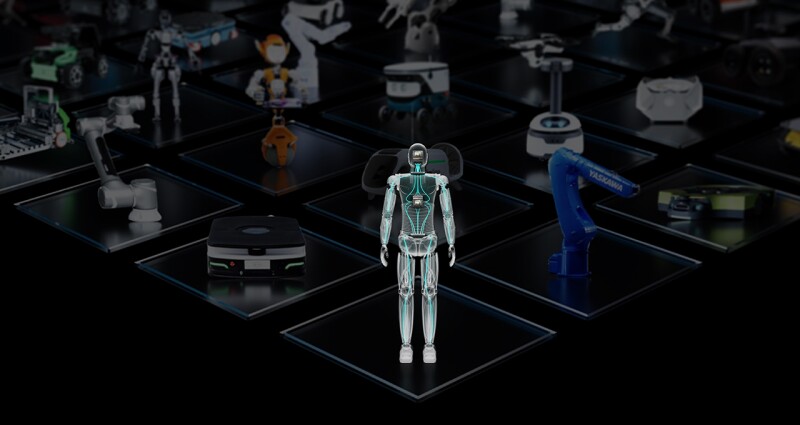
    “The GR00T model takes multi-modal instructions and past interactions as input, and produces the next action for the robot to execute,” the promo video explains
    NVIDIA

    NVIDIA also unveiled new hardware during the announcement. The Jetson Thor system-on-chip integrates a “high-performance CPU” and a next-generation Graphics Processing Unit capable of running models such as GR00T, thanks to its “transformer engine” which delivers 800 teraflops of 8-bit floating point AI performance.

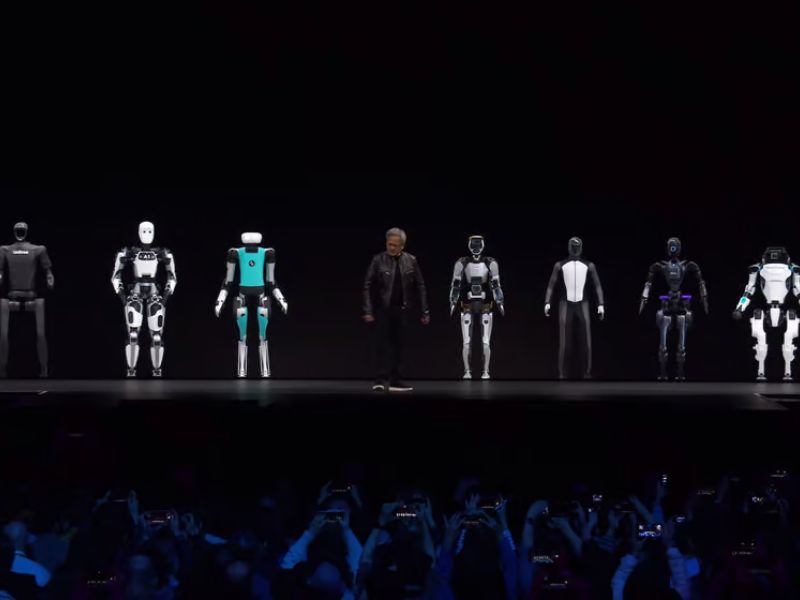
    Towards the conclusion of his keynote address at the GTC developer conference in San Jose, California, Jensen Huang, always engaging, was accompanied on stage by a lineup of nine humanoid robots currently under development. Furthermore, the company utilized its Jetson computers to power several Disney robots, training them with the Isaac Sim robotics simulator.

    Unveiling NVIDIA’s New AI Platform

    The aim of this assembly was to demonstrate the company’s efforts in creating a new AI platform for prominent players in humanoid robot advancement, such as Boston Dynamics, Figure AI, Agility Robotics, Unitree Robotics, Apptronik, 1X Technologies, Sanctuary AI, Fourier Intelligence, and XPeng Robotics.

    To conclude, the rapid pace of advancement in the humanoid robotics field is already evident, and with GR00T and its accompanying platforms and hardware, NVIDIA aims to play a central role in driving progress. You can catch Huang’s complete keynote address on the company’s YouTube channel or view the highlighted robotics promotion below.

    NVIDIA Robotics: A Journey From AVs to Humanoids

    Read the original article on: New Atlas

    Read more: Video: Figure’s Humanoid Robot now Converses with People
  • Video: Figure’s Humanoid Robot now Converses with People

    Video: Figure’s Humanoid Robot now Converses with People
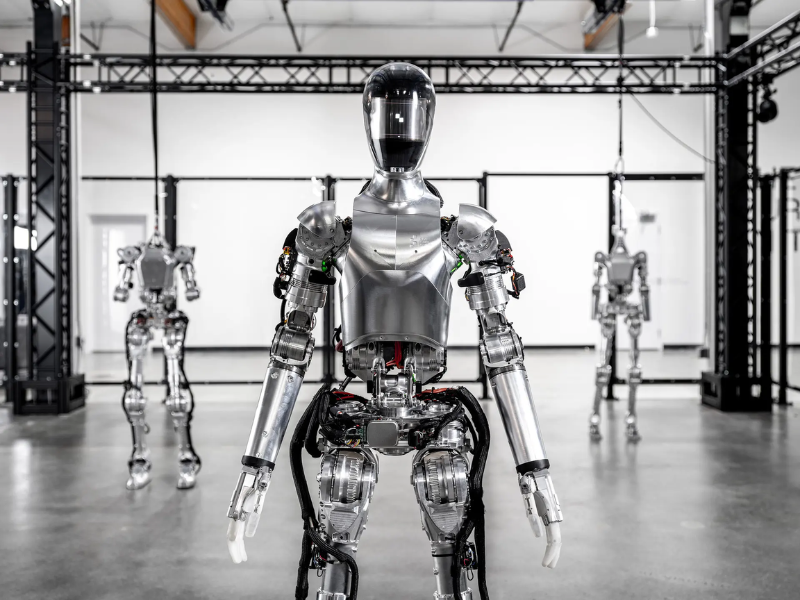
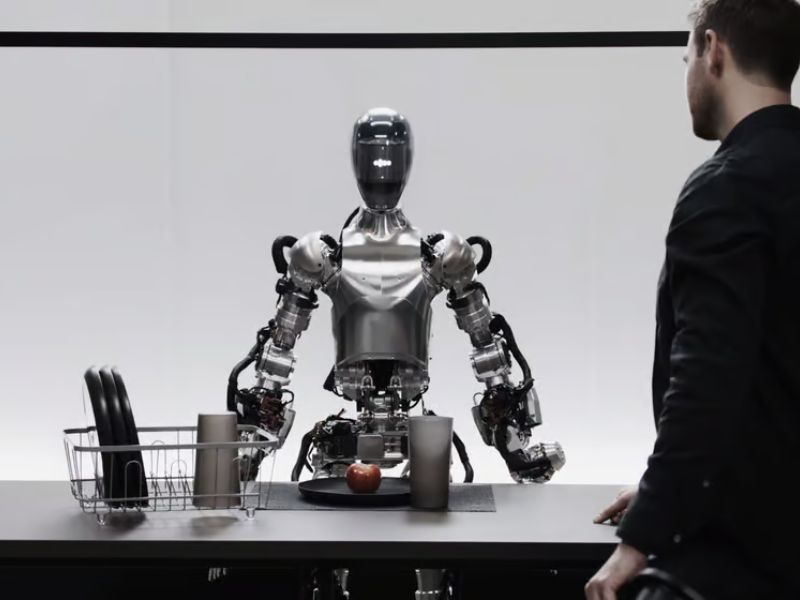
    In a recent video release, Figure showcased the initial outcome of its partnership with OpenAI to augment the abilities of humanoid robots. The Figure 01 robot is shown having real-time conversations.
    Thanks to a collaboration between Figure and OpenAI, the Figure 01 humanoid robot can now converse with people in real-time, and act on requests to do stuff
    Figure

    In a recent video release, Figure showcased the initial outcome of its partnership with OpenAI to augment the abilities of humanoid robots. The Figure 01 robot is shown having real-time conversations.

    The advancements made at Figure are remarkable. Entrepreneur Brett Adcock, who emerged from stealth mode just last year, assembled a team comprising experts from Boston Dynamics, Tesla, Google DeepMind, and Archer Aviation with the aim of developing the world’s first commercially feasible general-purpose humanoid robot.

    From Standing to Autonomous Functionality and Industry Deployment

    By October, the Figure 01 had already achieved standing and was executing fundamental autonomous functions. By the start of the following year, it had developed observational learning abilities and was ready to begin working at BMW by mid-January. Last month, we witnessed its presence on the warehouse floor just before Figure disclosed a prosperous Series B funding round and a collaboration pact with OpenAI aimed at advancing AI models for humanoid robots. Now, we are given insight into the implications of this collaboration.

    Figure Status Update – OpenAI Speech-to-Speech Reasoning

    Adcock stated in a recent post on X that the Figure 01 robot’s built-in cameras transmit data to a large vision-language model developed by OpenAI. Additionally, Figure’s own neural networks utilize images captured by the robot’s cameras at a rate of 10 Hz. OpenAI’s contribution extends to enabling the robot’s understanding of spoken language, with all incoming data processed by Figure’s neural network to facilitate rapid, precise robot movements.

    Autonomous Operation Confirmation and Future Aspirations

    He confirmed that the robot operated autonomously during the demonstration, and the video was recorded in real-time. This achievement is particularly noteworthy considering the partnership is less than two weeks old. However, Adcock expressed the aspiration to train a global model capable of operating humanoid robots on a scale of billions. Given the current pace of progress, this goal appears achievable in the near future.


    Read the original article on: New Atlas

    Read more: Progress in Soft Robotics: Robot Overcomes Complex Obstacles

  • Video: Tall Humanoid Robots at Amazon Facility

    Video: Tall Humanoid Robots at Amazon Facility

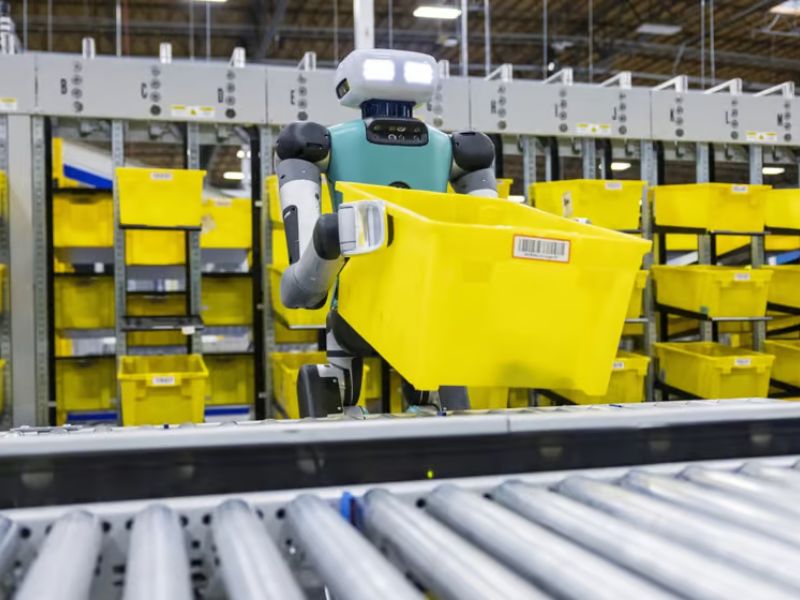
    Tall, proficient, and resembling insects to some extent, a fleet of Digit robots is currently navigating vacant bins within an Amazon research and development facility. This trial marks the initial phase of utilizing these robots to automate repetitive tasks in warehouses.
    Digit is currently being trialed as a way to relieve workers of difficult repetitive tasks, not relieve them of their jobs, says Amazon
    Agility Robotics

    Tall, proficient, and resembling insects to some extent, a fleet of Digit robots is currently navigating vacant bins within an Amazon research and development facility. This trial marks the initial phase of utilizing these robots to automate repetitive tasks in warehouses.

    Agility Robotics, a technology company supported by Amazon, provided the robots for the trial program. Their main product is the humanoid Digit robot, standing at 5.7 ft (175 cm) tall. It features legs reminiscent of grasshoppers, which the company describes as “backwards legs,” enabling it to squat to retrieve items from the ground and lift them to nearly six feet high. Digit is capable of lifting packages weighing up to 35 lb (16 kg) and maneuvering in various directions, navigating stairs, uneven terrain, and even walking while crouched.

    Digit’s Role in Amazon’s Workforce Evolution

    Amazon, boasting a workforce of over 750,000 robots, emphasizes that Digit’s role isn’t about replacing jobs but rather, about “collaborating with employees.” The company plans for these robots to handle the repetitive task of recycling empty totes that are no longer in use.

    Digit has previously ventured into the workforce, clearly not intended to replace human labor (with a hint of sarcasm). In 2019, a somewhat eerie, headless version of Digit collaborated with Ford in testing autonomous package delivery to households.

    Additionally, just last year, Digit commenced its operations at a warehouse managing fulfillment for the women’s wear brand, Spanx, as depicted in the following video.

    Agility Robotics Partners With GXO

    Digit isn’t the pioneer humanoid robot entering the workforce. Earlier this year, robotics company Figure announced the provision of its sleek metallic humanoid bots to BMW’s plant in Spartanburg, South Carolina, where they will undergo training for planned deployment.

    Advancements in Robotics Fine Motor Skills

    Despite Digit’s remarkable capabilities in crouching, backward walking, and lifting, it still lacks refined fine motor skills. However, advancements may come sooner than expected, as demonstrated by another robot we covered last month from Sanctuary AI. Although it lacks mobility, this bot possesses exceptionally fast and dexterous hydraulically activated hands. One can envision integrating this technology with the motor skills of Digit or other bots from companies such as Boston Dynamics, which may not be too distant in the future.

    Currently, Agility Robotics is quite optimistic about Digit’s potential to contribute to the workforce, evident from the establishment of a 70,000-square-foot (6,503-square-meter) facility in Salem, Oregon. Dubbed the “RoboFab” manufacturing plant, it is expected to have the capability to manufacture over 10,000 Digit robots annually.

    You can observe Digit in action at Amazon’s research and development facility near Seattle, Washington, and listen to insights from Agility Robotics’ Chief Commercial Officer, Rich Bhone, in the video below.

    Agility Robotics Broadens Relationship with Amazon

    Read the original article on: New Article

    Read more: ZenRobotics 4.0 Enhances Intelligence in Waste Sorting Automation

  • Toyota’s Soft Humanoid Grasps Objects with Entire Body

    Toyota’s Soft Humanoid Grasps Objects with Entire Body

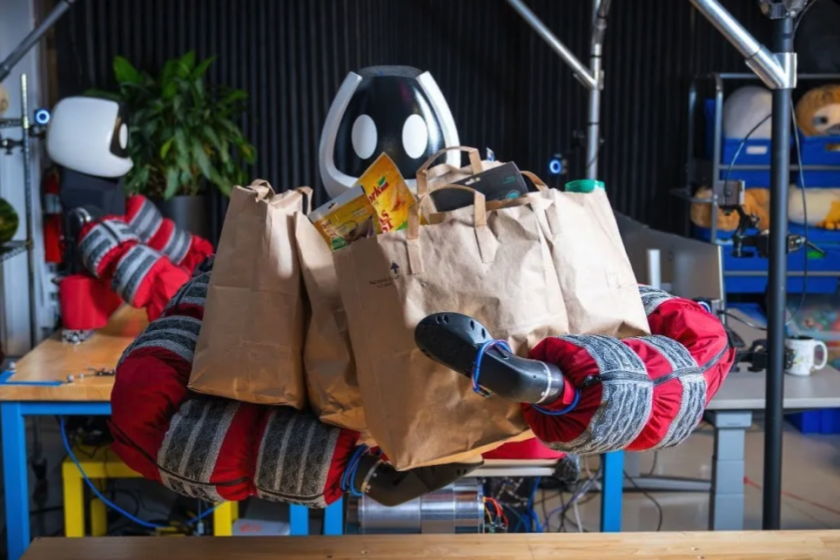
    The majority of humanoid robots typically use their hands to pick up objects, but this method doesn't mimic human behavior accurately, especially when dealing with bulky items. Humans utilize not only their hands but also their chests, hips, and arms in such situations. Toyota's innovative soft robot is designed with this human-like functionality in mind.
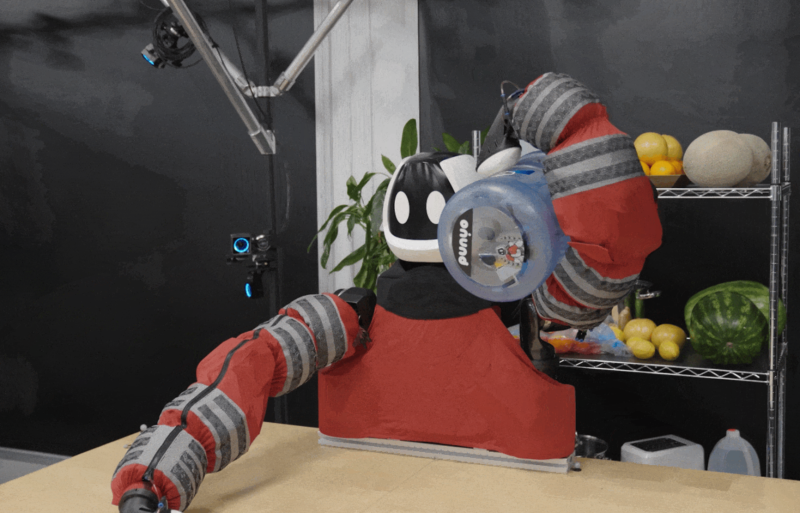
    Punyo is a torso-up soft humanoid robot designed to pick things up using its arms, chest and shoulders instead of just its hands
    Toyota Research Institute

    The majority of humanoid robots typically use their hands to pick up objects, but this method doesn’t mimic human behavior accurately, especially when dealing with bulky items. Humans utilize not only their hands but also their chests, hips, and arms in such situations. Toyota’s innovative soft robot is designed with this human-like functionality in mind.

    A Japanese-inspired Upper Torso Humanoid

    Named Punyo, this humanoid research platform focuses on the upper torso. Primarily, it embodies a charming Japanese aesthetic, featuring an endearing and welcoming facial expression, reminiscent of Disney’s Baymax from Big Hero 6, and a huggable, bulky appearance. Enhancing its appeal, Punyo appears adorned in a large, cozy-looking sweater.

    Certainly, the “sweater” serves a primarily hug-centric purpose. Crafted from grippy materials, it forms a soft, yielding layer atop Punyo’s rigid metal framework. Additionally, the fabric is equipped with tactile sensors, enabling Punyo to accurately perceive the texture of whatever it embraces, whether it be a person or an object it carries.

    Toyota researchers are training Punyo to handle a number of different large objects, including slinging a water jug up onto its shoulder and holding it steady from above
    Toyota Research Institute

    While the inclusion of dexterous hands might be a future possibility, Punyo is currently equipped with what can best be described as inflatable hooves. Toyota refers to them as paws, lacking any gripping claws. These appendages feature deformable, inflatable pads with dot patterns on their inner surfaces, monitored by cameras. This setup enables the robot to detect and identify objects upon contact as the patterns deform.

    Softness Enhanced with Air-Filled Bladders

    Moreover, Punyo’s arms incorporate additional softness via arrays of 13 air-filled bladders extending from the shoulders to the wrists. These bladders can be individually regulated for pressure, optimizing stiffness based on the robot’s activities.

    Robotics experts from the Toyota Research Group have been training Punyo through teleoperation to manipulate various large objects. This involves techniques such as leaning forward to hug items against its chest, then leaning back to lift them. Additionally, Punyo employs more complex carrying methods, like hoisting a water jug onto its shoulder and stabilizing it from above.

    Meet Punyo, TRI’s Soft Robot for Whole-Body Manipulation Research

    Furthermore, the robot exhibits a remarkable capability to handle multiple items in its arms, and its movement while manipulating objects suggests a more natural approach compared to other robots.

    Toyota’s Breakthrough in Robot Learning

    In September, Toyota showcased a significant advancement in robot learning. Robots were provided with a few examples of various kitchen tasks, such as spreading condiments on bread, peeling potatoes, rolling out pizza dough, and flipping pancakes with a spatula. Through a diffusion policy learning system, the robots underwent simulated task executions over a few hours and were then able to autonomously replicate the actions they observed.

    Punyo utilizes a similar AI learning process, with the added ability for the team to adjust variables regarding how closely it mimics example motions or the importance given to factors like speed, efficiency, or task accuracy.

    This approach differs from what we’ve seen in other humanoid robots. While the huggy lifting behavior may not be suitable for every scenario, it holds relevance in specific situations, especially once these machines become commonplace in our homes, possibly even caring for our infants. It’s certainly a thought-provoking concept to contemplate.


    Read the original article on: New Atlas

    Read more: ZenRobotics 4.0 Enhances Intelligence in Waste Sorting Automation

  • OpenAI´s Humanoids doing Great

    OpenAI´s Humanoids doing Great

    Norwegian humanoid robot manufacturer 1X states that the video is devoid of teleoperation, computer-generated imagery, editing, speed alterations, or pre-planned movements. Instead, it is entirely guided by neural networks, operating autonomously at normal speed.

    This is the company that OpenAI supported with its chips last year by investing $25 million in a Series A funding round. Another $100 million in a Series B round highlighted how influential OpenAI’s support is, showing the growing excitement about humanoid robots that can do many different tasks. This idea used to feel like it belonged in the distant future, but it’s exploded with interest in the last two years.

    The Humanoid Apearence

    1X’s humanoid robots seem quite basic compared to what companies like Tesla, Figure, Sanctuary, or Agility are developing. For instance, the Eve humanoid doesn’t even have feet or hands that can do delicate tasks. Instead, it moves around on wheels, balancing on a small wheel at the back, and its hands are simple claws. It looks more suited for a race on a sled, with a small LED smiley face that gives it a cute but toy-like appearance, almost like it might start asking for food and cuddles like a Tamagotchi.

    Entirely driven by neural networks. Completely self-governing. Operating at a consistent pace set by 1X.

    1X is working on a bipedal robot called Neo, which has hands that look more flexible and detailed. But maybe these features aren’t crucial in these early days of general-purpose robots. Most of the tasks robots will do initially seem to be simple, like “pick that thing up and move it over there,” which doesn’t require highly dexterous fingers like those needed for playing the piano. These robots will mainly be used in warehouses and factories with flat, concrete floors, where they won’t need to climb stairs or step over obstacles.


    Read the Original Article: NewAtlas

    Read more: Humanoid Figure Achieves Autonomous Task Learning and Performance

  • Humanoid Figure Achieves Autonomous Task Learning and Performance

    Humanoid Figure Achieves Autonomous Task Learning and Performance

    Within a year of development, Figure's 01 achieved the remarkable feat of walking—an accomplishment that Adcock considers to be a record-breaking milestone.
    Within a year of development, Figure’s 01 achieved the remarkable feat of walking—an accomplishment that Adcock considers to be a record-breaking milestone.

    Brett Adcock, from Figure, asserted a significant breakthrough in humanoid robotics over the weekend, which he referred to as a “ChatGPT moment.” This revelation becomes clearer as we now understand that the robot has gained the ability to observe human task performances, construct its own comprehension of the procedures, and subsequently execute these tasks autonomously.

    Humanoid Figure

    In a groundbreaking development, the humanoid figure has reached a remarkable milestone by gaining the ability to independently observe, acquire knowledge, and execute tasks. This technological advancement marks a significant leap forward in robotics, as it empowers humanoid entities to operate autonomously. No longer limited to pre-programmed instructions, these figures can now dynamically adapt to their surroundings, learn from their experiences, and perform tasks with a level of autonomy previously unseen.

    New Possibilities

    This achievement opens new possibilities for the integration of intelligent robotics into various fields, promising innovative solutions and increased efficiency in tasks ranging from routine activities to complex operations. The era of figures with the capacity to watch, learn, and perform tasks independently has arrived, ushering in a new era of robotics and artificial intelligence.

    Humanoid Robots

    Versatile humanoid robots are required to manage a diverse array of tasks, encompassing the comprehension of tools, devices, objects, techniques, and objectives that humans utilize to accomplish various activities. These robots must exhibit a level of flexibility and adaptability comparable to humans, allowing them to function effectively in an extensive spectrum of dynamic work environments.


    Read the Original Article: New Atlas

    Read More: Historic Launch: First U.S. Lunar Lander in Over 50 Years Sets Course for the Moon